Every day, millions of people ask AI systems for product recommendations, service comparisons, and brand advice. The answers they get are shaping purchasing decisions at a scale that didn't exist two years ago. But most brands have no idea. McKinsey found that only 16% of brands systematically track AI search performance, whether they're being recommended, ignored, or misrepresented in those AI-generated answers.
Traditional SEO tools can tell you where you rank on Google. But they can't tell you what happens when a customer asks ChatGPT "what's the best project management tool for startups?" or when Perplexity generates a comparison of CRM platforms. That's a different kind of visibility, one that requires a completely different way of measuring.
This guide breaks down how to measure your brand's AI visibility across the platforms that matter most, what metrics and KPIs indicate whether you're winning or losing, and what to do with that data once you have it. For the operating cadence and scorecard, use the companion AI brand monitoring guide.
Why Traditional SEO Metrics Don't Capture AI Visibility
Google Search Console tells you impressions and clicks. Ahrefs tells you keyword rankings and backlinks. These metrics are built for a world of ten blue links where the goal is to appear on page one.
AI-powered search works differently. When someone asks ChatGPT for a recommendation, there is no page one. There's a single answer, sometimes mentioning three or four brands, sometimes just one, sometimes none. Your brand either makes the cut or it doesnt. And unlike Google rankings, which are relatively stable, AI recommendation lists change with nearly every query.
AI visibility metrics don't measure clicks or visits. They measure how a brand appears and is positioned inside AI-generated answers that influence user decisions. A brand can be visible without being recommended, or recommended only in narrow or conditional contexts. For the conceptual framework, see What Does AI Visibility Mean.
This volatility means a single snapshot is meaningless. You need continuous monitoring across multiple AI platforms to understand your true AI visibility.
The Five AI Platforms You Need to Monitor
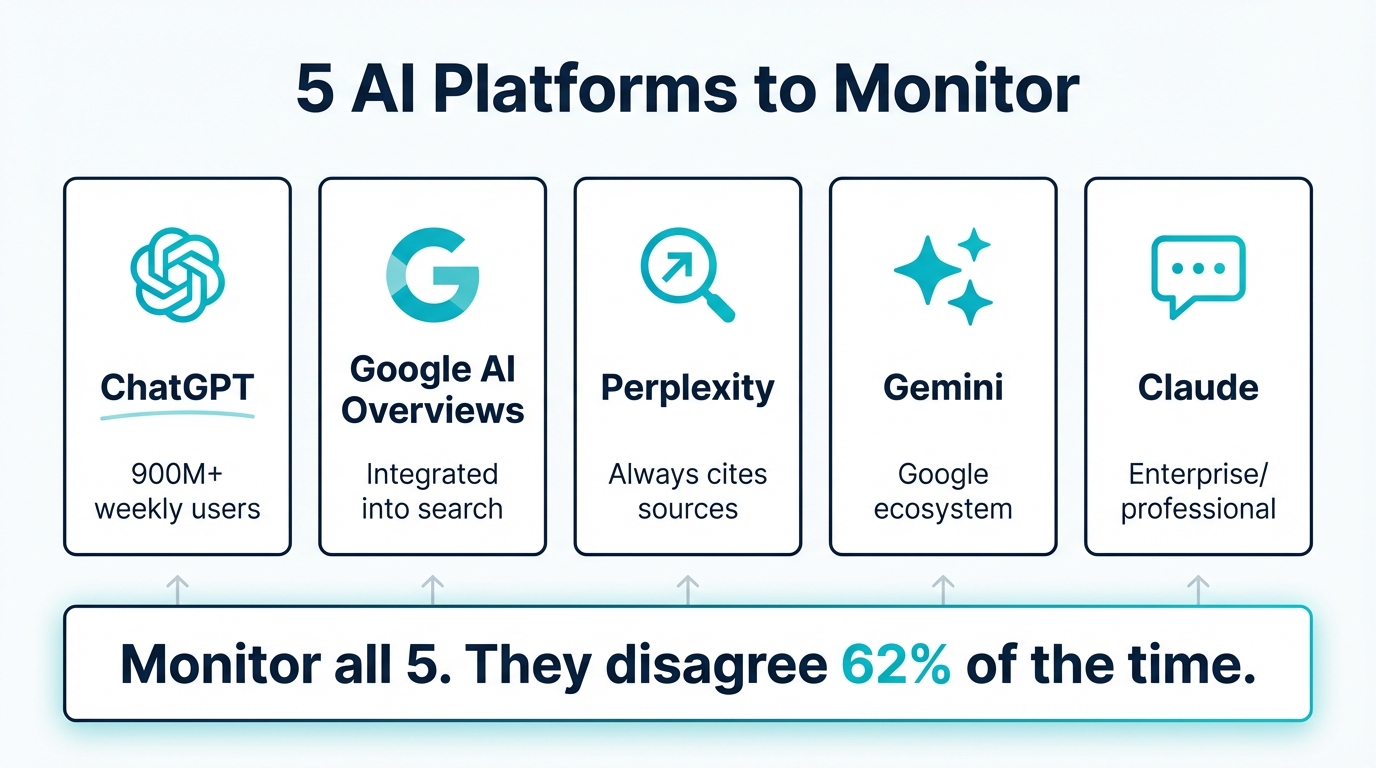
Not all AI platforms are equal, and each one draws from different data sources and uses different logic to make recommendations.
ChatGPT remains the most widely used AI for conversational queries, including product research and brand comparisons. Its recommendations are influenced heavily by the training data it was built on, supplemented by web browsing when enabled. Brands with strong earned media coverage and authoritative web presence tend to appear more frequently. For platform-specific tactics, see How to Rank in ChatGPT.
Google AI Overviews are rapidly changing how people interact with traditional search. Instead of clicking through to websites, users increasingly get their answers directly from Google's AI-generated summaries. If your brand isn't being cited in these overviews, you're losing visibility even if your organic rankings haven't changed. See our guide on How to Optimize for AI Overviews.
Perplexity is growing as a research-oriented AI search engine that cites its sources explicitly. Unlike ChatGPT, Perplexity shows users exactly where its information comes from, making it easier to track whether your brand or your competitors' content is being referenced. For more, see How to Appear in Perplexity AI.
Google Gemini operates across Google's ecosystem and is integrated into workspace tools, Android, and search. Its recommendations carry weight because of the sheer number of touchpoints where users encounter it.
Anthropic's Claude is gaining traction among professionals and enterprises. While its market share is smaller, its user base tends to be high-intent decision-makers, exactly the audience most brands want to reach.
Establish a Baseline Before You Measure
AI-generated answers vary significantly depending on how a question is phrased. Measuring a single prompt produces unreliable metrics.
A proper baseline requires a structured set of prompts that reflect three types of intent: informational research, product comparison, and purchase intent. Group these prompts by intent and test them consistently over time using the same competitors.
The goal is to understand how your brand performs across realistic decision scenarios, not isolated examples. For more on establishing baselines, see How to Track Your Brand's Visibility in ChatGPT.
The Core Metrics and KPIs
Tracking AI visibility isnt as simple as checking whether your brand name appears in a response. You need to separate presence from preference, and measure several distinct dimensions.
Presence answers whether your brand appears at all. Preference answers whether your brand is recommended. When users ask for advice or comparisons, AI systems often rank, frame, or qualify brands differently. Some brands are positioned as defaults, others as alternatives, and others are excluded entirely. Effective AI visibility metrics must distinguish between being mentioned and being preferred.
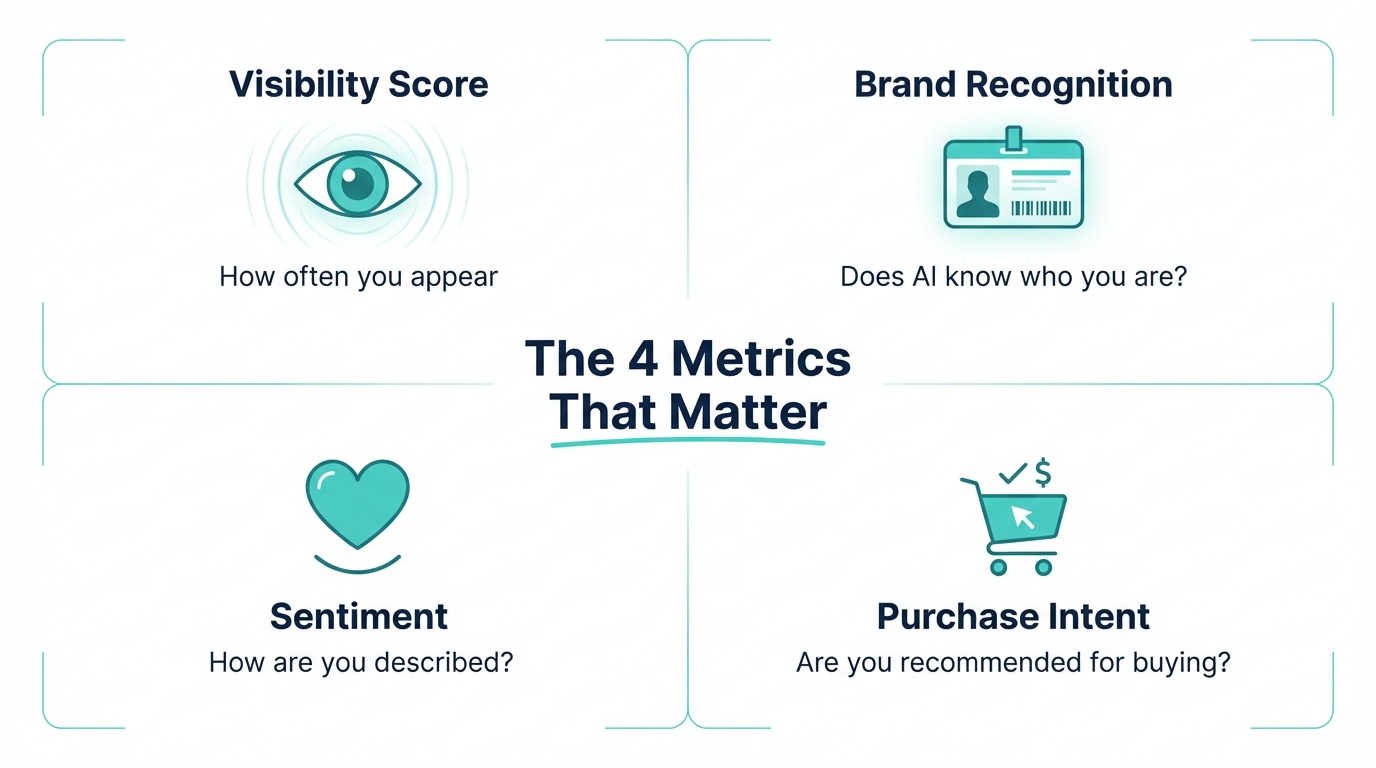
Visibility Score
Visibility measures how often your brand appears when AI systems respond to queries relevant to your industry. This is the foundational metric.
Track this across different AI platforms and across different types of queries: informational ("what is AEO?"), comparative ("best tools for X"), and transactional ("which product should I buy for Y?"). Visibility also includes where you appear in the response. Being mentioned first as the top recommendation is fundamentally different from being listed fourth as an afterthought.
Brand Recognition
Brand recognition answers a more fundamental question: does the AI actually know who you are?
This matters most for brands with common word names or lower market presence. When someone asks "What is Copper?", does AI understand they might mean the CRM, or does it only know about the metal? Brand recognition issues are often invisible until you test specifically for them.
Sentiment
Sentiment measures how AI characterizes your brand when it does mention you.
Is your brand described as "the industry leader" or as "a budget alternative"? Is the AI highlighting your strengths or flagging your weaknesses? Sentiment tracking reveals whether AI's perception matches your brand positioning, and where the gaps are.
Purchase Intent
Purchase intent is the metric that matters most for revenue: when users ask AI for buying recommendations, does it recommend you?
A brand can appear in informational queries but never get recommended when users ask "which should I buy?" Purchase intent measures whether AI positions you as the answer when money is on the line.
Recommendation Rate
The frequency with which your brand is suggested as a suitable option when advice or comparisons are requested. This is closely tied to purchase intent but measured as a percentage across your prompt set.
Prompt Coverage
The range of prompt types and intents where your brand appears. A brand with high visibility but narrow prompt coverage may only show up for one type of query while being invisible for others.
Identify Drivers Behind Metric Changes
AI visibility metrics change for specific reasons.
Common drivers include changes in brand positioning, content clarity, competitive pressure, and model behavior.
Tracking metrics alongside context helps identify why performance improves or declines, rather than simply observing movement. Understanding why entity recognition matters can help explain many metric changes.
See It in Action
Watch how to check your brand's AI visibility in under 2 minutes:
How to Actually Measure This
The Manual Approach
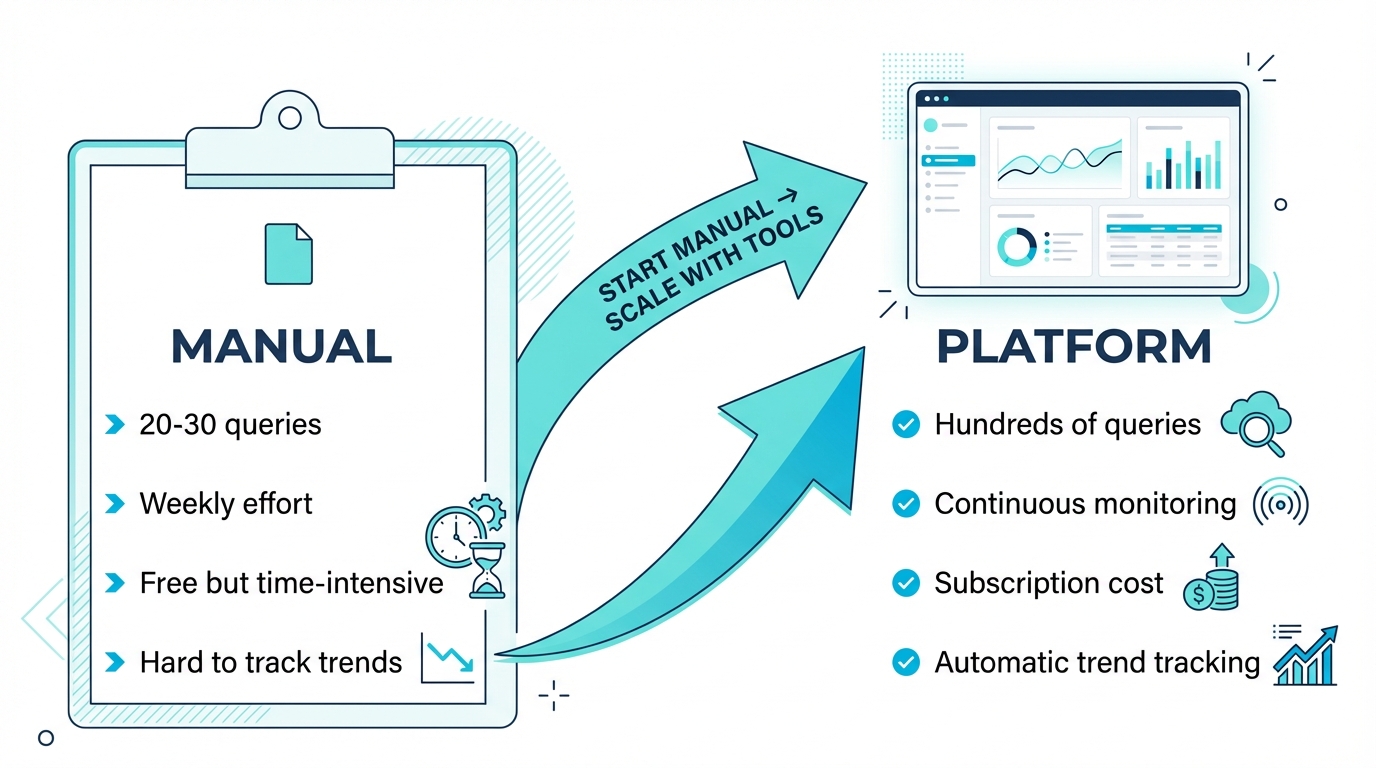
You can start measuring AI visibility today without any tools. Open ChatGPT, Perplexity, and Google, and type in 20-30 queries that your ideal customer would ask. Questions like:
- "What's the best [your category] tool?"
- "Compare [your brand] vs [competitor]"
- "[Your category] recommendations for [specific use case]"
- "What do people think about [your brand]?"
Document which brands appear, in what order, with what framing, and from what sources. Do this weekly and you'll start seeing patterns. For detailed walkthroughs, see How to Track Your Brand's Visibility in ChatGPT or our Perplexity-specific tracking guide.
The problem with the manual approach is scale. AI responses are volatile. The same query can produce different results minutes apart. And you need to track across five platforms, dozens of query variations, and multiple geographies. Manually, this becomes a full-time job within weeks.
The Platform Approach
This is where AI visibility platforms come in. Tools like friction AI automate the process by continuously querying AI systems across ChatGPT, Google AI Overviews, Perplexity, Gemini, and Claude. Instead of manually checking 30 queries once a week, the platform monitors hundreds of queries continuously and surfaces the patterns that matter.
For a full breakdown of what's available, see our complete AI visibility tools comparison across 4 tool categories.
What makes this particularly valuable for emerging and challenger brands is the diagnostic layer. It's one thing to know you're not showing up in AI recommendations. It's another to understand exactly why. Our 5-brand study across ChatGPT, Claude, and Gemini shows just how much variance exists across models.
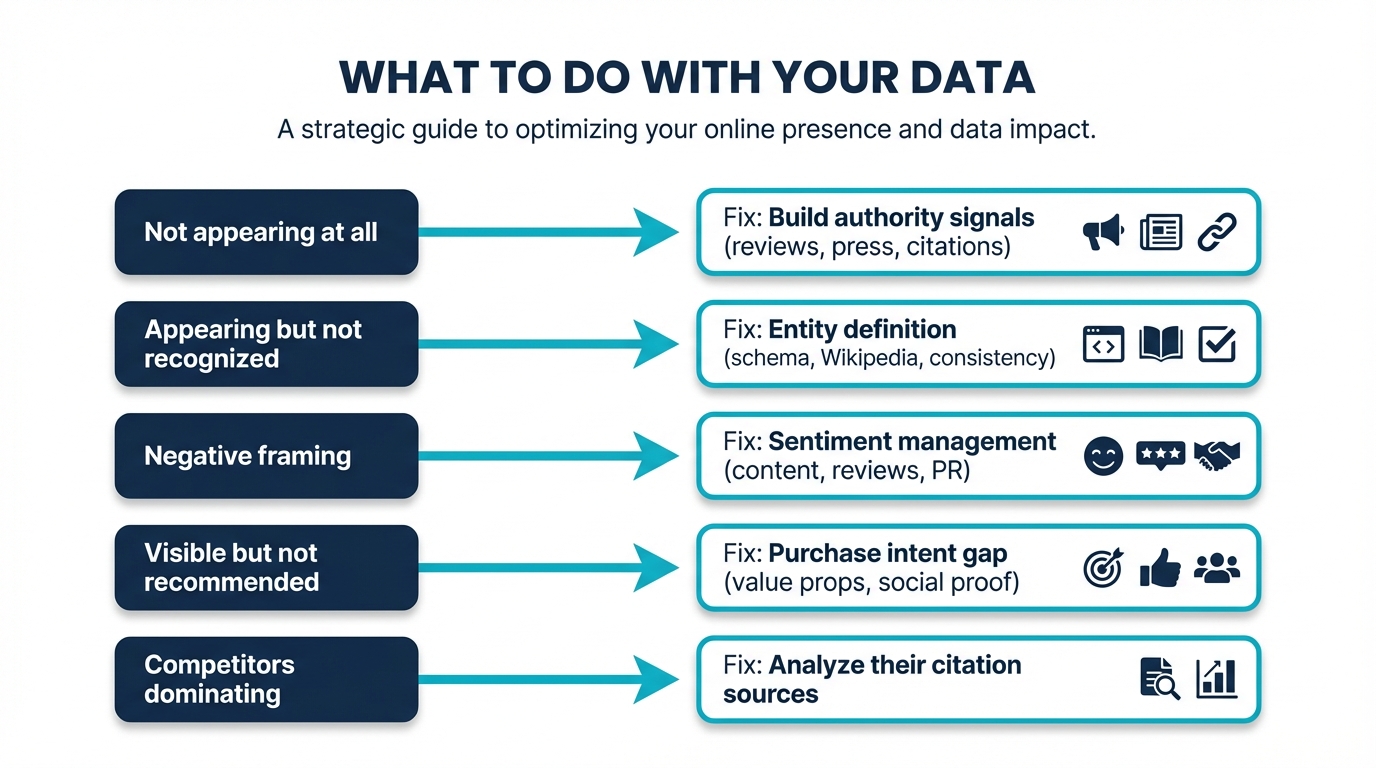
What To Do With the Data
Measuring AI visibility is only useful if it changes what you do. Here's how to turn the data into action.
If you're not appearing at all: The issue is almost always authority. AI systems recommend brands they consider credible, and credibility is built through earned media coverage, citations in industry publications, presence in trusted communities, and consistent structured data across the web. See How to Improve Your AI Visibility for the full playbook.
If you're appearing but not being recognized correctly: This is a brand recognition problem. Focus on creating clear, consistent content that explicitly states your category, use cases, and key differentiators.
If you're appearing with negative or inaccurate framing: This is a sentiment issue, and it's often the most urgent to fix. Identify the sources the AI is pulling from and either update that content or create new authoritative content that provides the correct framing.
If you're visible but not recommended in purchase scenarios: You have a purchase intent gap. Competitors are better positioned for buying queries. They have clearer value propositions, stronger social proof, or more content that explicitly addresses purchase decisions.
If your competitors are dominating: Analyze their citation sources. Where are they being mentioned that you're not? This gives you a specific outreach and content creation target list. For more on tracking sources, see AI Citation Tracking: How to Monitor AI Sources.
Monitor Metrics Over Time
AI systems evolve continuously. Metrics should be tracked over time to identify the impact of content or positioning changes, shifts caused by model updates, and emerging competitors or substitutes. Without historical tracking, it is impossible to separate meaningful change from short-term variance.
For a complete guide to building an ongoing monitoring practice, see AI Brand Monitoring: How to Track What AI Says About Your Brand.
Frequently Asked Questions
What is an AI visibility score?
An AI visibility score measures how often and how prominently your brand appears in AI-generated answers. It's typically a percentage or index that lets you track performance over time and compare against competitors.
What metrics should I track for AI-driven brand visibility?
Track four core metrics: visibility (appearance rate), brand recognition (correct identification), sentiment (how you're described), and purchase intent (recommendation in buying queries). These cover the full picture.
How do I measure AI search visibility?
Run consistent prompts across AI models, track whether you appear, note your position and framing, and measure over time. Tools like friction AI automate this process.
What KPIs can track our performance in AI search visibility?
Key AI visibility KPIs include: visibility rate, share of voice vs competitors, sentiment score, purchase intent rate, and citation frequency. Track these monthly to measure progress.
For a deeper dive, see our AI share of voice tracking guide.
How to measure brand visibility in ChatGPT?
Ask ChatGPT category questions, comparison queries, and direct brand questions. Track whether you appear, how you're described, and whether you're recommended. Do this systematically over time.
Related Articles
- AI Brand Monitoring: How to Track What AI Says About Your Brand
- What is AI Visibility? Definition, Examples & Why It Matters
- How to Report AI Visibility to Leadership