Tracking across multiple AI platforms? This guide covers ChatGPT specifically. For the multi-platform workflow across ChatGPT, Claude, and Perplexity together, see How to Track AI Brand Mentions Across ChatGPT, Claude & Perplexity.
When someone asks ChatGPT for a recommendation in your industry, does it mention your brand? And if it does, what does it say? Tracking brand mentions in ChatGPT is becoming essential as AI-driven discovery replaces traditional search for a growing share of purchase decisions. This guide covers how to monitor when ChatGPT mentions your brand, what to measure, and how to improve your mention rate.
What Counts as a Brand Mention in ChatGPT?
A brand mention in ChatGPT is not simply the brand name appearing in a response.
A brand can appear in an AI-generated answer in several ways:
-
as a neutral reference
-
as a weak or conditional option
-
as a recommended choice
-
as an example to avoid
For measurement purposes, a brand mention should be defined as the consistant appearance of a brand in AI-generated answers that influence user understanding or decision making.
This definition goes beyond raw mentions and focuses on context. For a deeper breakdown of visibility types, see What Does AI Visibility Mean .
2. Establish a Baseline Across Representative Prompts
ChatGPT responses vary significantly depending on how a question is phrased.
Tracking a single prompt produces unreliable results. A baseline requires a structured set of prompts that reflect:
-
informational research
-
product comparison
-
purchase intent
These prompts should be grouped by intent and tested consistently over time.
The goal of the baseline is to answer two questions:
-
Does the brand appear at all?
-
How frequently does it appear relative to competitors?
Without this baseline, changes in visibility cannot be interpreted.
How to Manually Check If ChatGPT Mentions Your Brand
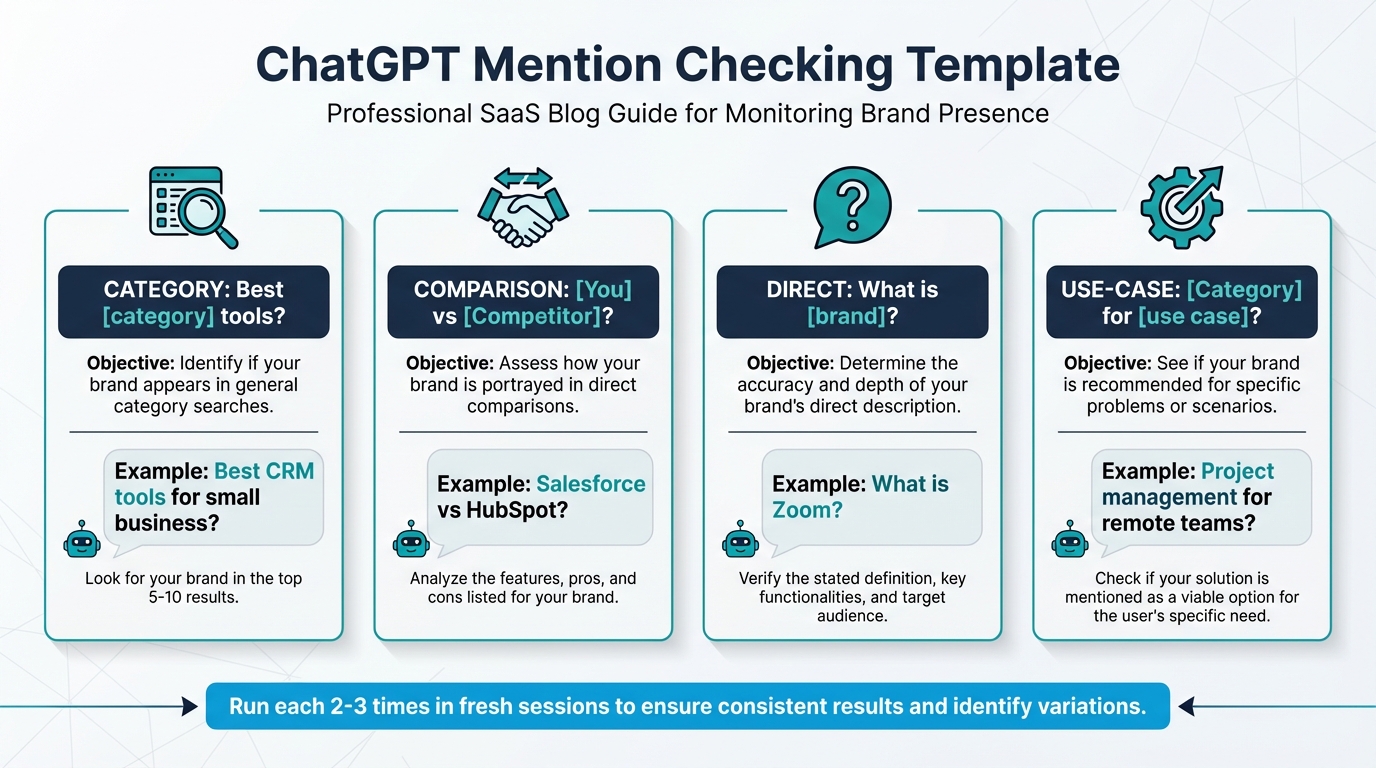
The simplest way to check for brand mentions is to ask ChatGPT directly. Here's a structured approach:
- Create a prompt template set. Write 10-15 prompts that represent how real customers would ask about your product category. Examples: "What are the best [your category] tools?" "Compare [competitor A] vs [competitor B] for [use case]." "What's the best way to [problem you solve]?"
- Run each prompt in a fresh ChatGPT session. Use a new conversation for each prompt (previous context influences responses). Use the default model, not GPT-4 with browsing, to test what most users experience.
- Record the results systematically. For each prompt, note: (a) Was your brand mentioned? (b) Was it recommended or just listed? (c) What was the sentiment (positive, neutral, negative)? (d) Which competitors were mentioned? (e) What reasons did ChatGPT give for its recommendations?
- Calculate your mention rate. Divide the number of prompts where your brand was mentioned by the total number of prompts. This is your baseline mention rate. Track it monthly.
Important caveat: ChatGPT responses are non-deterministic. The same prompt can produce different results on different days or in different sessions.
Run each prompt 2-3 times and look for patterns rather than treating any single response as definitive.
Manual vs Automated ChatGPT Mention Monitoring
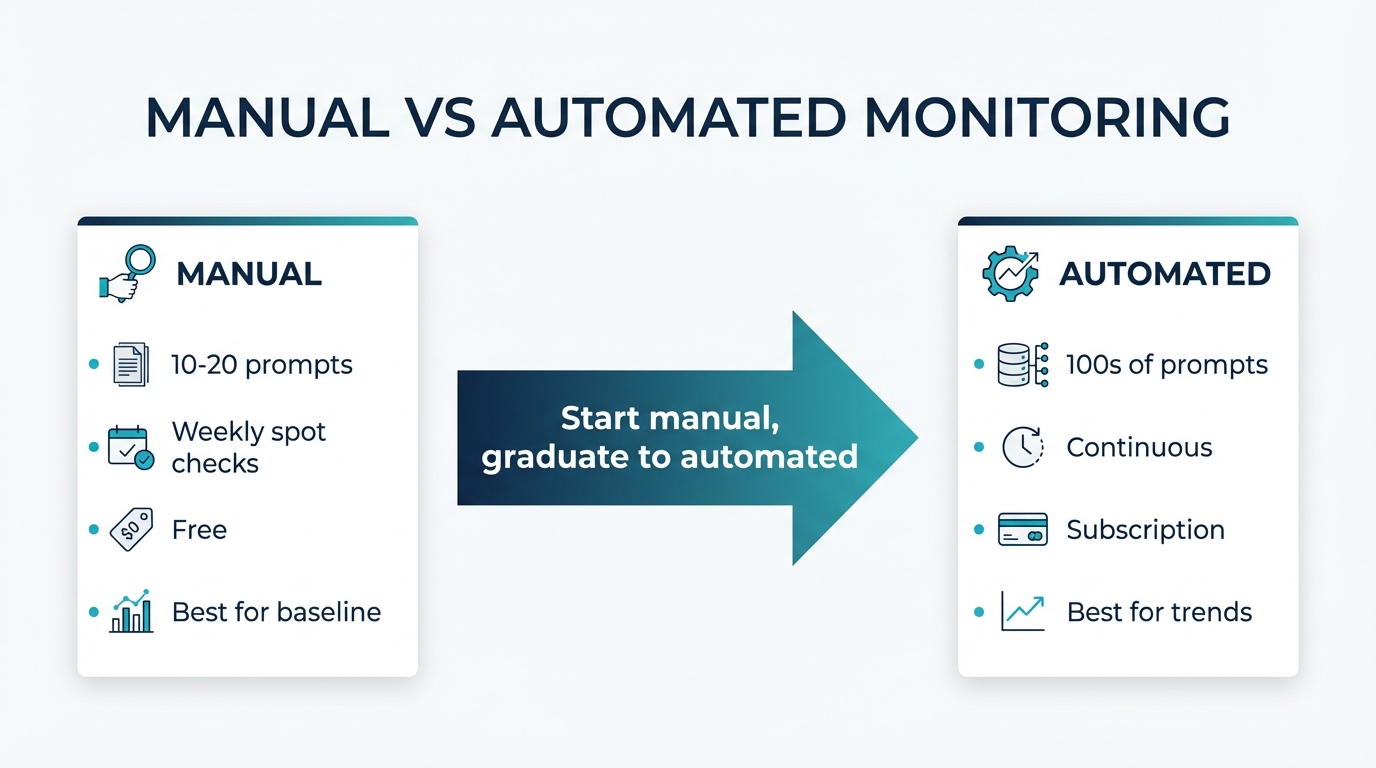
| Aspect | Manual Checking | Automated Monitoring |
|---|---|---|
| Cost | Free (your time only) | Platform subscription (varies) |
| Frequency | Weekly or monthly spot checks | Continuous or daily automated checks |
| Scale | 10-20 prompts per session | Hundreds of prompts across multiple models |
| Consistency | Variable, hard to standardize | Standardized prompts and scoring |
| Competitor tracking | Possible but time-intensive | Built-in competitor comparison |
| Historical trends | Requires manual spreadsheet tracking | Automatic trend charts and alerts |
| Best for | Early-stage brands, initial baseline | Ongoing monitoring, competitive intelligence |
Start with manual checking to understand the landscape. Once you have a baseline and know which prompts matter, automated monitoring becomes valuable for tracking trends and catching changes. For the full monitoring toolkit, see our AI brand monitoring guide.
3. Separate Mentions From Recommendations
Mentions and recommendations are not the same.
A mention indicates presence. A recommendation indicates preference.
When users ask for advice, comparisons, or best options, ChatGPT often ranks or frames brands differently. Some brands are positioned as defaults, others as alternatives, and others are excluded entirely.
Tracking brand visibility requires distinguishing between:
-
passive mentions
-
active recommendations
-
conditional recommendations tied to specific use cases
This distinction is essential for brands that rely on AI-driven discovery to influence purchases.
Key Metrics for ChatGPT Brand Monitoring
Effective tracking focuses on a small set of repeatable metrics.
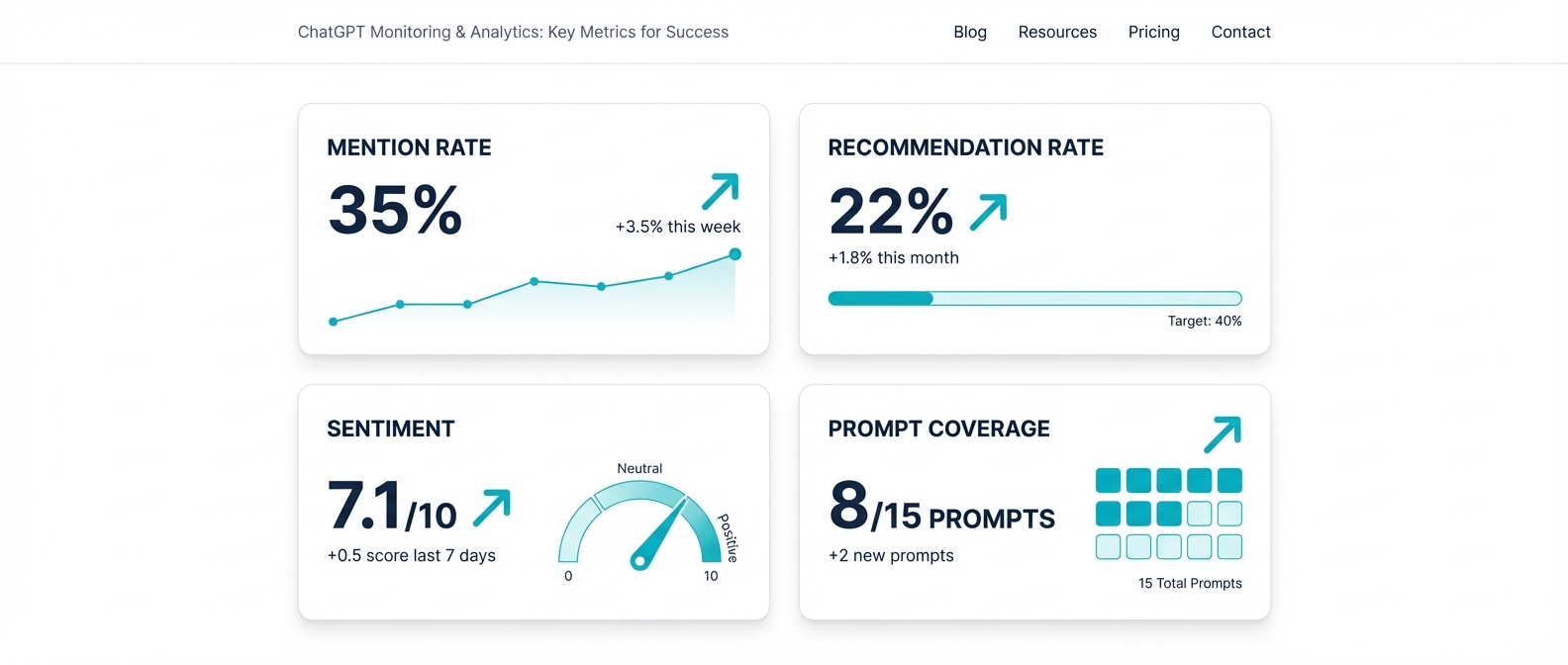
Common metrics for tracking ChatGPT brand mentions include:
Visibility score
A relative measure of how often a brand appears across a defined prompt set.
Recommendation rate
The frequency with which a brand is suggested as a suitable option when advice is requested.
Prompt coverage
The breadth of prompt types and intents where the brand appears.
Brand framing signals
Qualitative indicators such as sentiment and purchase readiness inferred from how the brand is described.
Together, these metrics describe a brand's footprint inside AI-generated answers.
Identify Topics and Signals That Influence Mentions
ChatGPT does not generate recommendations randomly.
Its answers are influenced by how clearly a brand is defined, how consistently products are described, and how often authoritative sources reinforce those descriptions.
Tracking mentions at the topic level helps identify:
-
areas where a brand is strongly associated
-
gaps where competitors dominate
-
themes where substitutes are preferred
These insights are typically used to prioritize content updates, clarify positioning, and strengthen authority signals. Understanding why entity recognition matters will help you act on these insights effectively.
6. Monitor Visibility Over Time
AI models evolve, and so do the signals that shape their answers.
Visibility tracking should be continuous rather than one-time. Monitoring trends over time helps identify:
-
the impact of content or positioning changes
-
shifts caused by model updates
-
emerging competitors or substitutes
This turns AI visibility into a measurable and observable channel rather than an opaque one.
How to Start Tracking ChatGPT Mentions Today
The framework described above can be implemented manually, but doing so doesn't scale well.
Platforms such as friction ai automate this process by running structured prompt sets, benchmarking brands against competitors, and tracking visibility and reccomendation signals over time across models like ChatGPT, Gemini, and Claude.
The underlying measurement logic remains the same regardless of tooling.
How to Increase Your Brand's Mention Rate in ChatGPT
If your brand isnt being mentioned, here are the most common reasons and fixes:
- Weak entity signal: ChatGPT needs to "know" your brand exists as a distinct entity. Ensure your brand has a Wikipedia page or Wikidata entry, appears on authoritative third-party sites (review platforms, industry publications), and has consistent NAP (name, address, phone) data across the web. See why AI ignores your brand for the full diagnostic.
- Category mismatch: ChatGPT may not associate your brand with the category users are asking about. Check whether your website and third-party mentions clearly describe what your product does and which category it belongs to.
- Recency gap: ChatGPT's training data has a cutoff. If your brand launched or pivoted after the training cutoff, the default model may not know about you. This improves over time as models are updated. Using ChatGPT with web browsing mode can surface newer brands.
- Low authority: ChatGPT tends to recommend brands that appear frequently across authoritative sources. Invest in PR, guest posts on industry sites, and getting listed on comparison and review platforms. For the full playbook, see building brand authority AI platforms recognize.
If ChatGPT mentions you but with negative framing, see our guide on how to fix negative AI brand sentiment.
Conclusion
As AI assistants increasingly shape how people discover and evaluate products, brand visibility inside AI-generated answers has become a critical signal.
Tracking this visibility requires more than counting mentions. It requires understanding context, recommendations, and relative positioning across prompts and competitors.
A structured approach makes AI-driven discovery measurable and actionable.
Start tracking your brand visibility across ChatGPT, Claude, and Gemini.
For the full framework on what to track, see our guides on visibility, brand recognition, sentiment, and purchase intent.
Frequently Asked Questions
How can I see brand mentions in ChatGPT?
You can manually ask ChatGPT about your brand, but this doesn't scale. Tools like friction AI automate this by running hundreds of prompts and tracking mentions across ChatGPT, Claude, Gemini, and Perplexity.
How do I monitor ChatGPT brand mentions?
Monitoring requires regular, systematic testing. Ask category questions ("best CRM for startups"), comparison questions ("X vs Y"), and direct questions ("What is [brand]?"). Track responses over time to spot trends.
What's the best tool to track mentions in ChatGPT?
Several tools exist for ChatGPT brand monitoring. friction AI, Profound, Otterly AI, and others offer different approaches. See our comparison of AI visibility tools for details.
Why is tracking brand mentions in ChatGPT important?
ChatGPT influences purchasing decisions. If your brand isn't mentioned when users ask buying questions, you're losing opportunities you can't see in traditional analytics. Tracking gives you visibility into this blind spot.
Can I track my brand's success in ChatGPT?
Yes. Track visibility (how often you appear), sentiment (how you're described), and purchase intent (whether you're recommended in buying scenarios). These metrics show your actual AI presence.
For a complete guide to monitoring your brand across all AI platforms (not just ChatGPT), see AI Brand Monitoring: How to Track What AI Says About Your Brand.
See also: For the manual cross-platform workflow that combines ChatGPT, Claude, and Perplexity in a single audit round, see our multi-platform brand mention tracking guide.
Related Articles
- How to Rank in ChatGPT: Get Your Brand Recommended
- AI Brand Monitoring: How to Track What AI Says About Your Brand
- AI Citation Tracking: How to Monitor When AI Cites Your Brand