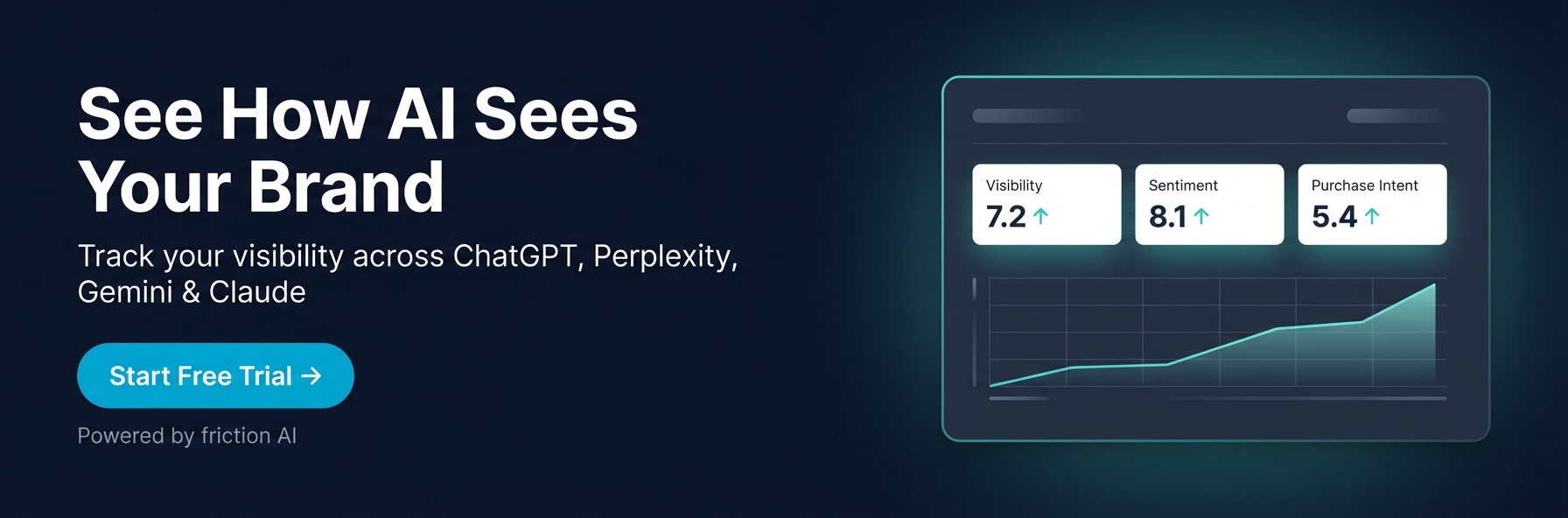
AI brand sentiment refers to the overall tone, positive, negative, or neutral, that AI-powered search engines convey about your brand when answering user queries. Monitoring AI sentiment helps you understand whether platforms like ChatGPT and Perplexity recommend your brand favorably or surface outdated and negative information.
Sentiment Is Not Visibility
Visibility answers: does AI mention your brand?
Sentiment answers: how does AI talk about your brand when it does?
These are different questions. A brand can be highly visible and still have a sentiment problem. If ChatGPT consistently describes you as "controversial," "outdated," or "expensive compared to alternatives," visibility isn't helping you.
For the visibility framework, see What is AI Visibility.
What AI Sentiment Looks Like
When AI mentions your brand, it frames you in some way. That framing is sentiment.
Positive sentiment: - "[Brand] is widely regarded as a leader in..." - "Many users recommend [Brand] for..." - "[Brand] is known for excellent customer support..."
Neutral sentiment: - "[Brand] is one of several options in this space..." - "[Brand] offers features including..." - "Some users prefer [Brand] while others choose..."
Negative sentiment: - "[Brand] has faced criticism for..." - "Users have reported issues with..." - "Compared to competitors, [Brand] is more expensive..."
The exact words matter. AI doesn't just list brands. It characterizes them.
Why AI Sentiment Matters
Sentiment shapes perception before users ever visit your site.
When someone asks ChatGPT "What's the best CRM for startups?" they get an answer with framing baked in.
If your brand is mentioned but described as "enterprise-focused" or "complex to set up," that user has already formed an opinion.
Unlike a Google result where users click through and judge for themselves, AI delivers the verdict directly. The framing is the first impression.
Where Sentiment Comes From
AI sentiment reflects patterns in the training data and real-time sources.
Training data: If reviews, articles, and discussions about your brand skew negative, that pattern gets absorbed. The model learns that negative framing is the appropriate way to describe you.
Real-time search: When AI pulls current sources, it inherits the tone of those sources. If the top results for your brand mention a recent controversy, that becomes part of the response.
Competitive context: AI often compares brands. Your sentiment can be relative. "[Brand A] is easier to use than [Brand B]" positions both brands, regardless of their absolute qualities.
For how AI gathers this information, see The AI Brand Recognition Pyramid.
Sentiment vs Reviews
AI sentiment is related to reviews but not identical.
Reviews are explicit ratings. Sentiment is implicit framing.
A brand might have 4.5 stars on G2 but still have negative AI sentiment if: - Recent news coverage was critical - Comparison articles position them unfavorably - Common complaints appear frequently in discussions
AI synthesizes across sources. It doesn't just average review scores.
How to Check Your AI Sentiment
friction AI tracks sentiment automatically, showing you how ChatGPT, Claude, Gemini, and Perplexity describe your brand over time.
For manual checks, ask AI directly about your brand and read teh response carefully.
Prompts to try: - "What do people think of [Brand]?" - "What are the pros and cons of [Brand]?" - "How does [Brand] compare to [Competitor]?" - "Is [Brand] good for [use case]?"
Look for: - Adjectives used to describe you - Whether pros or cons are mentioned first - How you're positioned relative to competitors - Any caveats or qualifications
Run these across ChatGPT, Claude, Gemini, adn Perplexity. Sentiment can vary by model.
The Sentiment Spectrum
Not all sentiment is clearly positive or negative. There's a spectrum:
Strong positive: Recommended as a top choice, praised specifically Mild positive: Mentioned favorably, included in good options Neutral: Listed without strong characterization either way Mild negative: Mentioned with caveats, positioned as second choice Strong negative: Criticized, warned against, associated with problems
Most brands land somewhere in the middle. The goal is to shift toward positive without overclaiming.
Sentiment and Purchase Intent
Sentiment directly affects purchase intent.
If AI describes your brand positively when answering buying questions, users are more likely to consider you. If AI hedges or warns, they'll look elsewhere.
This is why sentiment matters even more than raw visibility. Being mentioned in a way that discourages purchase is worse than not being mentioned at all.
For the full picture on purchase behavior, see What is Purchase Intent in AI.
Can You Change AI Sentiment?
Yes, but not directly.
You can't edit what AI says about you. But you can influence the sources AI learns from:
- Encourage positive reviews on platforms AI indexes
- Create content that frames your brand clearly
- Address common criticisms publicly
- Earn positive coverage from authoritative sources
- Ensure consistent, positive messaging across your web presence
Over time, these signals shift the pattern. The model learns a new framing.
For specific tactics, see How to Improve Your Brand Sentiment in AI.
The Bottom Line
AI sentiment is how your described, not just whether you're mentioned.
Visibility gets you into the conversation. Sentiment determines whether that helps or hurts you.
Monitor both. Optimize for both.
Frequently Asked Questions
What is AI sentiment vs traditional sentiment analysis?
Traditional sentiment analysis classifies customer reviews or social posts as positive, negative, or neutral. AI sentiment measures how large language models like ChatGPT, Claude, Gemini, and Perplexity describe your brand when users ask about it. It's the output side of the same underlying pattern, but it's what potential customers actually see when they research you via AI.
How does AI learn sentiment about my brand?
AI models learn sentiment through patterns in training data and real-time search. Training data includes reviews, news articles, forum discussions, and any text mentioning your brand that the model crawled. Real-time search adds current data that updates the picture. Both combine to produce the framing AI uses when someone asks about your brand.
Can two AI models describe my brand differently?
Yes, routinely. ChatGPT, Claude, Gemini, and Perplexity draw from different training data and weight sources differently. BrightEdge research shows Google AI Overviews are 44% more likely to criticize brands than ChatGPT. Track sentiment across all major platforms, not just one, to understand your full sentiment picture.
Is neutral AI sentiment bad?
Usually yes, for a competitive brand. Neutral framing means AI isn't recommending you confidently, which costs you against competitors getting positive framing. Some categories (regulated industries, B2B enterprise) reasonably get neutral treatment by default. For most consumer and SaaS brands, neutral sentiment signals you need to add positive coverage and address weak spots.
Does AI sentiment affect SEO rankings?
Not directly. Google's SEO ranking algorithm doesn't use AI-generated sentiment as a signal. But AI sentiment strongly affects conversion rates from AI-driven referral traffic. Perplexity traffic lands on your site with expectations shaped by how Perplexity framed you. Negative framing produces lower engagement and conversion, compounding negatively over time.
Related Articles
- How to Fix Negative AI Brand Sentiment (Step-by-Step)
- How to Track AI Sentiment Changes Over Time
- How to Control What AI Says About Your Brand