What Is AI Citation Tracking?
AI citation tracking monitors when AI platforms reference your content as a source in there responses.
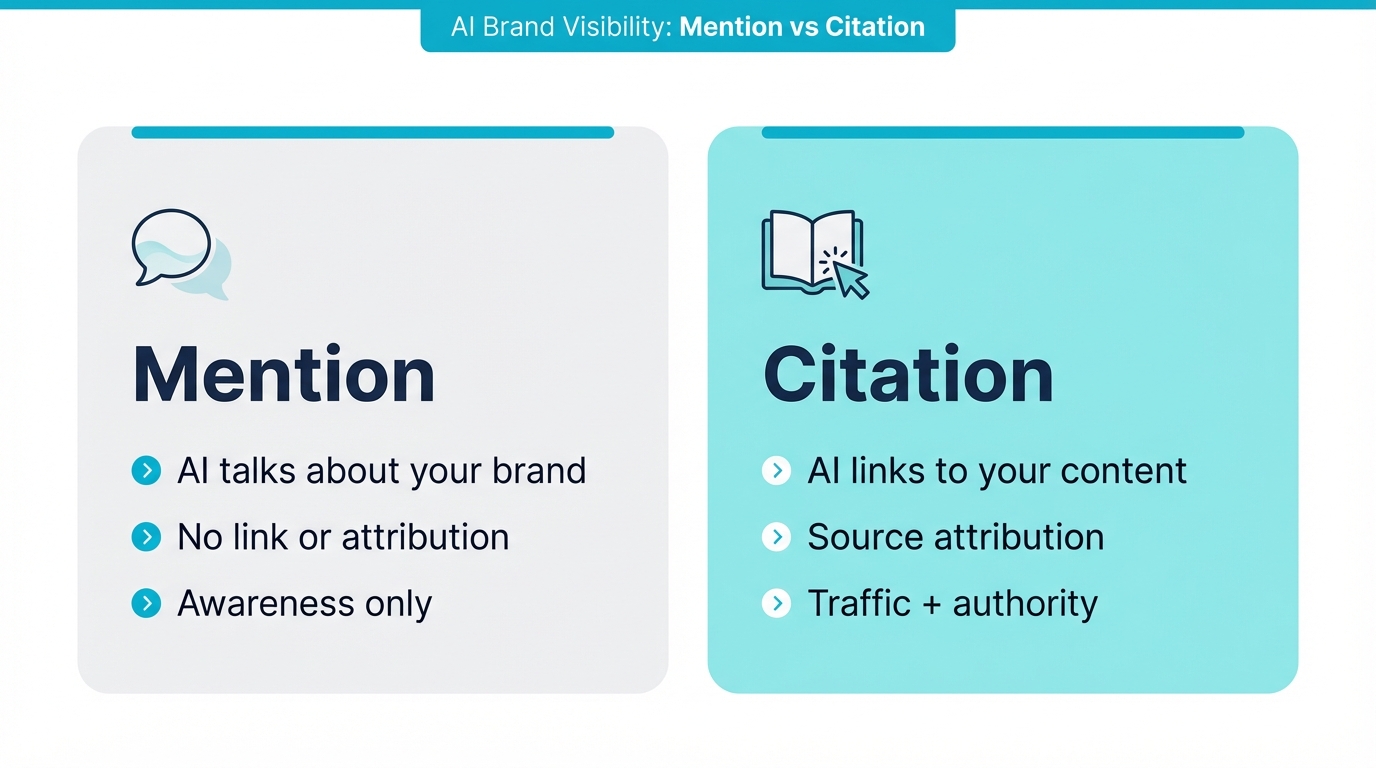
This is different from brand mentions:
- Mention: AI talks about your brand
- Citation: AI links to your content as a source
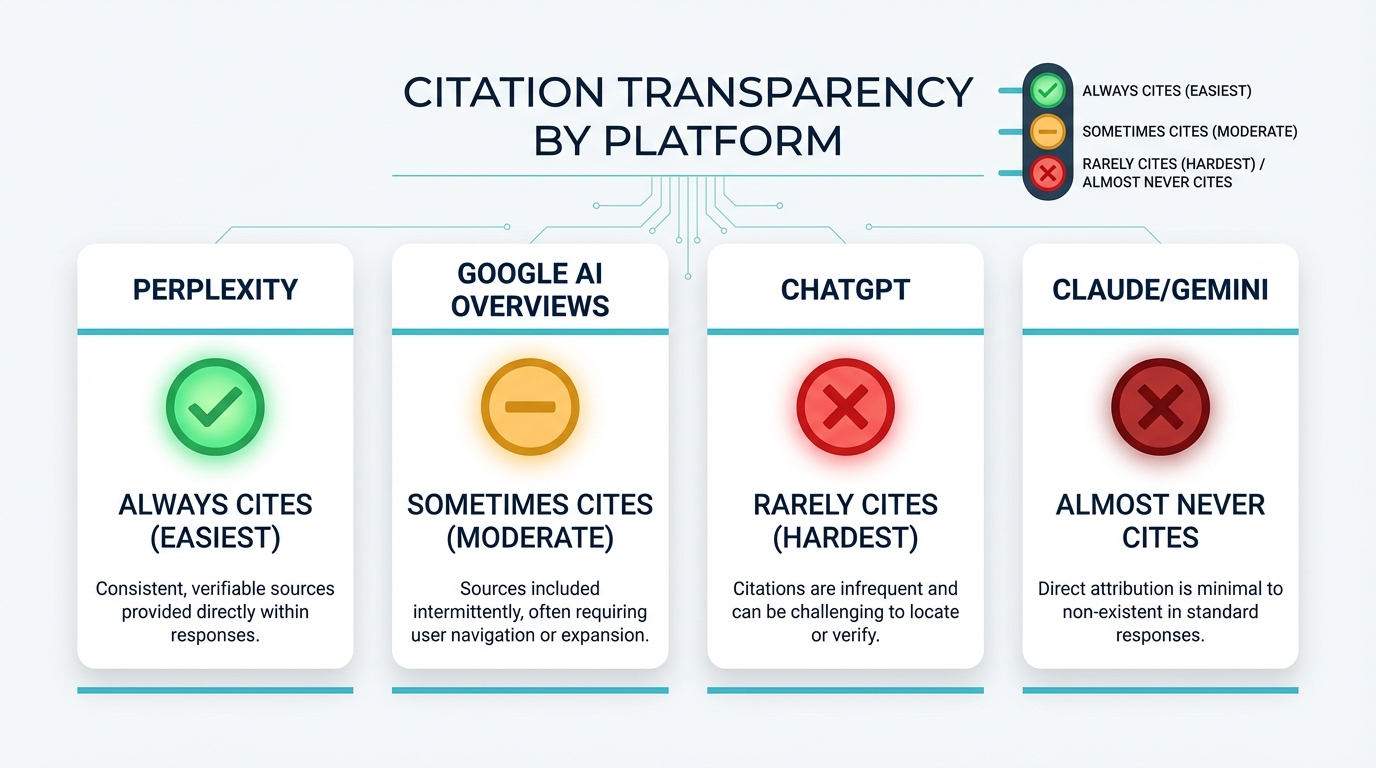
Perplexity always cites sources. ChatGPT with browsing sometimes does. Claude and Gemini rarely do.
McKinsey found that brand-owned pages make up only 5-10% of the sources AI uses. Citations matter because they can drive traffic and signal that AI trusts your content.
Why Citations Matter
Traffic potential
When Perplexity cites your page, users can click through.
This is measurable traffic from AI, unlike mentions which are invisible to analytics.
Authority signal
Being cited means AI found your content valuable enough to reference. This suggests strong topical authority.
Competitive insight
Tracking competitor citations shows which content AI prefers in your space.
Content validation
If certain pages get cited frequently, that content is working. If pages never get cited, they may need improvement.
Which Platforms Cite Sources?
Perplexity (always cites)
Perplexity is citation-first. Their Publisher Program shows how they prioritize source attribution. Every response includes numbered sources with clickable links. This makes it the primary platform for citation tracking.
ChatGPT with browsing (sometimes cites)
When ChatGPT searches the web, it sometimes includes source links. Less consistant than Perplexity, but citations do appear.
Google AI Overviews (sometimes cites)
AI Overviews often include source links, though the format varies.
Claude & Gemini (rarely cite)
These platforms rely more on training data and less on real-time search. Citations are uncommon.
For platform-specific optimization, see How to Appear in Perplexity.
How to Track AI Citations
Manual tracking
- Search relevant queries in Perplexity
- Check if your pages appear in the sources
- Note which content gets cited
- Track competitor citations for comparison
This works but doesn't scale.
Automated tracking
friction AI tracks citations across Perplexity and other platforms automatically, showing which of your pages AI references and how that changes over time.
Analytics signals
Watch for traffic from AI sources in your analytics:
- Perplexity referrals
- ChatGPT referrals
- Unknown or direct traffic spikes correlated with AI activity
Platform-Specific Tracking
Perplexity (easiest to track): Perplexity always shows source citations with clickable links. Search your target queries directly in Perplexity and check whether your content appears in the citations. Monitor referral traffic from perplexity.ai in your analytics. Perplexity citations are the most reliable indicator of AI citation performance because they're visible and clickable. For Perplexity-specific tactics, see How to Appear in Perplexity AI.
Google AI Overviews (moderately trackable): AI Overviews sometimes link to source pages in expandable sections. Search your target queries in Google (signed out, incognito) and check if an AI Overview appears. If it does, expand the source section to see if your domain is cited. GSC does not currently separate AI Overview impressions from regular search impressions.
ChatGPT (hardest to track): ChatGPT in its default mode does not cite sources or provide links. When using web browsing mode, it sometimes includes source URLs, but this is inconsistent. The only reliable way to track ChatGPT mentions is to periodically prompt it with your target queries and check whether your brand appears in the response. Automated tools that do this at scale are the practical solution for ongoing monitoring.
Claude and Gemini (limited citation): Claude and Gemini rarely provide source citations in their responses. They may mention brands or products based on training data, but without clickable source attribution. Tracking mentions in these platforms requires direct prompting and logging the results.
What Gets Cited
Based on patterns, AI tends to cite:
High-ranking content
Pages that rank well in traditional search are more likely to be found and cited.
Direct answers
Content that clearly answers the query being asked. Lists, definitions, how-to guides.
Authoritative sources
Well-known publications and established domains.
Recent content
Fresh content, especially for queries where recency matters.
Structured content
Pages with clear headings, lists, and organized information.
How to Increase Your Citations
1. Rank for relevant queries
AI search tools find content through search. Better rankings = more citations.
2. Answer questions directly
Structure content to provide clear answers. Use the query as a heading, then answer immediately.
3. Use structured formatting
Lists, tables, H2/H3 headings. Make it easy for AI to extract information.
4. Keep content fresh
Update important pages regularly. Add recent data and examples.
5. Build domain authority
Authoritative domains get cited more. Build backlinks and topical depth.
For the full optimization guide, see How to Improve Your Brand's AI Visibility.
How to Benchmark Your Citations Against Competitors
Citation tracking becomes most valuable when you compare your citation rate to competitors. Here's a simple framework:
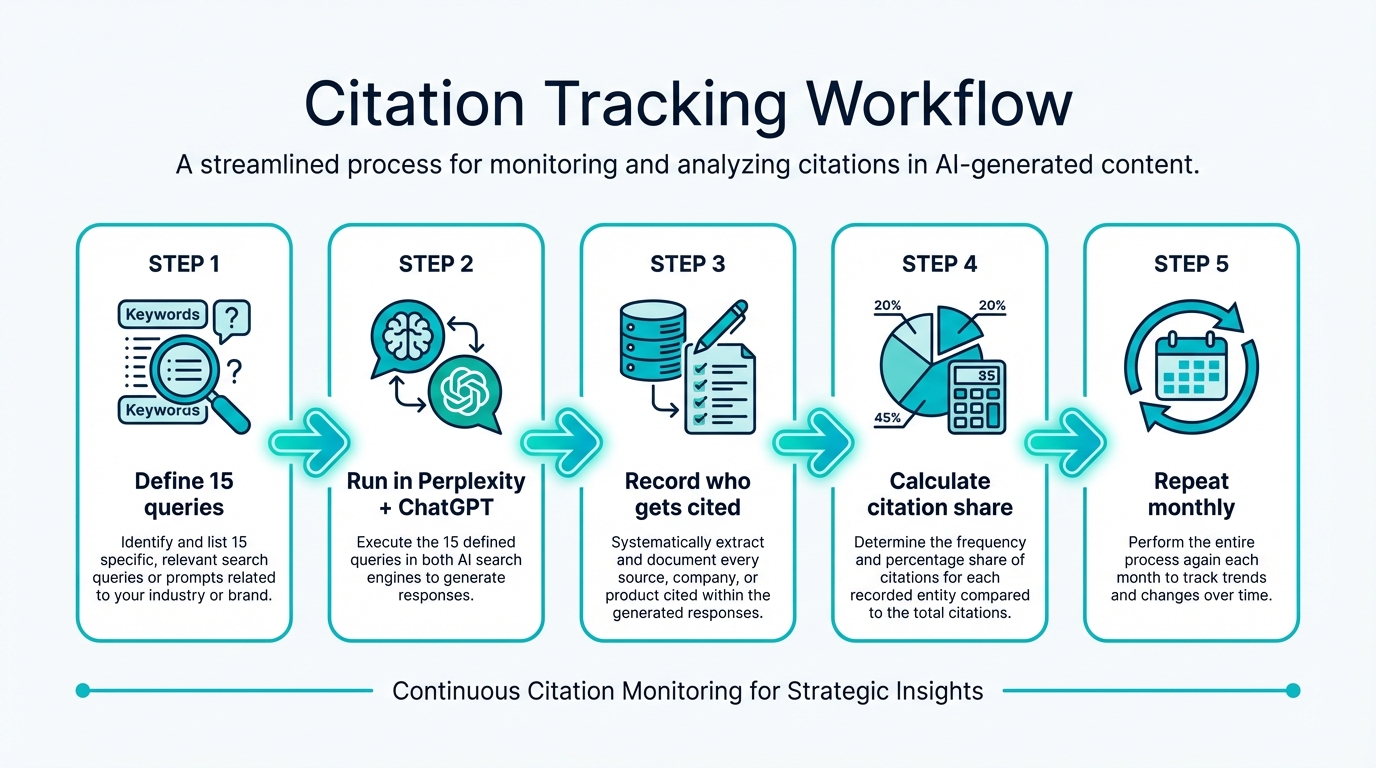
- Select 10-20 target queries that represent your core topic areas. These should be the queries where you want AI to recommend your brand.
- Run each query in Perplexity (and ChatGPT with browsing, if relevant). Record which brands are cited for each query.
- Calculate citation share: For each query, count how many of the citations belong to you vs. each competitor. Across all queries, calculate your average citation share.
- Track monthly: Repeat monthly to see trends. Are you gaining citation share or losing it? Which competitors are growing?
This benchmarking approach turns citation tracking from a binary ("am I cited or not?") into a competitive metric you can optimize over time. For the full competitive intelligence framework, see AI Competitive Intelligence: Tracking Your Brand vs. Competitors.
Setting Up a Citation Tracking Workflow
Here's a practical workflow you can implement this week:
Step 1: Define your query set. Select 15-25 queries that represent your core topics. Include a mix of branded queries ("[your brand] reviews"), category queries ("best [your category] tools"), and informational queries ("how to [problem you solve]"). These are the queries where you want AI platforms to cite or mention your content.
Step 2: Run initial baseline. Search each query in Perplexity (primary) and ChatGPT with browsing (secondary). Record: (a) does the answer mention your brand? (b) does it cite your content with a link? (c) which competitors are mentioned or cited? (d) what is the sentiment toward your brand?
Step 3: Score each query. Use a simple scoring system: 2 points if your content is cited with a link, 1 point if your brand is mentioned without a citation, 0 if absent. Calculate your total score and citation share (your score divided by total possible points).
Step 4: Identify gaps. For queries where you score 0, examine what competitors are doing that you're not. Do they have more authoritative content? Better structured answers? Stronger domain authority? This gap analysis drives your content priorities.
Step 5: Repeat monthly. Track changes over time. AI models evolve, re-crawl, and retrain. Your citation performance will shift. Monthly tracking reveals whether your optimization efforts are working and where to focus next.
Citation Tracking vs Visibility Tracking
These are related but different:
| Metric | What it measures | Why it matters |
|---|---|---|
| Visibility | Brand mentions in AI | Awareness |
| Citations | Source links to your content | Traffic + authority |
| Sentiment | How AI describes you | Perception |
| Purchase intent | AI recommendations | Revenue |
Citations are one piece of the visiblity puzzle. Track all four for the complete picture.
For the full metrics framework, see AI Visibility Metrics: What to Measure.
The Bottom Line
AI citation tracking shows when platforms like Perplexity reference your content as a source.
This matters because citations drive traffic and signal authority. Unlike invisible mentions, citations are actionable.
Track your citations alongside visibility, sentiment, and purchase intent for a complete view of how AI sees your brand.
For the broader picture of tracking all aspects of your brand in AI (not just citations), see our guide on AI Brand Monitoring.
Frequently Asked Questions
How do I track AI citations for my brand?
Run a fixed prompt set across ChatGPT, Claude, Gemini, and Perplexity monthly. For each query, record whether your domain appears in the source citations (Perplexity and AI Overviews surface these explicitly), which pages get cited, and alongside which competitors. Perplexity is the easiest to track because every answer includes linked sources; ChatGPT and Claude require checking web-search mode specifically.
What metrics matter for citation tracking?
Four core metrics. First, citation rate (percentage of queries where your content is cited). Second, page-level distribution (which URLs get cited, and how concentrated citations are). Third, share of voice against named competitors. Fourth, sentiment framing of how your brand is characterized in cited passages. Track all four monthly for trend analysis.
Can I track ChatGPT citations in Google Analytics?
Not directly in default mode. ChatGPT rarely sends referral traffic because it doesn't link to sources. Perplexity is the only major AI platform that consistently generates measurable referral traffic. Filter GA4 by source/medium containing "perplexity" to see Perplexity-driven clicks. For ChatGPT, use manual or automated citation tracking tools since referral traffic isn't a reliable signal.
How often should I monitor AI citations?
Monthly for most brands. Perplexity and AI Overviews update in near real-time, so weekly can help for active optimization work. Quarterly is too slow because competitor shifts and platform updates happen faster than that. If you just launched content changes and want to measure impact, bi-weekly for 2-3 months is reasonable.
What's the difference between citations and mentions?
A mention is when AI names your brand in the answer text ("Brands like Acme operate in this space"). A citation is when AI links to a specific URL from your domain as a source. Citations carry more weight because they indicate AI trusted your content enough to attribute information to it. Both are useful signals; track separately.
Related Articles
- How to Get Your Content Cited by AI: The Complete Guide
- How to Appear in Perplexity AI: Get Cited and Mentioned
- What Types of Content Do AI Models Actually Cite?
- How to Rank in ChatGPT: Get Your Brand Recommended