ChatGPT SEO is the practice of optimizing your brand and content to appear in ChatGPT's responses when users ask questions related to your industry, product category, or area of expertise. It combines traditional search optimization principles with new tactics designed for how OpenAI's model retrieves, synthesizes, and presents information to its 200+ million weekly active users.
How ChatGPT Uses Search
ChatGPT doesn't work like Google. Understanding the mechanics behind its responses is the first step to influencing them.
Training Data vs. Live Browsing
ChatGPT operates in two distinct modes. In its default mode, it generates responses from patterns learned during training on a massive corpus of web data, books, and documents. This training data has a knowledge cutoff, meaning it reflects the web as it existed at a specific point in time.
When ChatGPT searches the web, it can retrieve current pages and synthesize an answer with source links. OpenAI says ChatGPT Search may use third-party search providers, while eligible workspaces can also use OpenAI-indexed and cached content.
The exact retrieval path can vary by product and configuration.
Search providers and OAI-SearchBot
OpenAI's ChatGPT Search documentation says the product may send rewritten queries to third-party search providers. OpenAI also operates OAI-SearchBot for discovery. There is no single index or ranking position that guarantees inclusion.
Make the site accessible to OAI-SearchBot, keep important pages indexable, submit sitemaps to the major search engines, and fix crawl errors. Treat Bing Webmaster Tools and Google Search Console as diagnostic inputs rather than proof that ChatGPT will select a page.
How ChatGPT Selects Sources
ChatGPT doesn't rank sources the way Google does. It retrieves multiple pages, extracts relevant information, and synthesizes a response. The sources it cites tend to share common characteristics: high domain authority, clear and specific claims, recent publication dates, and content that directly addresses the query.
According to an analysis by SEO Clarity, content that provides direct, factual answers to specific questions is cited more frequently than general-purpose content targeting broad keywords.
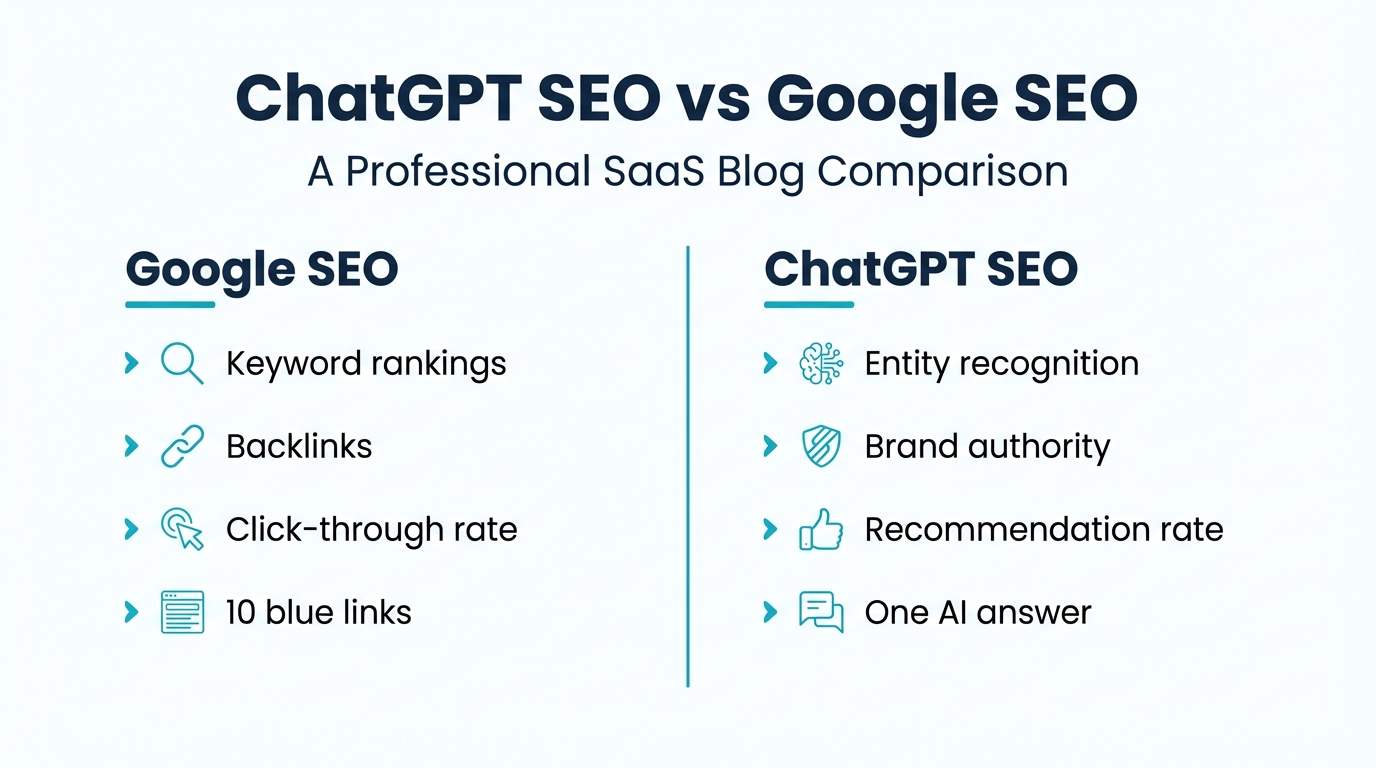
ChatGPT SEO vs Google SEO
The two channels share DNA but diverge in critical ways.
| Dimension | Google SEO | ChatGPT SEO |
|---|---|---|
| Search index | Google's crawler and index | OpenAI crawling/indexed content plus third-party search providers, depending on the experience |
| Result format | Links, snippets, featured answers | Synthesized paragraph with optional citations |
| Selection factors | Backlinks, on-page signals, Core Web Vitals | Relevance, crawl access, source quality, clarity, accuracy, and freshness |
| User behavior | Click through to websites | Read the AI response, may click citations |
| Keyword strategy | Exact match, related terms, search intent | Conversational queries, problem-solution framing |
| Traffic attribution | Clear via analytics | Limited, difficult to track referral paths |
| Update cycle | Continuous crawling | Training data cutoff + real-time browsing |
| Competitive landscape | Known ranking positions | Opaque mention/recommendation patterns |
The biggest practical difference: Google sends traffic to your site. ChatGPT often answers the question directly, and users may never click through to a source. That makes brand mentions and recommendations within the response itself the primary currency of ChatGPT SEO.
Step-by-Step ChatGPT SEO Checklist
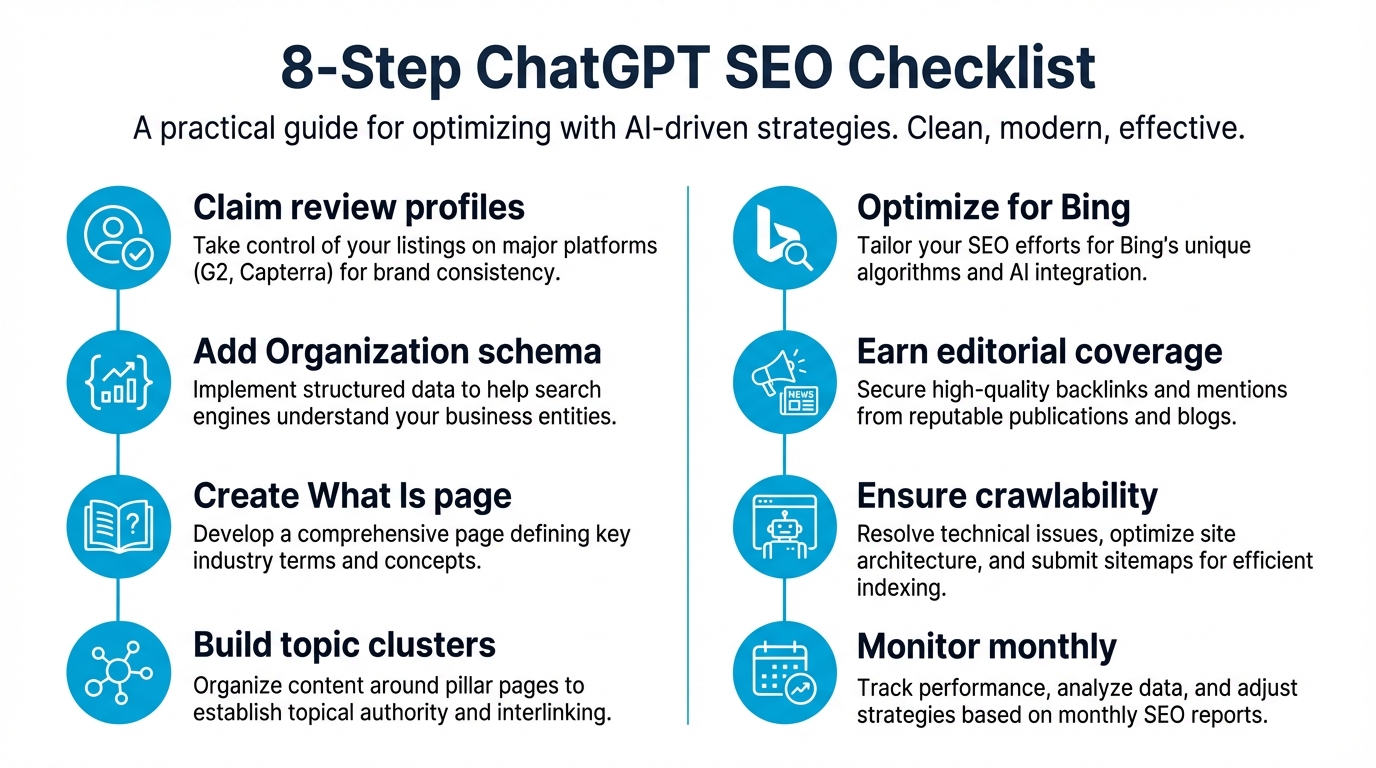
Here's a practical, prioritized checklist for optimizing your brand's presence in ChatGPT responses.
1. Make Your Site Available to ChatGPT Search
Confirm that OAI-SearchBot is allowed in robots.txt, important pages are indexable, and your CDN is not blocking OpenAI's published crawler traffic. Then use Google Search Console and Bing Webmaster Tools to find broader crawl and indexing problems.
2. Define Your Brand Entity Clearly
Your website should contain clear, unambiguous statements about what your brand does, who you serve, and what makes you different. Place this information on your homepage, about page, and product pages. Use Organization and Product schema markup to reinforce these definitions.
ChatGPT needs to understand your brand as a distinct entity before it can recommend you. Vague positioning leads to vague (or absent) mentions.
3. Create Question-Answering Content
ChatGPT users ask questions. "What's the best email marketing tool for ecommerce?" "How do I choose a CRM for a 50-person team?" Your content should match these patterns.
Build dedicated pages that answer specific, high-intent questions in your category. Structure them with the question as a heading and a direct, comprehensive answer immediately following. Don't bury the answer under 500 words of preamble.
4. Publish Original Data and Research
ChatGPT prefers citable sources, content with specific numbers, original research, and verifiable claims. Publish benchmark reports, survey results, and proprietary data that no other source has.
When ChatGPT encounters a factual question and finds your original research in its retrieval results, your content becomes the natural citation choice.
5. Build Third-Party Authority Signals
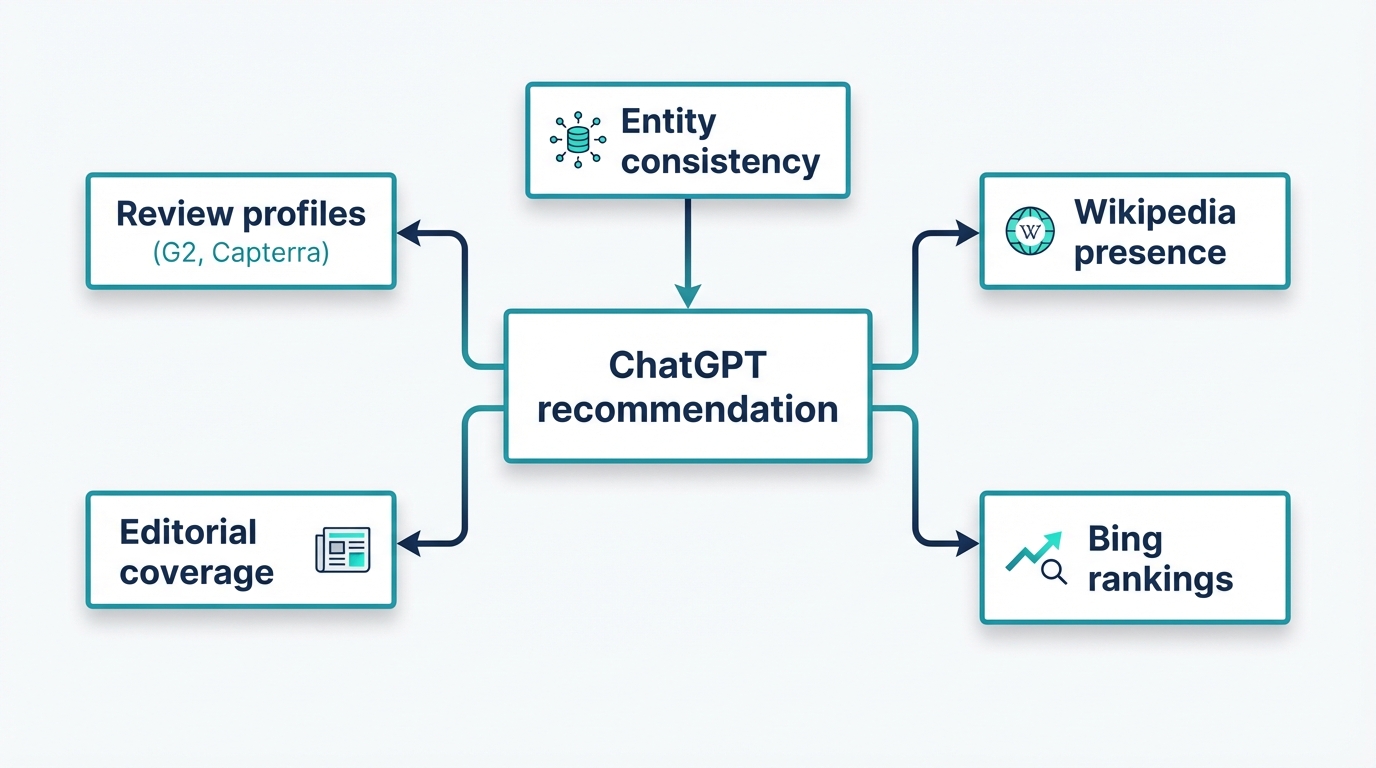
ChatGPT's training data includes reviews, industry publications, Reddit threads, forum discussions, and news coverage. Your brand's presence across these third-party sources influences how ChatGPT perceives your authority and relevance.
Pursue reviews on G2, Capterra, and Trustpilot. Contribute expert commentary to industry publications. Participate authentically in relevant communities.
6. Structure Content for AI Parsing
Use clear heading hierarchies (H2, H3) that describe the content of each section. Include comparison tables for product and feature comparisons. Use lists for step-by-step processes. Define technical terms explicitly rather than assuming context.
7. Keep Content Current
When ChatGPT browses for current information, it prefers recent sources. Update your core pages regularly with current data, recent examples, and accurate pricing. Include visible publication and update dates on your content.
8. Optimize for Conversational Keywords
Map out the conversational questions users ask about your category. Tools like AlsoAsked and AnswerThePublic can help identify these patterns. Create content that addresses these natural-language queries directly.
ChatGPT-Specific Ranking Signals
While OpenAI hasn't published an official ranking algorithm, patterns emerge from testing and observation.
Source Consensus
ChatGPT tends to recommend brands and solutions that are mentioned positively across multiple independent sources. If five different industry publications name your product as a top choice, ChatGPT is more likely to include you than a brand mentioned by only one source.
This consensus signal makes PR and review-site coverage a direct contributor to ChatGPT visibility.
Factual Specificity
Vague claims like "industry-leading solution" don't get cited. Specific claims, "reduces email bounce rates by 23% on average" or "integrates with 150+ platforms," give ChatGPT concrete information to include in its responses.
Audit your content for vague marketing language and replace it with specific, verifiable statements.
Content Freshness
For browsing-mode queries, ChatGPT prioritizes recent content. A comparison guide updated in March 2026 will be preferred over an otherwise identical guide last updated in 2024.
Include visible "last updated" dates on your content. Refresh statistics, screenshots, and examples regularly.
Domain Authority
Authoritative sources are more likely to be trusted and reused. Build that authority through useful content, earned links, independent coverage, consistant brand information, and primary evidence that other sites can verify.
Entity Consistency
ChatGPT builds an internal representation of your brand based on information encountered across sources. If your brand description is consistent across your website, LinkedIn, Crunchbase, G2, and industry publications, the AI's entity model for your brand will be stronger and more accurate.
Inconsistent messaging creates ambiguity, which reduces the likelihood of confident recommendations.
Mentioned, cited, and recommended are different outcomes
Treat ChatGPT visibility as four separate checks:
- Found: Can ChatGPT retrieve a relevant page or identify the company?
- Mentioned: Does the brand appear in the answer at all?
- Cited: Does the answer link to the brand's page or another source discussing it?
- Recommended: Does ChatGPT present the brand as a suitable choice for the user's constraints?
A citation isn't automatically a reccomendation, and a mention can be neutral or negative. Track each outcome separately across a stable prompt set.
Measuring ChatGPT SEO Results
Measuring ChatGPT visiblity is harder than measuring Google rankings, but it's not impossible.
Manual Query Testing
Run a set of category-relevant queries through ChatGPT monthly and document whether your brand appears. Track both browsing-mode and default-mode responses separately. Build a query set of 20-50 questions that represent high-intent searches in your category.
Citation Tracking
When ChatGPT cites sources in browsing mode, your analytics can capture some of this traffic. Look for referral traffic from chatgpt.com and associated OpenAI domains. The volume will be small compared to Google, but the intent is often high.
Competitive Monitoring
Track not only your own mentions but also competitor mentions. If ChatGPT consistently recommends three competitors and not you, that gap tells you where to focus your optimization efforts.
AI Visibility Platforms
Manual testing doesn't scale. Dedicated AI visibility platforms can automate query monitoring across ChatGPT and other AI engines, tracking your mention rate, recommendation rate, and competitive share of voice over time.
According to Rand Fishkin's SparkToro research, zero-click searches now account for nearly 60% of Google searches. The trend toward AI-delivered answers will accelerate this. Brands that measure and optimize their ChatGPT presence now will hold the advantage as user behavior continues shifting.
Frequently Asked Questions
Does ChatGPT use Google rankings?
Not in a simple one-to-one way. ChatGPT Search can use OpenAI crawling and indexing as well as third-party search providers. Strong search visibility often helps because it reflects crawlability, relevance, and authority, but a Google or Bing position does not guarantee a ChatGPT citation or recommendation.
Can I pay to appear in ChatGPT?
Not currently. OpenAI does not sell sponsored placements within ChatGPT's responses. All appearances are organic, determined by the model's training data and real-time retrieval results. This may change as OpenAI explores monetization, but for now, earning your way into ChatGPT responses requires building genuine authority, creating citable content, and maintaining a strong presence across the web. There are no shortcuts or paid alternatives.
Related Articles