Perplexity SEO is the practice of optimizing your content to appear as a cited source in Perplexity AI's search results. Unlike ChatGPT or Gemini, Perplexity functions as a search engine first, crawling the web in real time and citing every source it uses, making it the most transparent AI search platform for brands tracking their visibility.
How Perplexity's Search Engine Works
Perplexity operates differently from other AI platforms. Understanding its architecture is the foundation for optimizing your presence on it.
Real-Time Web Crawling
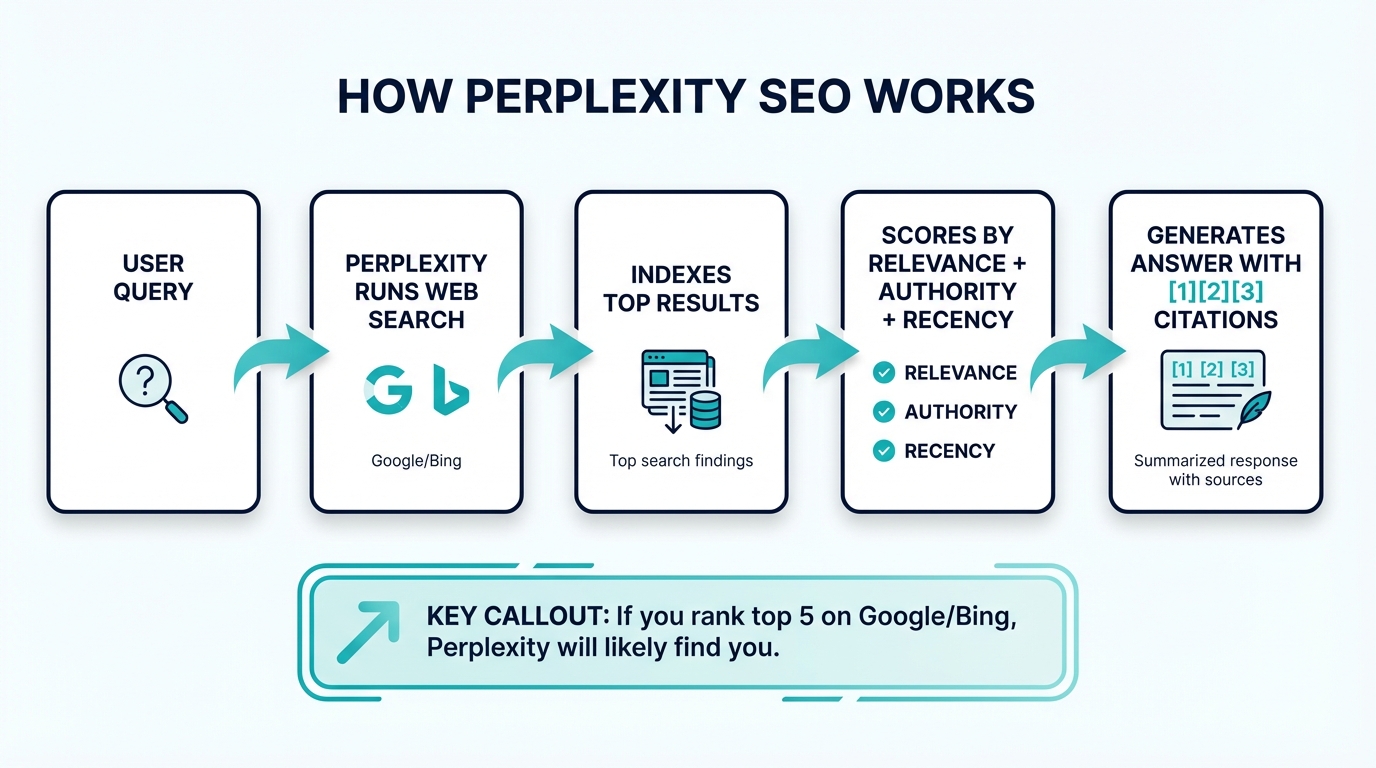
Perplexity doesn't rely on static training data for its search responses. It crawls the web in real time using its own bot, PerplexityBot, which visits pages, indexes content, and feeds current information into its response generation.
This real-time approach means your content's current state matters, not what it looked like six months ago when a language model was being trained. If you publish a new comparison guide today, Perplexity can discover, index, and cite it within days.
The Citation Model
Perplexity's defining feature is inline citations. Every claim in a Perplexity response links back to a source. Users see numbered citations throughout the response, and can click through to the original pages.
This is a significant difference from ChatGPT or Gemini, which may mention brands without linking to any source. On Perplexity, if your content appears, users can reach your site directly. That makes Perplexity citations a measurable, traffic-driving asset.
According to Perplexity's own documentation, the platform processes hundreds of millions of queries and serves millions of users. Its audience skews toward researchers, professionals, and information-intensive searchers who value sourced answers.
Response Generation Pipeline
When a user asks Perplexity a question, the system follows a retrieval-augmented generation (RAG) pipeline. First, it formulates search queries based on the user's prompt. Then it retrieves relevant pages from across the web. The language model synthesizes the retrieved content into a coherent answer, attributing specific claims to specific sources.
The retrieval step is where your content either makes the cut or gets passed over. Perplexity selects sources based on relevance, authority, and the specificity of the information they provide.
Perplexity Pro and Focus Modes
Perplexity offers different search modes that affect how sources are selected. The default search casts a wide net. Focus modes narrow retrieval to specific source types: Academic, Writing, YouTube, Reddit, and more. If your content is relevant to academic or professional queries, understanding which focus modes your audience uses helps you target your optimization.
Perplexity Pro uses more advanced models and deeper retrieval, pulling from more sources and producing longer, more detailed responses. Pro responses tend to cite more sources per answer, increasing the opportunities for your content to appear.
Perplexity Ranking Signals
Perplexity hasn't published a formal ranking algorithm, but consistent patterns emerge from analysis of its citation behavior.
Source Freshness
Because Perplexity crawls the web in real time, fresh content has a direct advantage. A guide updated this month will be preferred over an identical guide last updated in 2024. Perplexity's results frequently include recent publications, and its interface highlights publication dates when available.
Maintain visible "last updated" dates on your content. Refresh statistics, examples, and comparisons regularly.
Domain Authority
High-authority domains appear more frequently in Perplexity citations. This aligns with how the platform's retrieval system evaluates source credibility. A claim from a well-known industry publication or a high-authority brand site will be preferred over the same claim on a low-authority blog.
Your existing domain authority, built through traditional SEO, directly supports your Perplexity visibility. According to a study from Surfer SEO, high-authority domains are disproportionately represented in AI-generated citations across platforms, including Perplexity.
Content Specificity
Perplexity cites content that makes specific, attributable claims. "Our survey of 1,200 marketers found that 67% increased their AI budget in 2025" gets cited. "Many marketers are increasing budgets" doesn't.
Each citation in a Perplexity response links to a source because the model pulled a specific piece of information from that source.
Your content needs to contain those specific, citable data points.
Structural Clarity
Content with clear headings, comparison tables, numbered lists, and well-organized sections is easier for Perplexity's retrieval system to parse and extract information from. Dense, unstructured prose is harder for the system to work with.
Topical Relevance and Depth
Perplexity prefers pages that cover a topic thoroughly rather than pages that touch on it briefly. A comprehensive guide to a subject will be cited more frequently than a surface-level overview, because the comprehensive guide provides more citable claims across more subtopics within a query's scope.
Perplexity SEO vs ChatGPT SEO
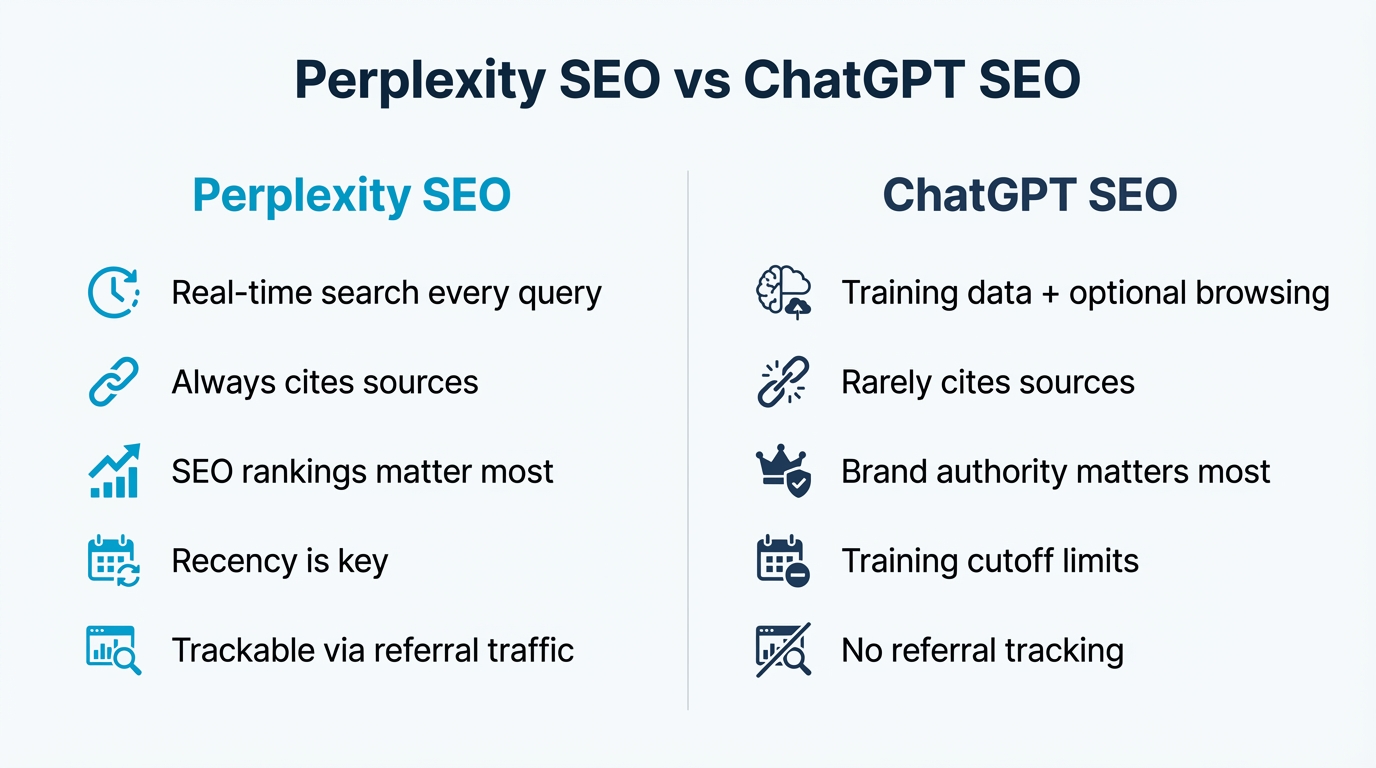
Both platforms are AI-powered, but they require different optimization approaches.
| Dimension | Perplexity SEO | ChatGPT SEO |
|---|---|---|
| Search method | Real-time web crawling via PerplexityBot | Bing index (browsing mode) + training data |
| Citation style | Always cited, inline numbered references | Occasional citations in browsing mode, none in default |
| Traffic potential | Direct clicks from inline citations | Limited, mostly brand awareness |
| Content freshness | High impact (real-time crawl) | Moderate (browsing) to low (training data) |
| Crawler control | PerplexityBot in robots.txt | GPTBot in robots.txt |
| Transparency | Full source visibility for every claim | Opaque in default mode, partial in browsing |
| User intent | Research-heavy, detail-oriented queries | Conversational, broad questions |
| Optimization speed | Days to weeks (real-time indexing) | Weeks to months (Bing indexing) to unknown (training data) |
The biggest practical difference: Perplexity citations drive clicks. Every source is linked and visible to the user. ChatGPT mentions may drive awareness but rarely drive direct traffic unless the user is in browsing mode and clicks a citation.
This makes Perplexity SEO more directly measurable than ChatGPT SEO. You can track referral traffic from perplexity.ai in your analytics and tie it to specific pages.
SEO Tactics Specific to Perplexity
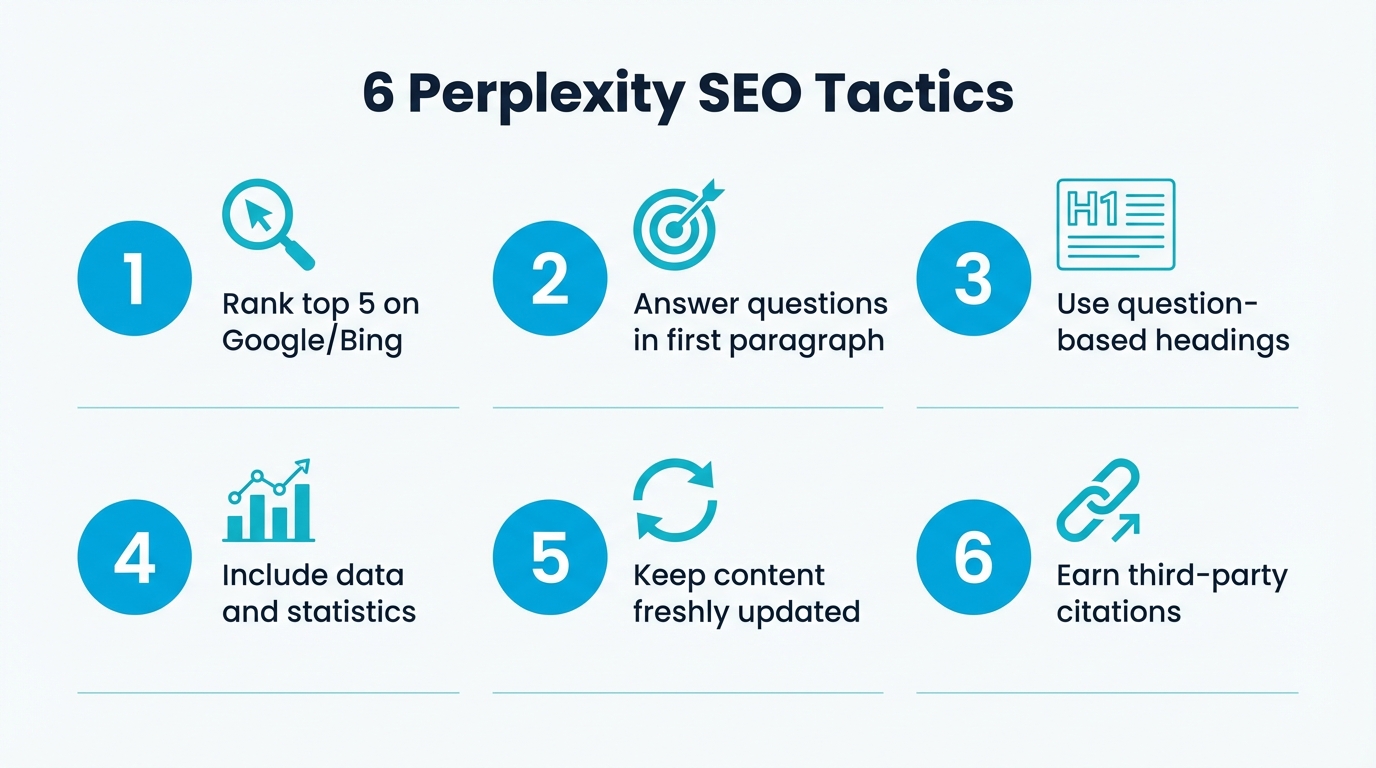
Here's what to prioritize for Perplexity visibility, ranked by impact.
Publish Original Data and Research
Original data is the single highest-impact tactic for Perplexity SEO. When Perplexity needs to answer a question with a specific statistic or data point, it cites the primary source. Be that primary source.
Publish survey results, benchmark data, proprietary analysis, and case studies with real numbers. Content built on original data gets cited repeatedly across different queries, because the data point is unique to your content.
Build Comprehensive Comparison Content
Perplexity users frequently ask comparison questions. "What's the difference between X and Y?" "Which CRM is best for small teams?" "How does [your category] pricing compare?"
Create detailed comparison pages with structured tables, feature breakdowns, and specific evaluation criteria. These pages align with a high volume of Perplexity queries and provide the structured information that Perplexity's citation model prefers.
Create FAQ-Style Content Structures
Perplexity excels at answering specific questions. Pages structured around frequently asked questions, with clear question headings and direct answers, match Perplexity's query-response pattern. The platform can extract a specific answer from your FAQ and cite it for the relevant question.
Keep Content Current
This bears repeating because its more impactful on Perplexity than on any other AI platform. Perplexity's real-time crawl means it can access and cite your content as soon as it's published or updated. Set a monthly cadence for reviewing your highest-traffic pages and updating any stale information.
Define Your Expertise Clearly
Your about page, author bios, and content bylines establish your site's authority on specific topics. Perplexity's retrieval system considers topical authority when selecting sources. If your site demonstrates deep expertise in a specific domain through extensive, authoritative coverage, your content in that domain will be cited more frequently.
Write for Researchers
Perplexity's user base skews toward research-oriented queries. These users want depth, evidence, and sourced claims. They're not looking for surface-level overviews. Write content that satisfies a researcher's expectations: thorough analysis, supporting evidence, and clear methodology.
Technical Requirements for Perplexity
Getting your technical setup right ensures Perplexity can access and index your content without friction.
Robots.txt Configuration
Check your robots.txt file for PerplexityBot directives. If you want Perplexity to index your content (and you should, if you're reading this), make sure you're not blocking PerplexityBot. Perplexity documents its bot behavior and respects robots.txt rules.
If your robots.txt blocks PerplexityBot, your content won't appear in Perplexity results regardless of its quality. Check this first.
Page Load Performance
PerplexityBot, like any crawler, has timeouts. If your pages load slowly, the crawler may not fully index your content. Standard web performance best practices apply: optimize images, minimize render-blocking resources, and ensure server response times are under one second.
Crawlable Content
Content rendered through client-side JavaScript can be difficult for crawlers to access. Ensure your critical content is available in the initial HTML response or rendered server-side. Test by viewing your page's source (not the rendered DOM) to confirm your key content is present.
Sitemap and Internal Linking
A current XML sitemap helps PerplexityBot discover your pages. Strong internal linking between related pages reinforces topical relationships and helps the crawler understand your site's content architecture.
Structured Data
While Perplexity's retrieval doesn't depend on schema markup the way Google's featured snippets do, structured data provides additional signals about your content's topic, type, and attributes. Implementing FAQ, HowTo, and Product schema adds machine-readable context that can inform retrieval decisions.
How to check whether your brand appears in Perplexity
Build a small prompt set before changing the site. Include category prompts, problem-based prompts, comparisons, and questions that should cite your own research or documentation.
For each prompt, record whether the brand is mentioned, where it appears, which pages Perplexity cites, and whether the description is accurate. Run each prompt more than once and save the date. This separates a one-off response from a repeatable visibility pattern.
Use Perplexity brand tracking for ongoing measurement. Use the optimization steps below when the cited pages or missing topics explain why the brand is absent.
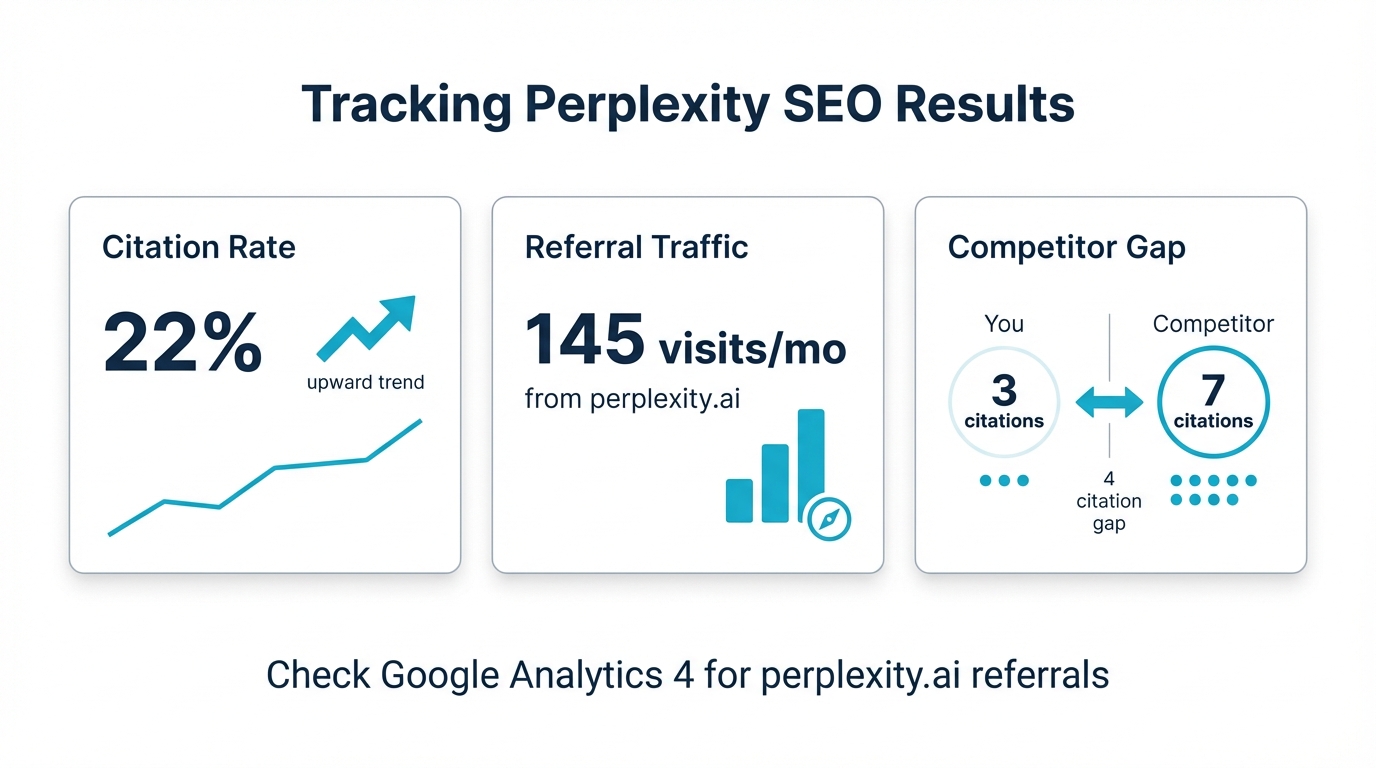
Tracking Your Perplexity SEO Results
Perplexity is the most trackable AI search platform, thanks to it's transparent citation model.
For a full framework covering metrics, baseline methodology, and analytics integration, see our Perplexity brand tracking guide.
Referral Traffic
Monitor your analytics for traffic from perplexity.ai. This direct referral metric tells you how many users click through from Perplexity citations to your site. In Google Analytics 4, check the referral source report and filter for perplexity.ai.
The traffic volume may be modest compared to Google organic, but pay attention to engagement metrics. Perplexity referral traffic often shows higher time on page and lower bounce rates, because users arriving from Perplexity are typically in research mode with specific intent.
Citation Monitoring
Track which of your pages Perplexity cites and for which queries. You can do this manually by running your target queries through Perplexity and documenting the results, or use an AI visibility platform that automates this monitoring.
Build a query set of 20-40 questions that represent your target audience's research behavior. Run these monthly and track citation presence and position over time.
Competitive Citation Analysis
Run competitor queries through Perplexity and document which brands get cited. If a competitor appears as a source for queries relevant to your category and you don't, that gap tells you where to create or improve content.
Track your citation share of voice: across your query set, what percentage of citations point to your content versus competitors? This metric reveals your competitive position on Perplexity specifically.
Page-Level Performance
Identify which of your pages get cited most frequently on Perplexity. These high-performing pages can serve as templates for future content. Analyze what they have in common: format, depth, data density, and structure. Apply those patterns to other pages.
AI Visibility Platforms
Manual tracking works for small-scale monitoring but becomes impractical as your query set and competitive tracking needs grow. Dedicated AI visibility platforms can automate Perplexity monitoring alongside other AI search engines, providing consistent tracking over time. For a full comparison, see What is Generative Engine Optimization?.
Related Articles
- How to Appear in Perplexity AI
- AI Citation Tracking: How to Monitor AI Sources
- What is Generative Engine Optimization?