AI share of voice measures how often AI systems mention your brand compared to competitors when users ask prompts in your category. It is most useful when you define a fixed competitor set, a fixed prompt set, and a repeatable test method so results are comparable over time.
This guide covers one consistent definition and formula, a practical testing workflow, platform-by-platform considerations, and how to report results without mixing different metrics.
What AI share of voice is and what it is not
For this article, mention-based AI share of voice means:
- You run a defined prompt set on one or more AI platforms.
- You count brand mentions in the outputs.
- You calculate each brand’s share of total mentions across your tracked brands.
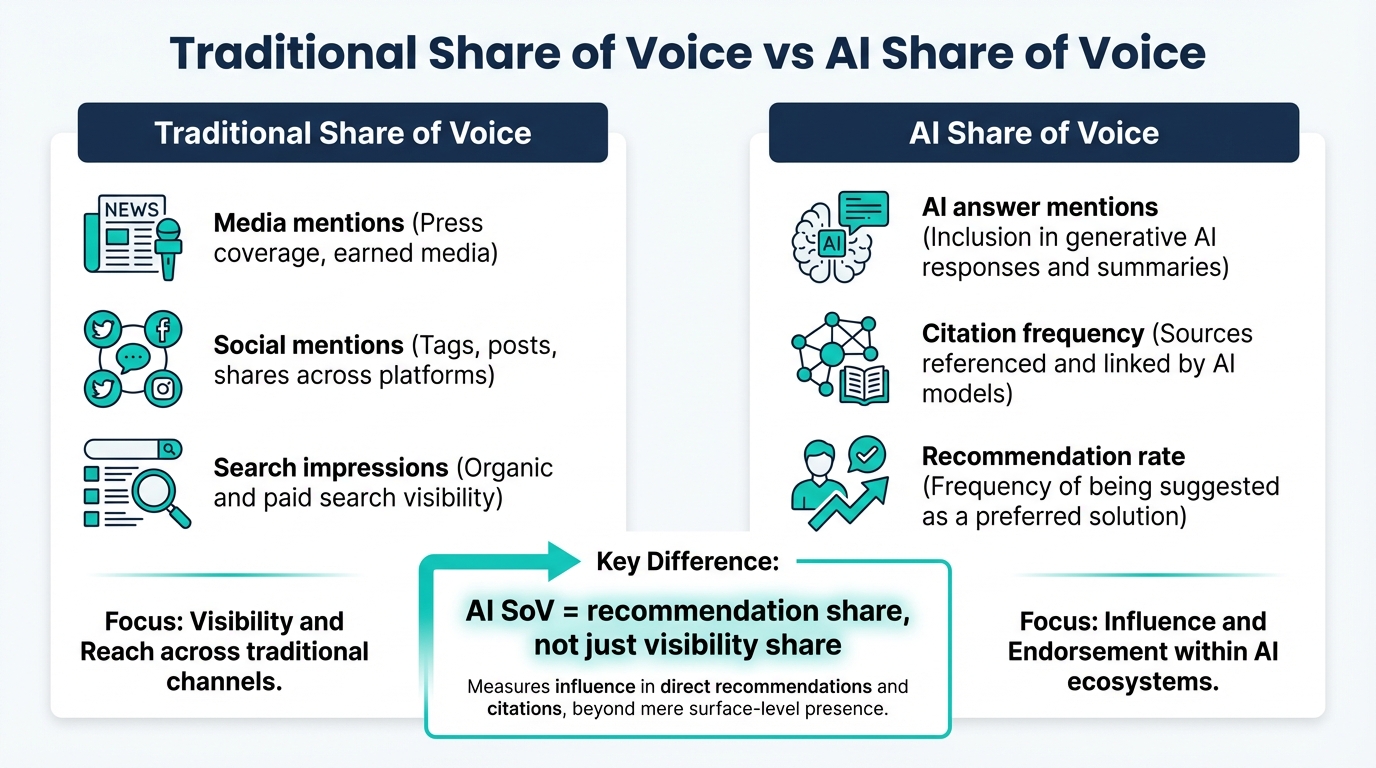
AI share of voice is often confused with the simpler question, “Did the model mention us at all?” That is a different metric. In this article:
- Share of voice (mention-based) is a competitive metric based on mentions.
- Mention rate is a coverage metric based on answers.
Keeping these separate prevents reporting contradictions, especially when responses list many brands.
Definitions and the one formula to use
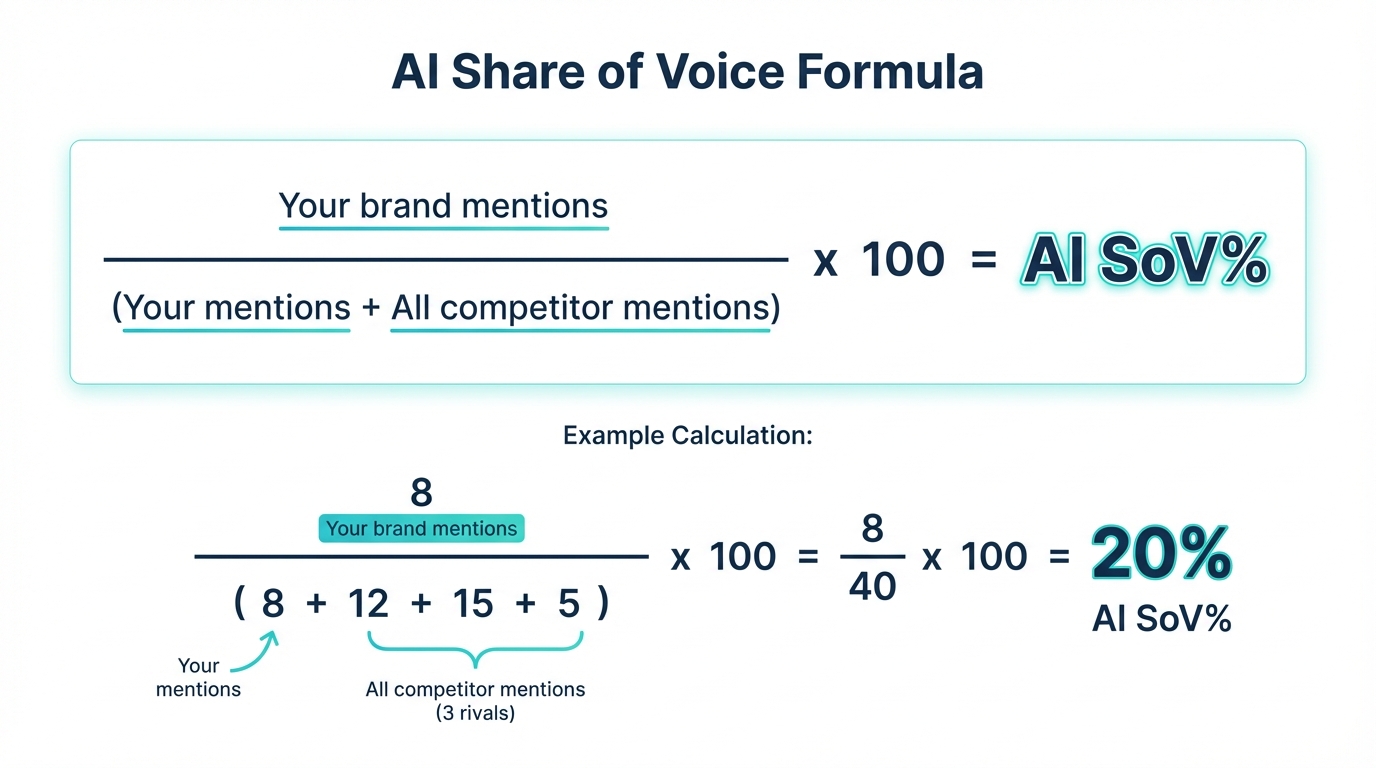
Mention-based AI share of voice formula
Use this formula consistently:
AI share of voice (mention-based) = mentions of your brand divided by mentions of all tracked brands, for the same prompt set and run window.
If you want a percentage, multiply by 100, but keep the ratio definition intact.
Mention rate (answer coverage) definition
Mention rate = number of answers where your brand appears divided by total answers.
Mention rate is useful, but it is not share of voice. A brand can have a high mention rate but a lower share of voice if competitors are co-mentioned frequently.
Why consistent methodology matters
AI outputs vary for reasons that are easy to miss in casual testing:
- Prompt phrasing changes which sources or memories are used.
- Retrieval and citation behavior can differ by platform, product surface, and mode.
- Some experiences have multiple modes (for example, with browsing or without browsing), which can change what is eligible to appear.
- Stochastic generation means two runs can produce different brand lists, ordering, and phrasing.
For share of voice to be defensible, it must be tied to a documented prompt set and a documented run window. Otherwise, changes may reflect testing drift rather than real visiblity movement.
How to calculate AI share of voice step by step
Step 1: Define your tracked brands
Pick a competitive set that reflects what users actually compare. Many teams start with 4 to 8 brands, then expand once the workflow is stable.
Guidelines that help keep results meaningful:
- Include direct alternatives a buyer would plausibly shortlist.
- Avoid mixing segments unless your buyers truly cross-shop between them.
- Keep the set stable for trend reporting. If you change it, treat the new run as a new baseline.
Step 2: Build a prompt set you can re-run
Create a library that matches real discovery questions. A common structure is 15 to 25 prompts that mix:
- Category prompts: “Best [category] tool”
- Use case prompts: “Best tool for [specific problem]”
- Audience prompts: “Best [category] for [audience type]”
- Comparison prompts: “[Brand A] vs [Brand B] for [use case]”
Keep prompts in a versioned document so you can re-run the exact same set later. If you update prompts, label the prompt set version and don't blend results across versions in the same trend line.
Step 3: Specify the run configuration
Before you run anything, document:
- Platform and product surface (for example, ChatGPT vs a search-integrated view)
- Model name and mode (where applicable)
- Market and language (for example, US English)
- Date and time window
- Repetitions per prompt (to capture variability)
A simple standard is to run each prompt multiple times. The key is to keep the repetition count consistent across runs so month-to-month comparisons remain fair.
Step 4: Collect outputs and count mentions
For each answer:
- Record whether each tracked brand is mentioned.
- Count mentions per tracked brand.
- Optionally track position and how the brand is framed, but keep your core share of voice based on mentions to avoid mixing qualitative judgments into the main metric.
Be explicit about what counts as a mention. For example:
- Does a list item count as one mention?
- Do repeated mentions in one answer count multiple times?
- How do you handle parent brands vs product names?
Pick rules that are simple, document them, and keep them unchanged.
Step 5: Calculate platform-level share of voice
Calculate share of voice separately for each platform using the same formula:
Platform AI share of voice = your brand mentions on that platform divided by all tracked brand mentions on that platform, for the same prompt set and run window.
This separation matters because platforms can behave differently based on retrieval, citation, and model behavior. Platform-level numbers are also the most actionable for diagnosing gaps.
Step 6: Calculate combined share of voice (if you need it)
After you have platform-level results, you can compute a combined figure. Do this carefully:
- Combine only runs that used the same prompt set version, market, and comparable run windows.
- State exactly which platforms are included.
- If you apply weighting by platform importance, document the weights and keep them stable.
Do not replace platform-level reporting with a single blended number. Combined figures are useful for executive dashboards, but platform-level results tell you where to focus.
Step 7: Calculate mention rate separately
For each platform, compute mention rate:
Mention rate = answers where your brand appears divided by total answers.
You can also compute a combined mention rate across all platforms, but keep it clearly labeled as mention rate, not share of voice.
Worked example (structure, not a benchmark)
A clean way to present results is to report:
- Prompt set size and version
- Platform and model or mode
- Run date and repetitions
- Mentions by brand
- Share of voice by platform
- Mention rate by platform
Avoid turning a single run into a generalized benchmark. Treat the example as a repeatable template you can apply to your own category.
Platform-by-platform tracking notes
Different platforms surface brands using different mechanisms. That does not mean any platform behaves the same way all the time, so avoid absolutes. Instead, treat these as practical considerations for test design and interpretation.
ChatGPT
ChatGPT outputs often reflect the model’s learned patterns plus whatever retrieval or browsing features are enabled in your chosen mode. Recommendations may be sensitive to:
- Whether your session is using a browsing or retrieval mode
- How the prompt is framed (short “best X” vs detailed constraints)
- Stochastic variation across runs
To keep ChatGPT tracking consistent:
- Specify the model and mode used.
- Keep prompts and repetition counts consistent.
- Re-test on a defined cadence so you can observe shifts after model changes.
Perplexity
Perplexity commonly provides answers with citations, which can be helpful for diagnosing why a brand was included. For tracking:
- Save the citations alongside the answer output where possible.
- Keep the market and language constant.
- Save the cited pages so you can inspect whether source changes coincide with visibility changes.
Perplexity’s product and behavior can change over time, so document the exact experience you used.
Gemini
Gemini outputs can vary by product surface and mode. When tracking Gemini:
- Record where you accessed Gemini and which mode was used.
- Keep your prompt set stable.
- Pay attention to how many brands it typically lists per answer, since longer lists change the total mention pool and can affect share of voice math.
Google AI Overviews
AI Overviews appear in Google results rather than as a single conversational thread, and they may show citations and summarized content. Tracking typically involves:
- A fixed keyword or query set that maps to your prompt library where possible
- A consistent market and language configuration
- Capturing whether your brand is mentioned, plus citation context if present
Google’s own documentation can be a reference point for how these features are presented and how sources can appear: https://developers.google.com/search/docs/appearance/ai-features
A competitor benchmarking workflow that stays consistent
Phase 1: Establish a baseline run
Run the full prompt set across your selected platforms using the documented configuration. For each platform, compute:
- Mention-based share of voice for each tracked brand
- Mention rate for each tracked brand
Archive:
- The raw outputs
- The mention extraction rules you used
- The run metadata (prompt set version, market, date, repetitions, model or mode)
Phase 2: Gap analysis by prompt cluster
Focus on prompts where:
- Competitors are frequently mentioned and you are not (mention rate gap)
- Your share of voice is low even when you appear (co-mention crowding)
Investigate external presence factors in a way that is concrete and auditable. For example, you can compare review and directory coverage on sites like G2 and Capterra, and note differences in category placement or depth of listings.
Keep this diagnostic work seperate from the share of voice measurement itself. The measurement should remain a clean count using the same rules.
Phase 3: Ongoing monitoring and change control
Re-run the same prompt set on a consistant schedule. When you report changes, include:
- What changed in share of voice by platform
- What changed in mention rate by platform
- Whether any test configuration changed (model, mode, market, prompt set version)
If the model version or platform mode changes, call that out explicitly.
Treat major configuration changes as a new baseline if needed, rather than implying a pure performance shift.
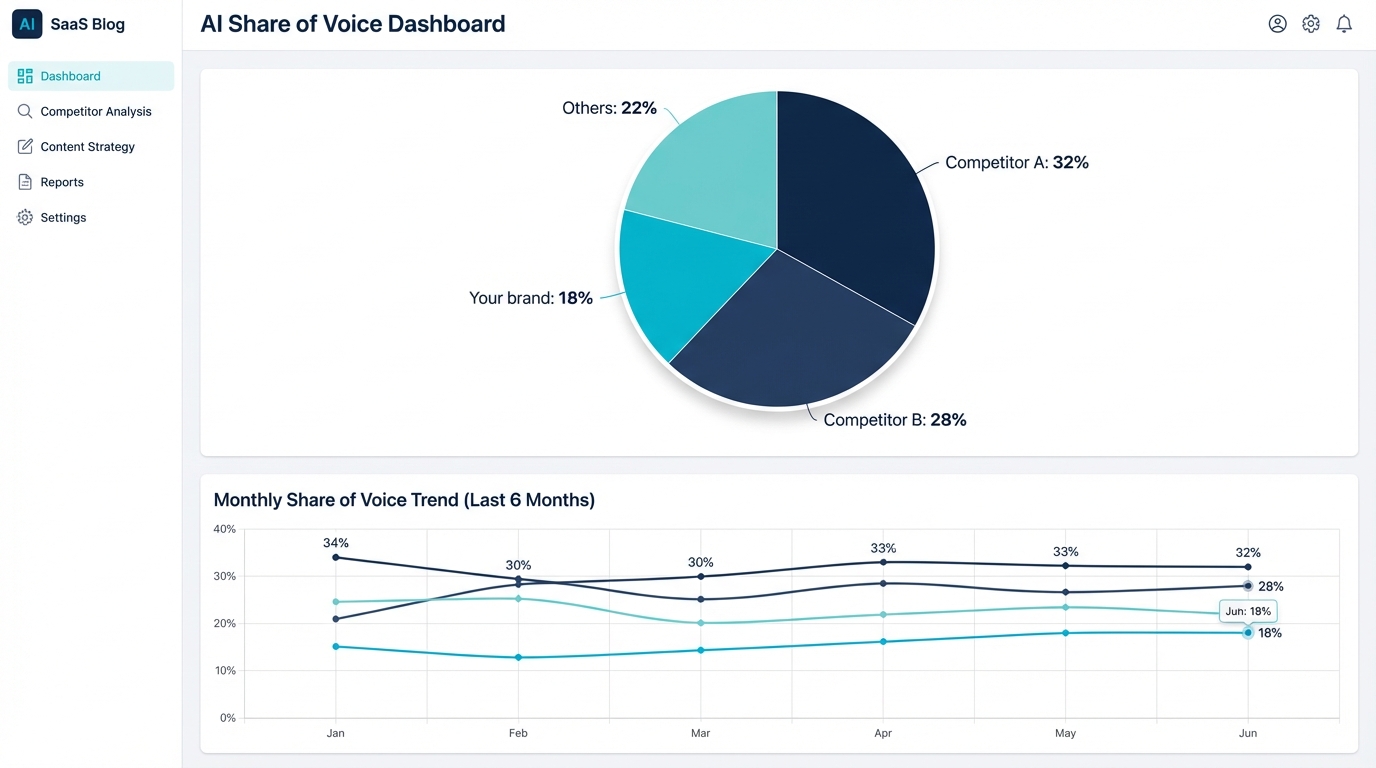
How to report results clearly
A reporting format that avoids confusion:
-
Run metadata - Prompt set version and size - Platforms included - Model and mode per platform - Market and language - Date and run window - Repetitions
-
Platform-level tables - Mentions by brand - Mention-based share of voice by brand - Mention rate by brand
-
Combined rollups (optional) - Combined mentions and combined share of voice (with a clear method statement) - Combined mention rate
-
Notes - Any changes to competitor set, prompt set, or mention counting rules - Anything unusual observed during the run
Tools for AI share of voice tracking
Manual tracking is workable for a first snapshot, but it becomes time-consuming once you add:
- Multiple platforms
- Multiple repetitions
- Regular re-runs
- Change control and archiving
If you evaluate automation, look for whether the tool can:
- Store a versioned prompt library
- Run prompts on a schedule
- Preserve raw outputs for auditing
- Separate platform-level reporting from combined rollups
- Keep model and mode metadata with each run
- Export results for your own analysis
friction AI positions itself as a way to automate prompt execution and competitive tracking across multiple AI platforms, so it can be a candidate if you want to operationalize the workflow rather than manage it in spreadsheets.
Pricing and plan details change over time. If you are comparing options, verify current pricing directly.
Last verified: July 26, 2026. Check current pricing at https://www.frictionai.co/pricing
Frequently asked questions
What is the correct formula for AI share of voice?
Use a mention-based formula consistently:
AI share of voice (mention-based) = mentions of your brand divided by mentions of all tracked brands, for the same prompt set and run window.
Report it per platform first, then compute a combined figure only if you clearly document how you combined results.
Is mention rate the same thing as share of voice?
No. Mention rate is answer coverage:
Mention rate = answers where your brand appears divided by total answers.
Share of voice is about your fraction of mentions among the tracked brands, not your presence in answers.
Should I measure AI share of voice per platform or combined?
Do both, but keep them separate:
- Platform-level share of voice is more actionable because it shows where you are underrepresented.
- Combined share of voice can be useful for a dashboard, but only if you document platforms included, run window, and any weighting.
How many prompts and repetitions do I need?
Use enough prompts to represent real discovery intent in your category and enough repetitions to handle answer variability. What matters most is consistency over time: the same prompt set version, the same repetition count, and documented model or mode settings.
Can you pay to be mentioned by AI systems?
Avoid assuming a universal rule across platforms or over time. Instead, treat AI visibility as a measurement problem: run controlled tests, document the configuration, and observe how outputs change.