For a deeper dive, see our Perplexity SEO guide.
What Makes Perplexity Different
Perplexity is an AI search engine, not just a chatbot.
Unlike ChatGPT (which relies heavily on training data), Perplexity searches the web for every query and always cites its sources. You can see exactly which pages it pulled from.
This makes Perplexity visibility more similar to traditional SEO than other AI platforms. If your pages rank and provide good answers, Perplexity is more likely to cite them.
How to Check If You're Visible in Perplexity
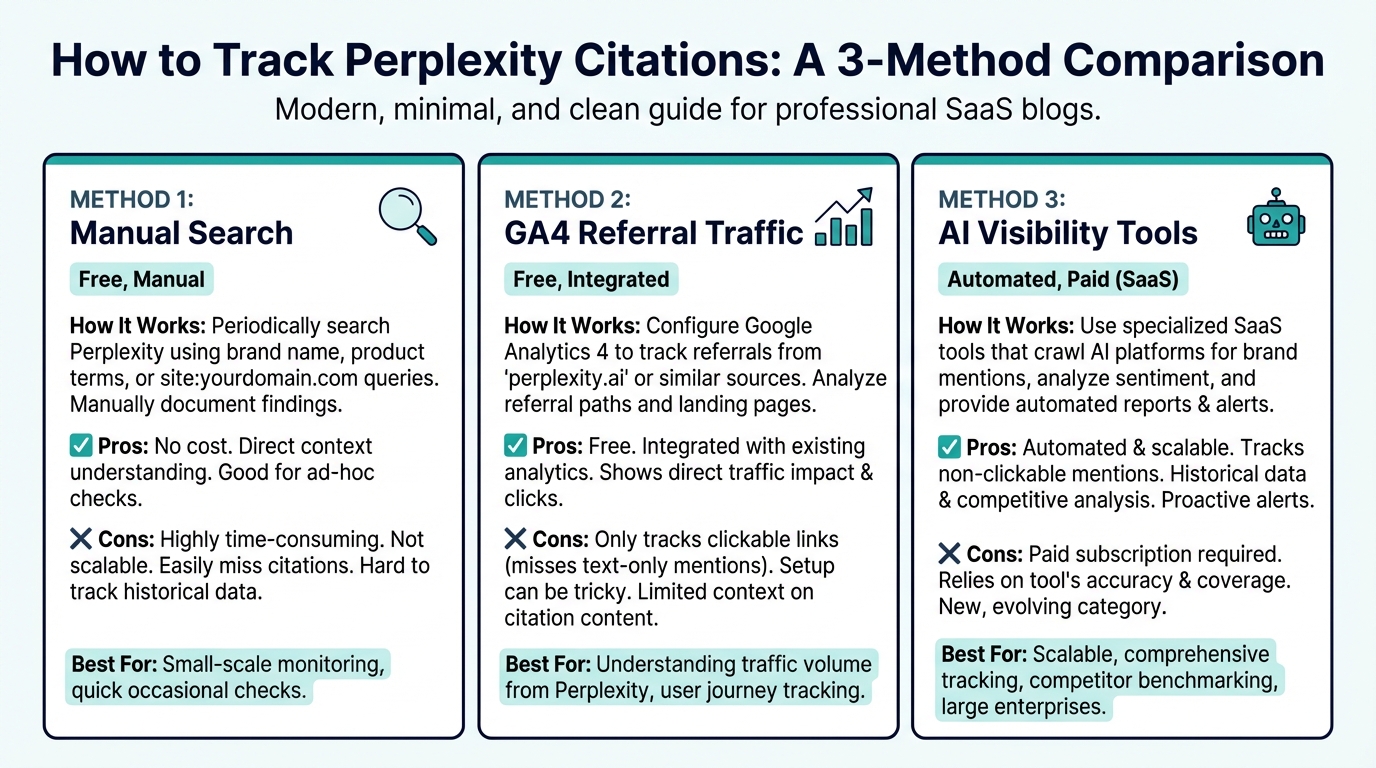
To check if Perplexity is citing your brand, search 10-15 category queries on perplexity.ai and note whether your brand appears in the synthesized answer or source citations. For ongoing tracking, filter GA4 referral traffic for "perplexity" or use automated citation monitoring. Three methods, from lowest to highest fidelity:
Manual search. Open Perplexity and test 10-15 category queries each week: best [your category] tools, [your brand] vs [competitor], what is [your brand], [category] for [use case]. For each query, check three things: whether your brand appears in the answer text, whether your domain appears in the citations, and how you're framed relative to competitors. Track results in a spreadsheet with columns for query, your citation (yes/no), competitor citations, and the source URLs Perplexity linked to.
Referral traffic analysis. In Google Analytics 4, filter source/medium by "perplexity". This tells you when users clicked through from a Perplexity citation to your site. Look for patterns: which pages get Perplexity traffic, and which queries drive it? Growing Perplexity traffic means more citations. Flat or falling traffic is a signal to diagnose.
Automated monitoring. AI visibility platforms, including friction AI, track Perplexity citations across a defined set of target queries and compare to competitors over time. This replaces manual checking and surfaces trend data: are your citations increasing or decreasing, and which queries are you losing to whom?
For a deeper framework on metrics, baseline methodology, and analytics integration, see our guide on how to track Perplexity brand visibility.
If you're not cited for your head category queries, the rest of this guide explains how to fix that.
How Perplexity Selects and Cites Sources
Perplexity operates differently from ChatGPT and Google AI Overviews. When a user asks a question, Perplexity runs a real-time web search and reads the top results. It then synthesizes an answer with numbered inline citations linked back to the specific source pages it used.
This citation-first architecture means Perplexity is the most transparent AI platform about where its information comes from. It also means getting cited in Perplexity is more measurable and more actionable than appearing in ChatGPT.
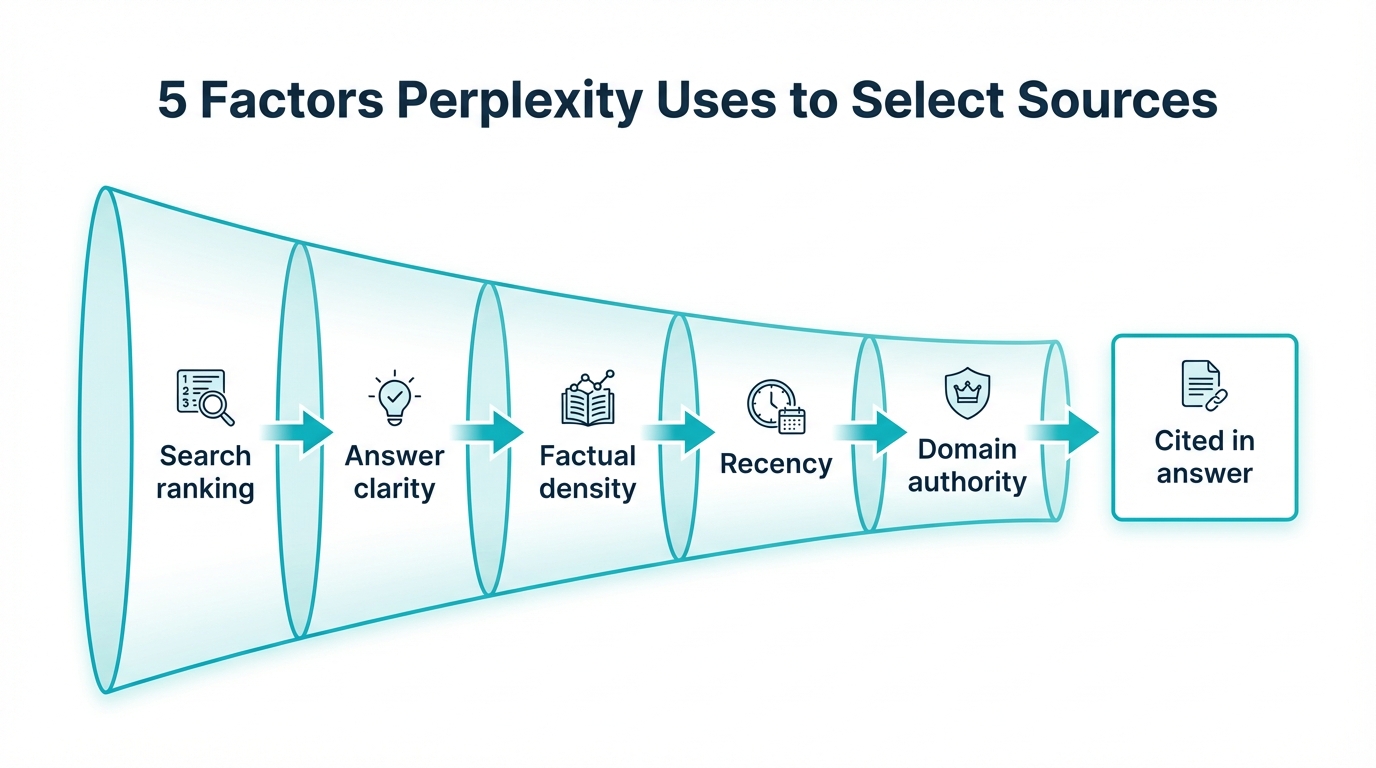
Key factors that influence whether Perplexity selects your content:
- Search ranking: Perplexity runs a search (often via Bing or Google) and prioritizes top-ranking results. If you rank in the top 10 for a query in traditional search, you're much more likely to be cited by Perplexity for that query.
- Answer clarity: Pages that provide direct, concise answers in the first few paragraphs are preferred over those that bury the answer after a long introduction. Perplexity's extraction favors content that mirrors the user's question.
- Factual density: Content with specific data points, statistics, and named examples gets cited more often than generic advice. Perplexity's model weights factual claims that it can verify across multiple sources.
- Recency: Perplexity has a strong preference for recent content. Pages with a recent publish or update date are favored, especially for queries with a time dimension.
- Domain authority: Established publications (news sites, industry publications, .edu and .gov domains) are cited more frequently. Building brand mentions on authoritative third-party sites increases your chances.
What Perplexity Favors
Based on observed patterns, Perplexity tends to cite:
High-ranking pages
Pages that rank well on Google and Bing are more likely to be found and cited.
Authoritative sources
Well-known publications, established brands, and pages with strong domain authority.
Direct answers
Content that clearly and directly answers the query being asked.
Recent content
Fresh content often gets prioritized, especially for queries where recency matters.
Diverse source types
Perplexity pulls from articles, forums, documentation, and other content types. Being present across multiple formats helps.
How to Get Cited in Perplexity
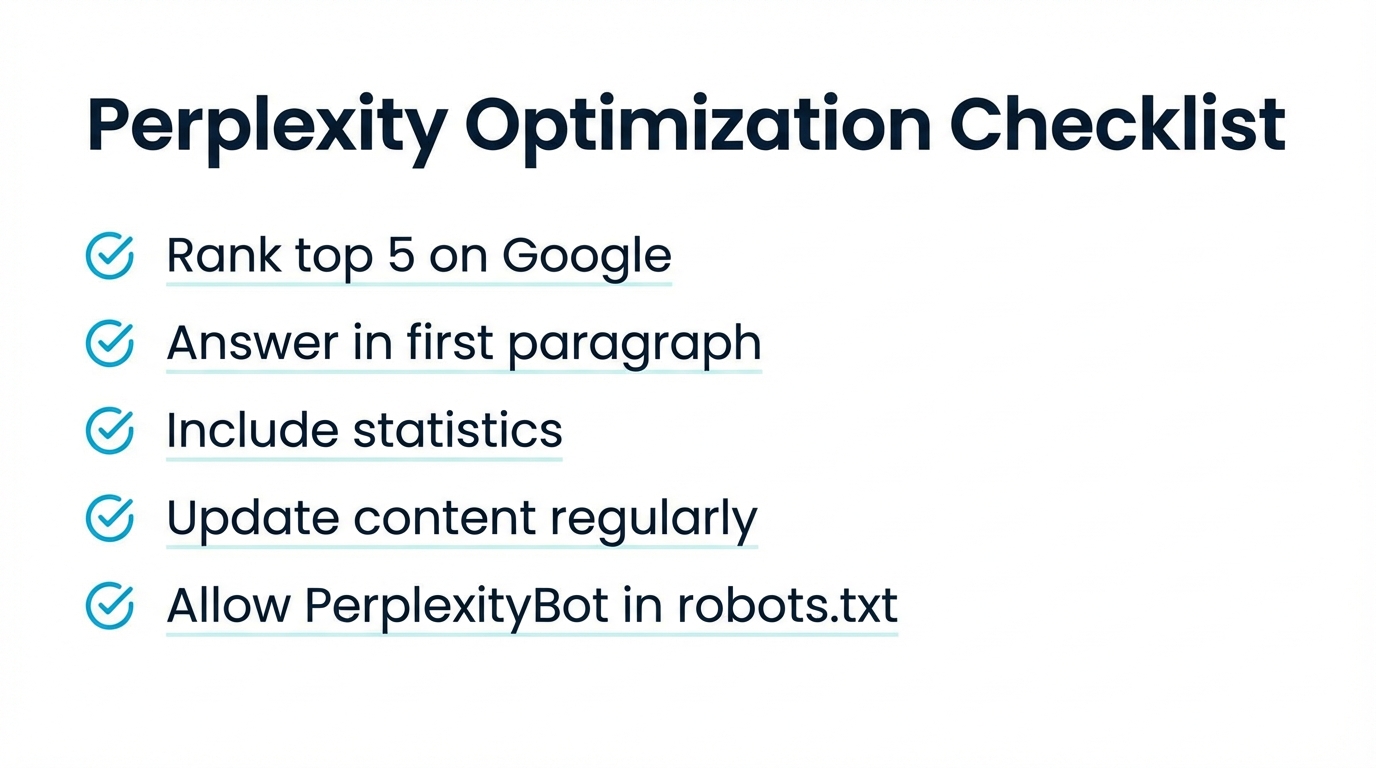
1. Rank well on traditional search
This is the foundation. Perplexity searches the web, so SEO fundamentals matter:
- Target relevant keywords
- Build quality backlinks
- Maintain good technical SEO
- Keep content fresh
Gartner predicts traditional search volume will decline 25% by 2026, but the rankings you hold today still directly feed Perplexity's source selection.
2. Create answer-focused content
Perplexity is looking for answers. Structure content to provide them:
- Clear headings that match query intent
- Direct answers early in the content
- Supporting detail and evidence
- Lists and structured formats
3. Build domain authority
Authoritative domains get cited more. Build authority through:
- Quality backlinks from relevant sites
- Consistent publishing in your niche
- Third-party recognition and coverage
4. Be present on multiple platforms
Perplexity indexes diverse sources. Don't just rely on your website:
- Publish on industry publications
- Maintain active profiles on relevant platforms
- Contribute to forums and communities where appropriate
5. Ensure crawlability
Make sure Perplexity's crawler can access your content:
- Check robots.txt for blocks
- Avoid heavy JavaScript that hides content
- Use clean, semantic HTML
Perplexity uses its own crawler (PerplexityBot). Make sure you're not blocking it.
Perplexity vs ChatGPT Optimization
The strategies overlap but have key differences:
Perplexity: - Real-time search for every query - Always cites sources (you get attribution) - More similar to traditional SEO - Recency matters more
ChatGPT: - Relies more on training data - Searches sometimes, not always - Brand recognition matters more - Citations less consistent
For ChatGPT-specific tactics, see How to Rank in ChatGPT.
How Perplexity Citations Differ From ChatGPT
| Aspect | Perplexity | ChatGPT |
|---|---|---|
| Cites sources? | Always, every answer includes numbered source citations | Only when using web browsing mode (not in default mode) |
| Source visibility | Clickable inline citations with URLs | Sometimes includes links, often mentions without linking |
| Search method | Real-time web search for every query | Trained on data + optional browsing. Default uses training data only |
| Optimization focus | SEO rankings + answer clarity + recency | Entity authority + brand recognition + content structure |
| Tracking method | Referral traffic from perplexity.ai + manual citation checks | No direct referral, must check manually or use monitoring tools |
| Best content format | Factual, data-rich, with clear answer in first paragraph | Comprehensive, authoritative, with clear entity associations |
The key takeaway: optimizing for Perplexity is closer to traditional SEO than optimizing for ChatGPT. If your pages rank well in Google and Bing, you're already halfway to appearing in Perplexity. The additional step is ensuring your content is structured for extraction. For what each AI platform prefers to cite, see our platform comparison data.
For Google's approach, see our AI Overviews optimization guide.
Why Perplexity Matters
Perplexity is growing fast, especially among researchers and professionals.
Key stats: - Perplexity has over 10 million monthly users - Heavy usage in tech, finance, and research - Growing as a ChatGPT alternative
If your audience uses Perplexity, you need to be visible there.
Common Mistakes
Ignoring traditional SEO: Perplexity finds content through search. Poor SEO = poor Perplexity visibility.
No answer structure: Rambling content doesn't get cited. Clear, direct answers do.
Stale content: Perplexity favors recency. Outdated pages get passed over.
Blocking crawlers: Check that PerplexityBot isn't blocked in robots.txt.
The Bottom Line
Perplexity is search-first AI. Getting cited requires the same fundamentals as ranking in traditional search, plus clear, answer-focused content.
The good news: if you're doing SEO well, you're already halfway there. The additional work is ensuring your content is structured for AI extraction and that you're not blocking AI crawlers.
Frequently Asked Questions
How can I check if I'm visible in Perplexity?
Search 10-15 of your category queries directly on perplexity.ai. For each query, check three things: answer-text mentions of your brand, source citations pointing to your domain, and how you're framed relative to competitors. For ongoing tracking, filter Google Analytics 4 referral traffic for "perplexity" or use automated citation monitoring.
How do I appear in Perplexity search results?
Rank well in traditional search first. Perplexity runs a real-time web search for every query and prefers top-ranked results from Google and Bing. Beyond SEO fundamentals, publish answer-focused content with direct answers in the first paragraph. Maintain recent publish and update dates, build domain authority, and ensure PerplexityBot is not blocked in your robots.txt.
Why isn't my brand showing up in Perplexity?
The most common reason is that your pages don't rank in the top 10 of traditional search for your category queries. Perplexity runs a web search for every query and prefers top-ranked results. Other common causes: your content buries the answer after a long intro, your publish dates are stale, or PerplexityBot is blocked in your robots.txt. Start with SEO fundamentals, then ensure answer structure and crawler access.
How do I track when Perplexity cites my brand?
Three ways. First, filter Google Analytics 4 referral traffic by source/medium containing "perplexity" to see when users click through from a citation. Second, manually search your brand and category queries weekly and record results in a spreadsheet. Third, use automated citation monitoring tools that run your target queries on a schedule and surface trend data over time.
Is optimizing for Perplexity different from optimizing for ChatGPT?
Yes, meaningfully. Perplexity runs real-time web search for every query, so traditional SEO rankings directly feed its source selection. ChatGPT relies more on training data and brand recognition, so entity associations and authoritative mentions matter more. Both value factual density and clear answer structure, but the Perplexity playbook leans on SEO fundamentals while the ChatGPT playbook leans on brand authority.
How long does it take to appear in Perplexity after publishing?
Once a page is indexed by Google or Bing (typically a few days for new content on established domains), it becomes eligible for Perplexity citation. Actual citation timing depends on query volume, how well the page ranks, and how fresh the content is relative to competing sources. Pages that rank in the top 10 can be cited within days of indexing. Pages that rank lower may never be cited, even if they are technically crawled.
For industry-specific guidance, see our guide on Perplexity visibility for SaaS brands.
Related Articles
- How to Rank in ChatGPT: Get Your Brand Recommended
- How to Optimize for Google AI Overviews (2026 Guide)
- AI Citation Tracking: How to Monitor When AI Cites Your Brand