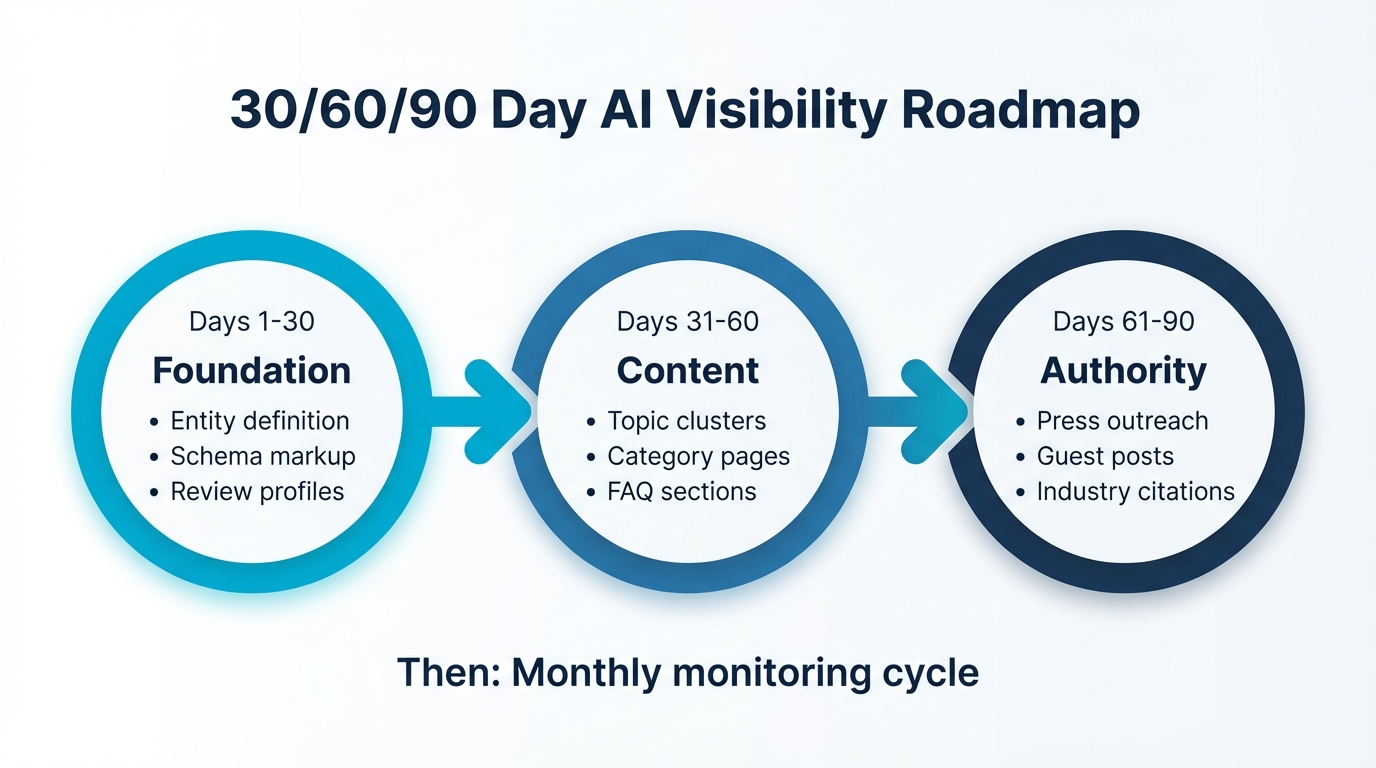
Building AI visibility from scratch is a 90-day operating plan, not a one-time content project. The work has four parts: establish a baseline, make the brand easy to identify, build independent evidence, and measure whether the brand starts appearing in relevant answers.
Short answer: Use days 1-14 to fix access and entity clarity, days 15-45 to strengthen external evidence, and days 46-90 to publish content for the prompts buyers actually use. Run the same prompt set throughout the process so you can distinguish real progress from normal answer volatility.
This roadmap is for a brand that is absent from category and recommendation prompts. If your brand already appears but performs inconsistently, use How to Improve Visibility in AI Search instead.
Before day 1: record the baseline
Do not start with schema or a new article. Start by recording what the major AI products currently say. Without that baseline, a later mention may feel like progress even when it is a one-off result.
Choose 10 prompts that reflect how customers discover and evaluate your category:
| Prompt group | Example | What it tests |
|---|---|---|
| Recognition | "What is [brand]?" | Whether the system identifies the right company |
| Category | "Which companies offer [category]?" | Whether the brand is associated with its market |
| Use case | "What should I use for [specific need]?" | Whether the brand appears for a buyer problem |
| Comparison | "[Brand] vs [competitor]" | Whether positioning and facts are accurate |
| Recommendation | "What are the best [category] tools for [buyer type]?" | Whether the brand enters a shortlist |
Run each prompt three times on the platforms your customers use. Keep the prompt wording, market, and model consistant. Save the answers and citations.
Record five baseline metrics:
- recognition accuracy;
- category mention rate;
- recommendation rate;
- factual errors;
- cited or supporting domains.
The baseline is complete when another person can repeat the same test without guessing what to ask or how to score the answer.
Days 1-14: make the brand accessible and unambiguous
The first phase fixes technical access and identity. Publishing more content before this work is complete can create more conflicting information.
Check crawl and index access
Confirm that important pages return a successful response without a login, JavaScript challenge, or geographic block. Check robots.txt, page-level robots directives, canonical tags, and sitemap inclusion.
Google Search Central recommends using URL Inspection to verify access and check for accidental robots or noindex restrictions. For ChatGPT Search, OpenAI advises publishers not to block OAI-SearchBot. Perplexity publishes separate guidance for PerplexityBot.
Training controls and search visibility are not the same setting. For example, OpenAI distinguishes GPTBot from OAI-SearchBot, and Google states that Google-Extended does not control inclusion in Google Search. Document the policy choice instead of copying a generic robots.txt template.
The access check is complete when:
- the homepage, About page, product pages, and important guides return
200; - each page has one self-referencing canonical URL;
- intended pages are indexable and included in the sitemap;
- the relevant search crawlers are not blocked unintentionally;
- the same content is visible to a crawler and a normal visitor.
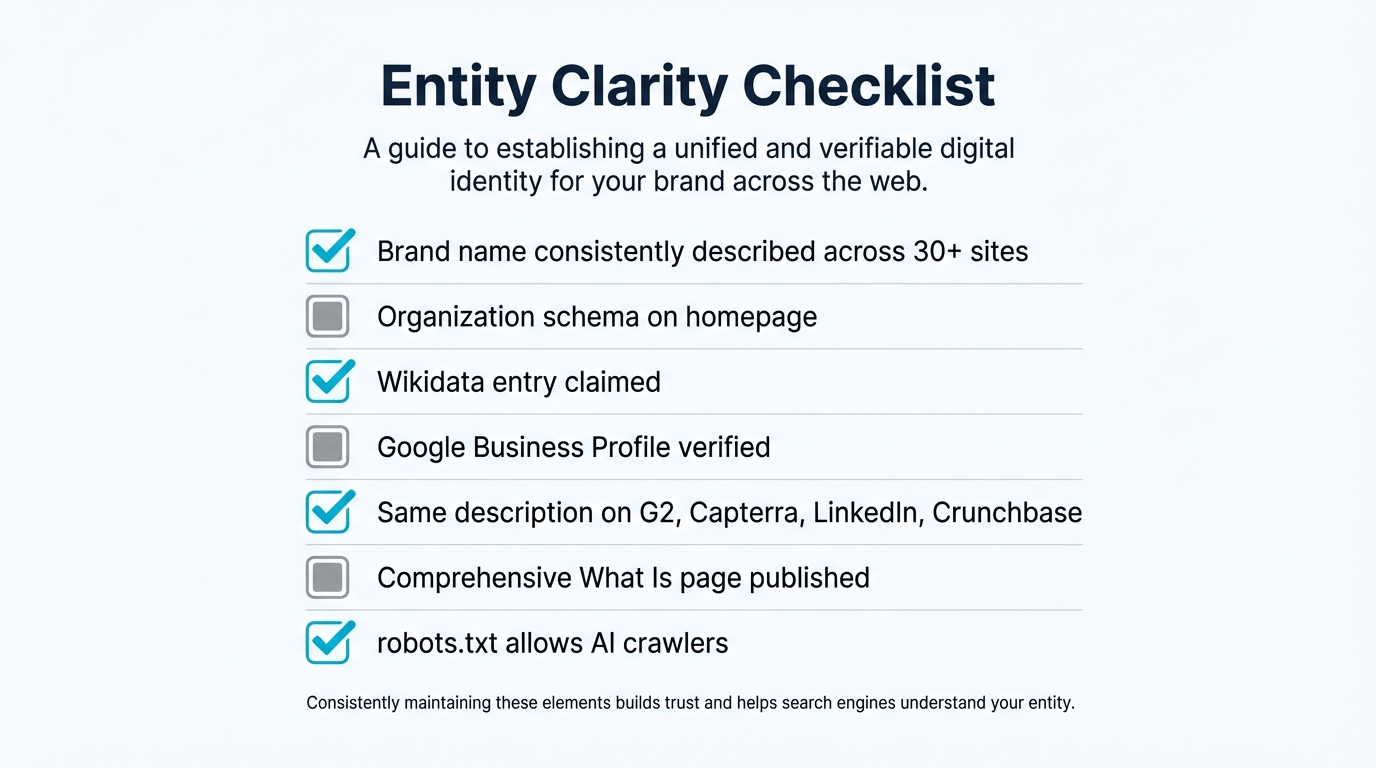
Create one consistent brand record
Write a short factual description that answers:
- What is the official brand name?
- What does the company sell?
- Which category does it belong to?
- Who is it for?
- What is the official domain?
- Which products or former names could cause confusion?
Use the same facts on the homepage, About page, company profiles, review listings, and press boilerplate. The wording can change, but the identity should not.
If the brand shares a name with another company, always include a category or location qualifier where context is limited. Do not create a Wikipedia or Wikidata entry solely for visibility. Those projects have their own sourcing and notability rules.
Add useful structured data
Add Organization schema to the canonical company page and connect it to the official URL, logo, and verified profiles. Add Product, SoftwareApplication, Service, Article, or FAQ markup only when the visible page supports it.
Structured data gives search systems explicit facts about a page. It does not compensate for thin content or guarantee an AI citation.
Day 14 deliverables
| Deliverable | Pass condition |
|---|---|
| Access audit | Important pages are crawlable, canonical, indexable, and in the sitemap |
| Brand fact sheet | Name, category, audience, domain, products, and disambiguation notes are approved |
| Structured data | Markup validates and matches visible content |
| Baseline prompt set | Prompts, providers, markets, and scoring rules are saved |
| Error log | Incorrect AI claims are listed with the answers or sources where they appeared |
Days 15-45: build independent evidence
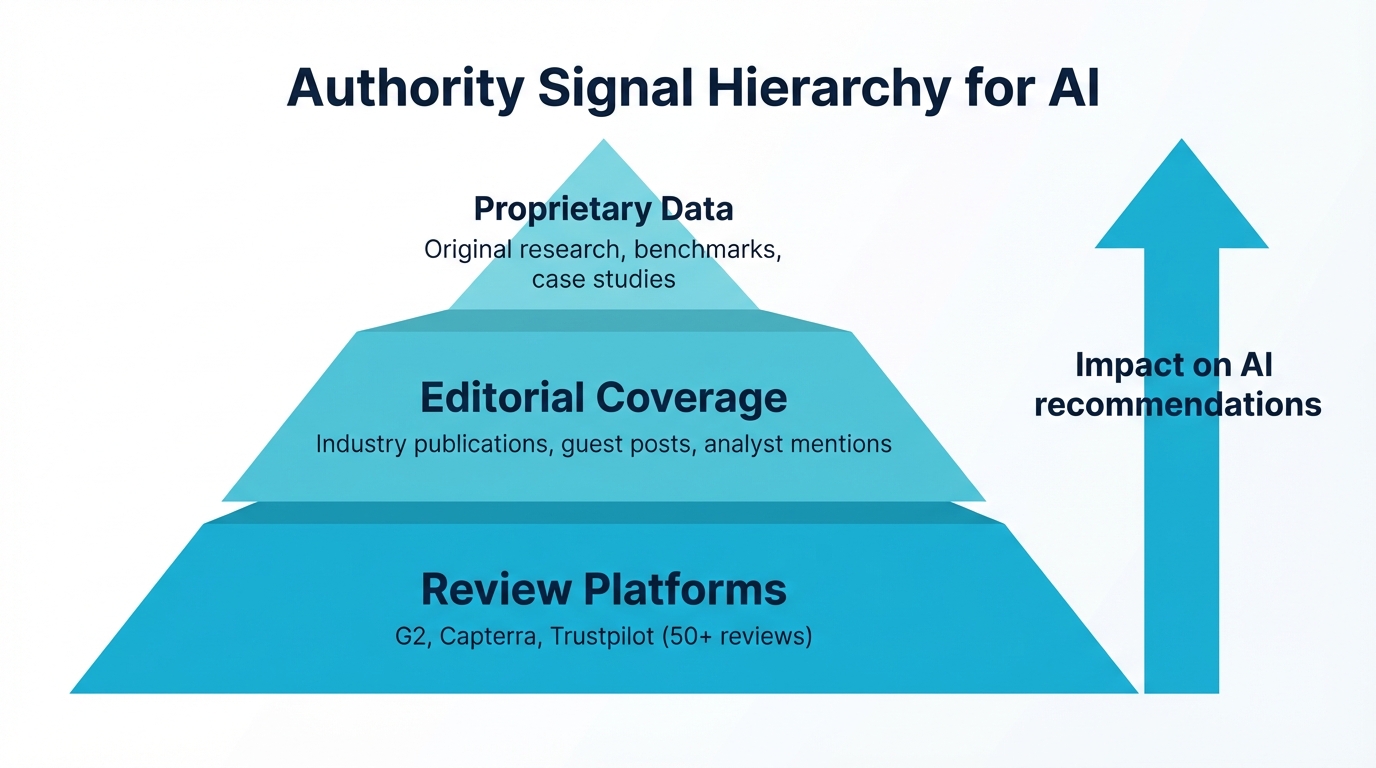
Your own site is neccessary, but it is only one source. Buyers and retrieval systems also encounter review sites, directories, community discussions, product documentation, editorial coverage, and comparison pages.
Fix existing profiles before creating new ones
Find the public profiles that already rank for your brand name or category. Correct old descriptions, domains, screenshots, pricing, and product names where the platform allows it.
Prioritize sources customers already use. A complete profile on the relevant review site is more useful than a dozen generic directory listings.
Ask for genuine reviews
Add review requests to a real customer workflow, such as onboarding completion or a support follow-up. Do not script the opinion or offer incentives that violate the platform's rules.
Track coverage and recency, not just the average score.
A profile with recent, specific reviews gives readers more useful evidence than a dormant profile with a perfect rating.
Earn sources that answer buyer questions
Inspect the sources cited for your 10 baseline prompts. Group them by type:
| Source type | Useful action |
|---|---|
| Comparison article | Offer a factual correction or missing product information |
| Review platform | Complete the profile and invite eligible customers to review |
| Community discussion | Answer questions openly when you have relevant experience |
| Industry publication | Contribute expert commentary or original data |
| Documentation | Publish a clear answer to the technical or implementation question |
Do not treat every citation as a link-building target. The goal is accurate, useful coverage in places a buyer would trust.
Publish one piece of original evidence
Generic advice is easy to duplicate. Original evidence gives other writers and systems a reason to refer to your work.
Choose something the company can support:
- anonymized product usage data;
- a documented benchmark;
- a customer case study with permission;
- a repeatable test and its method;
- a technical reference based on first-hand implementation.
State the sample, date, method, and limitations. If the evidence cannot be checked, don't present it as research.
Day 45 deliverables
| Deliverable | Pass condition |
|---|---|
| Priority profiles | Important listings use current facts and the canonical domain |
| Review workflow | Eligible customers receive a compliant review request |
| Source map | Baseline citations are grouped by source type and prompt |
| Evidence asset | One publishable data set, case study, benchmark, or technical reference exists |
| Correction log | Outdated external descriptions have an owner and status |
Days 46-90: build content around buyer prompts
By this point, the brand should be accessible and consistently described. The next task is to cover the questions that lead to discovery and reccomendation.
Map prompts to the right page type
Do not force every prompt into a blog post.
| Prompt intent | Best page type |
|---|---|
| "What is [brand]?" | Homepage or About page |
| "[Brand] pricing" | Pricing page |
| "[Brand] vs [competitor]" | Balanced comparison page |
| "Best option for [use case]" | Use-case page with proof and constraints |
| "How do I solve [problem]?" | Practical guide or documentation |
| "Does [brand] integrate with [tool]?" | Integration page or technical documentation |
Open each important section with a direct answer, then provide the supporting detail. Use descriptive headings. Cite sources where a factual claim needs support.
For a deeper content framework, read How to Get Your Content Cited by AI.
Strengthen internal paths
Link definition pages to practical guides, guides to product or use-case pages, and comparisons to the evidence that supports them. Use descriptive anchor text.
Internal links should help a reader move from a broad question to a specific decision. Adding dozens of unrelated links does not make the entity clearer.
Repeat the baseline without changing it
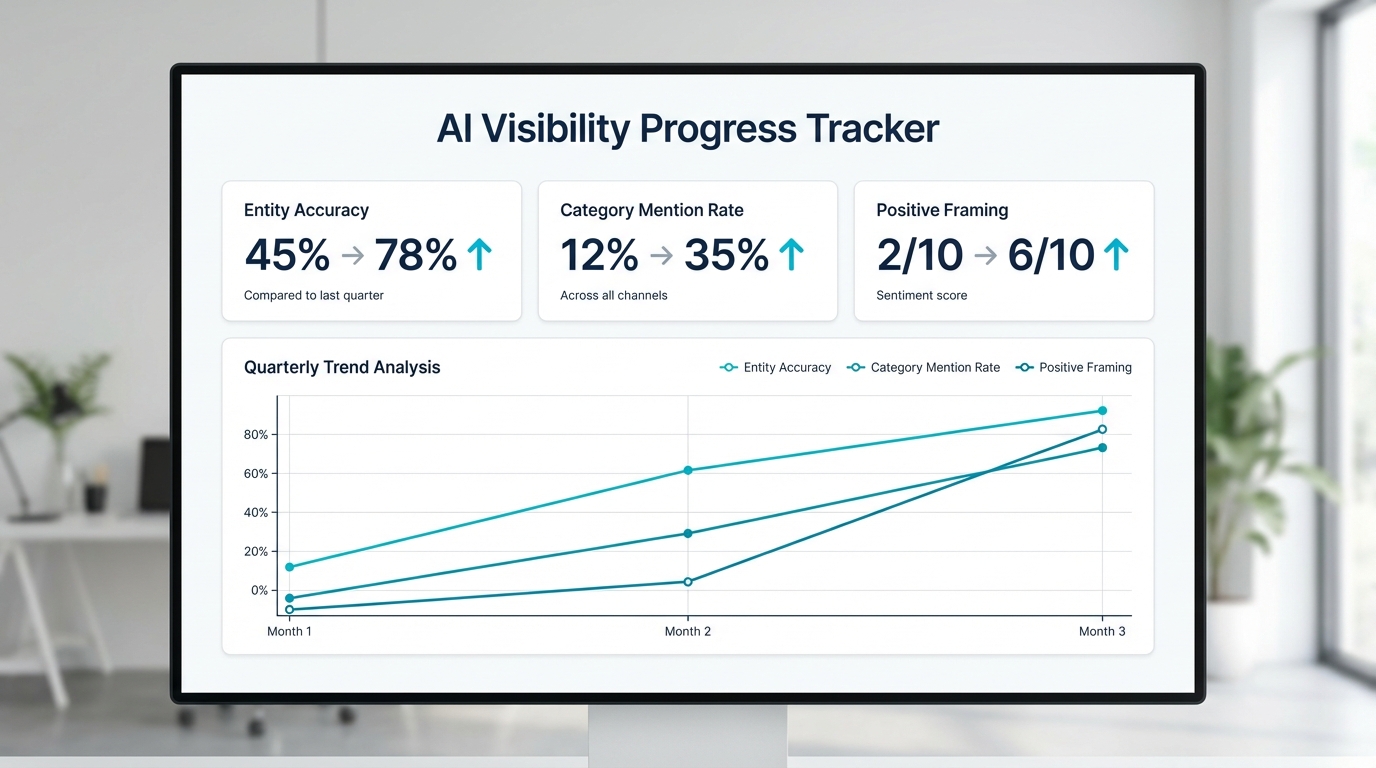
Run the original 10 prompts at days 30, 60, and 90. Add exploratory prompts separately so the core comparison remains stable.
Use this scorecard:
| Metric | Baseline | Day 30 | Day 60 | Day 90 |
|---|---|---|---|---|
| Recognition accuracy | ||||
| Category mention rate | ||||
| Recommendation rate | ||||
| Factual errors | ||||
| Unique supporting domains | ||||
| Stable outcomes across repeated runs |
Do not claim improvement from one answer. Look for a change that persists across repeated runs or appears across more than one provider.
How to act on the results
The scorecard should lead to a specific next action.
| Result | Likely issue | Next action |
|---|---|---|
| Brand is not recognized | Access or entity clarity | Recheck crawl access, canonical facts, and shared-name conflicts |
| Recognized but absent from category prompts | Weak category association | Improve category pages and independent category coverage |
| Mentioned but not recommended | Limited proof for the use case | Add reviews, examples, constraints, and use-case evidence |
| Recommended inconsistently | Weak or uneven supporting evidence | Compare sources and prompt variants before changing content |
| Facts are wrong | Conflicting or stale sources | Correct first-party facts and request external corrections |
| Site is cited but brand is absent | Content ranks without product relevance | Connect the article to a clear, supported brand use case |
What not to do
Do not create fake reviews, seed undisclosed promotional comments, or manufacture reference pages. Do not copy the same company description onto low-quality directories. Do not add schema for information that users cannot see.
Avoid changing the prompt set every week. If the test changes with the result, the trend is not comparable.
Do not promise a 90-day ranking or recommendation outcome. The schedule describes the work you control. Crawling, indexing, source selection, and generated answers remain outside your control.
What a realistic 90-day outcome looks like
At day 90, success does not require appearing in every answer. A useful outcome is more concrete:
- important pages are accessible and correctly indexed;
- the brand is described consistently across owned and priority external sources;
- the team has a repeatable prompt baseline;
- factual errors are declining;
- category mentions or recommendations appear more often than at baseline;
- the sources influencing answers are visible enough to guide the next cycle.
If none of these signals move, review the category target and evidence quality before publishing more content. The issue may be weak demand, an unclear market position, or strong overlap with established competitors.
Frequently asked questions
How long does it take to build AI visibility?
There is no guaranteed timeline. Technical and factual corrections can be completed quickly, while crawling, indexing, external coverage, and changes in generated answers take longer. Use 90 days as an operating cycle, not a promise.
Should a new brand start with content or technical work?
Start with access, canonical URLs, a clear company description, and a baseline. Then publish content for validated buyer questions. More content will not fix an inaccessible site or a confused entity.
Does a brand need Wikipedia or Wikidata?
No. Do not create entries only for marketing. Maintain accurate information on your own site and the reputable platforms relevant to your category. Wikipedia and Wikidata have independent sourcing and notability requirements.
How many prompts should a baseline contain?
Ten well-chosen prompts are enough for a manageable starting point. Cover recognition, category discovery, use cases, comparisons, and recommendations. Consistency matters more than a large prompt list.
Which metrics matter first?
Start with recognition accuracy, category mention rate, recommendation rate, factual errors, and supporting sources. Keep the provider, market, prompt wording, and number of runs visible alongside each result.
Related articles
- What Is AI Visibility?
- SEO vs AI Visibility
- How to Improve Visibility in AI Search
- How to Measure AI Visibility
- AI Visibility for Startups