Google AI Mode is Google's conversational AI search interface that lets users ask follow-up questions in a multi-turn dialogue, receiving comprehensive AI-generated answers with inline source citations. Launched as a distinct experience from AI Overviews, AI Mode represents Google's answer to ChatGPT and Perplexity, and it's reshaping how brands need to think about search visibility.
What Is Google AI Mode?
Google AI Mode is a full conversational search experience built into Google Search. When users activate it, they leave the traditional search results page behind and enter a chat-like interface powered by Gemini.
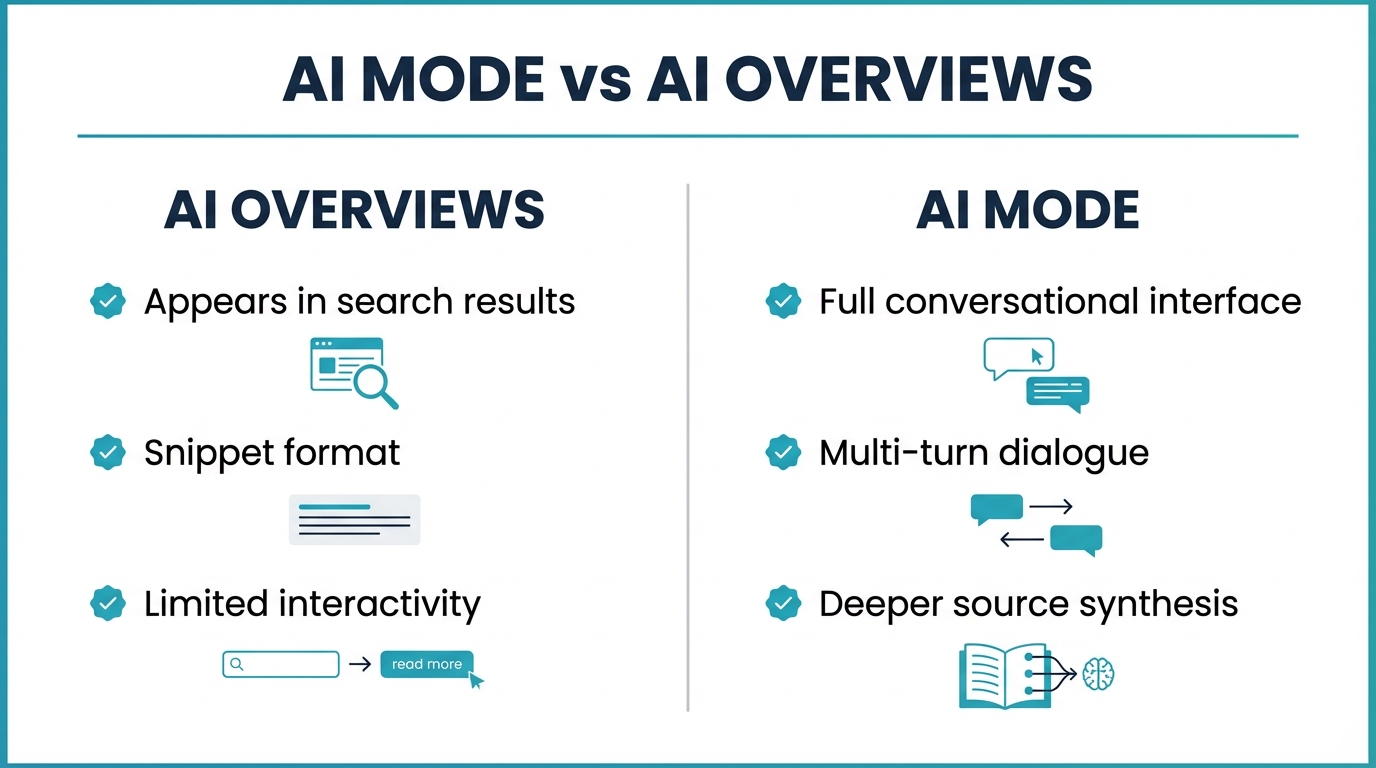
The distinction from AI Overviews matters. AI Overviews are the AI-generated summary boxes that appear at the top of regular search results. They're short, typically 2-4 paragraphs, and users see them alongside traditional blue links. AI Mode is something different: a complete conversational interface where users can ask questions, get detailed answers, ask follow-ups, and go deeper into topics without returning to standard search.
Think of it this way: AI Overviews enhance traditional search. AI Mode replaces it for the duration of the conversation.
Google rolled out AI Mode access through Search Labs and has been steadily expanding availability. According to Google's AI Mode announcement, the feature uses Gemini's latest models and draws from Google's full search index to generate responses.
For brands, this creates a new optimization surface. Your content can be cited in AI Mode responses, driving awareness and traffic from a channel that doesn't follow the same rules as traditional search rankings.
How AI Mode Selects Sources
AI Mode's source selection differs from both organic search and AI Overviews. Understanding the mechanics helps you optimize effectively.
AI Mode uses Gemini models with access to Google's real-time search index. When a user asks a question, the system retrieves relevant web pages, synthesizes information across them, and generates a response with inline citations linking back to the source pages.
Several factors influence which sources AI Mode selects.
Content depth and specificity. AI Mode favors pages that directly answer the user's question with specific, substantive information. Thin content that repeats generic advice gets overlooked in favor of pages with original data, detailed explanations, or unique perspectives.
Source authority. Domain authority still matters, but it's filtered through a different lens. AI Mode draws from authoritative sources within specific topic areas. A niche industry publication with deep expertise can outperform a generalist site with higher overall domain authority.
Content structure. Pages with clear headings, logical sections, and well-organized information are easier for AI systems to parse and cite. AI Mode needs to extract specific claims from your content and attribute them, so content that makes those claims easy to isolate performs better.
Freshness. AI Mode has access to Google's live index, giving it a recency advantage over LLMs limited by training data cutoffs. Fresh content on evolving topics gets weighted more heavily than outdated pages, even if the older pages have stronger backlink profiles.
Optimization Tactics for AI Mode
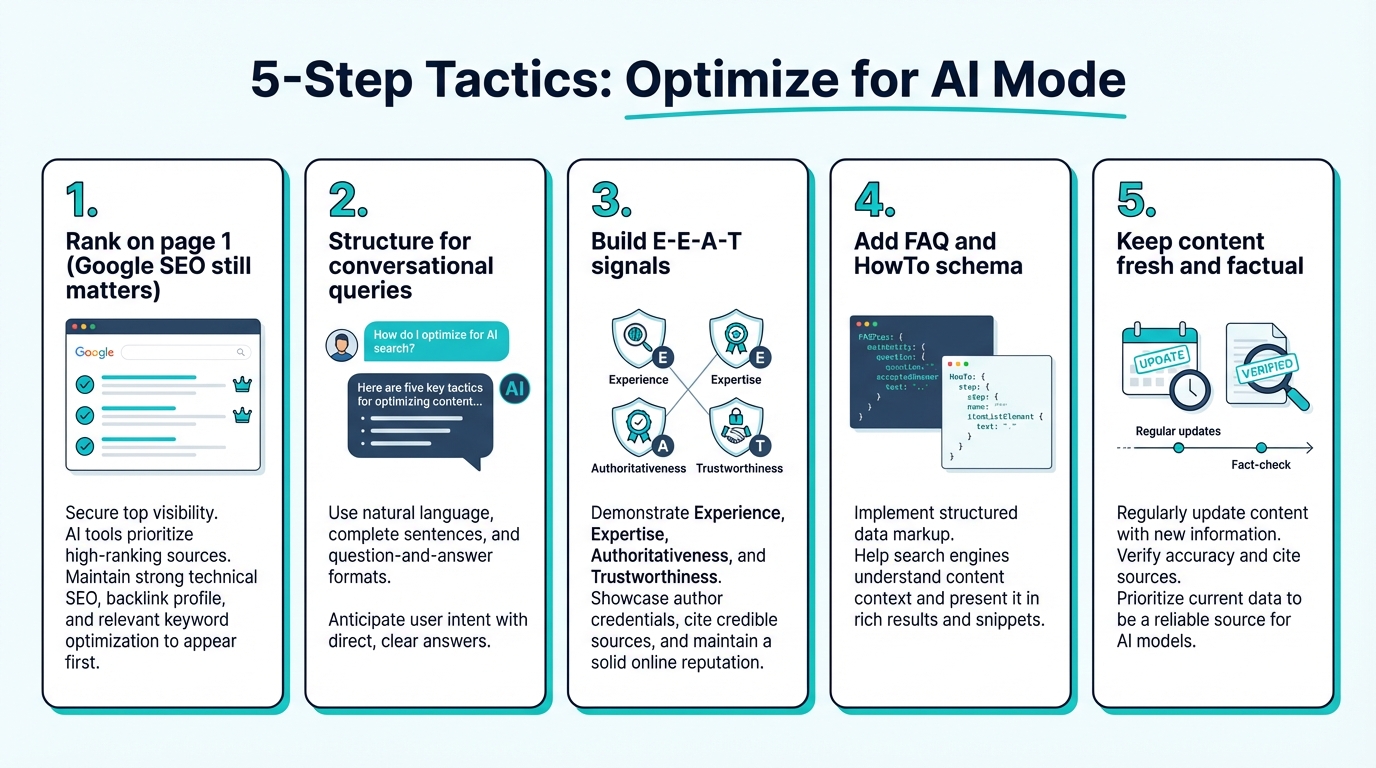
Here's what to do right now to improve your chances of being cited in AI Mode responses.
Write for Question-Answer Patterns
AI Mode is conversational. Users ask questions. Your content needs to answer those questions directly.
Structure key sections of your content as clear question-answer pairs. Use headings that mirror how users phrase questions. Follow each heading with a direct, concise answer in the first sentence or two, then expand with supporting detail.
This doesn't mean converting your entire site into FAQ pages. It means ensuring that every substantive piece of content has clear, extractable answers that AI Mode can cite.
Build Topical Depth, Not Breadth
AI Mode rewards comprehensive coverage of specific topics over superficial coverage of many topics. A 3,000-word guide that thoroughly covers one aspect of your industry is more valuable than ten 300-word posts that skim the surface.
Create content clusters: a pillar page covering a broad topic, supported by detailed pages covering each subtopic. This gives AI Mode multiple citation candidates when users ask related questions, increasing your total citation surface area.
Prioritize Original Data and Unique Insights
AI Mode pulls from multiple sources to synthesize answers. When your content contains original research, proprietary data, or unique analysis that other sources don't have, AI Mode has a reason to cite you specifically rather than any of the other pages covering the same topic.
Publish original surveys, industry benchmarks, case studies with real numbers, and analysis based on your own data. These become citation magnets because no other source has the same information.
Optimize Entity Signals
Ensure your brand entity is well-defined through consistant naming across your web presence, a complete Organization schema markup, and connected profiles on LinkedIn, Wikipedia (if you qualify), and Wikidata. AI Mode uses Google's Knowledge Graph, and strong entity signals improve your brand's recognition within that system.
Maintain Content Freshness
Update your high-value content regularly. AI Mode has access to Google's live index, which means it can see when content was last modified. Pages updated within the past few months get more consideration than pages that haven't changed in two years.
Add dateModified to your Article schema markup and update it whenever you make substantive changes. This signals freshness to both Google's search systems and AI Mode.
AI Mode vs AI Overviews vs Traditional Google
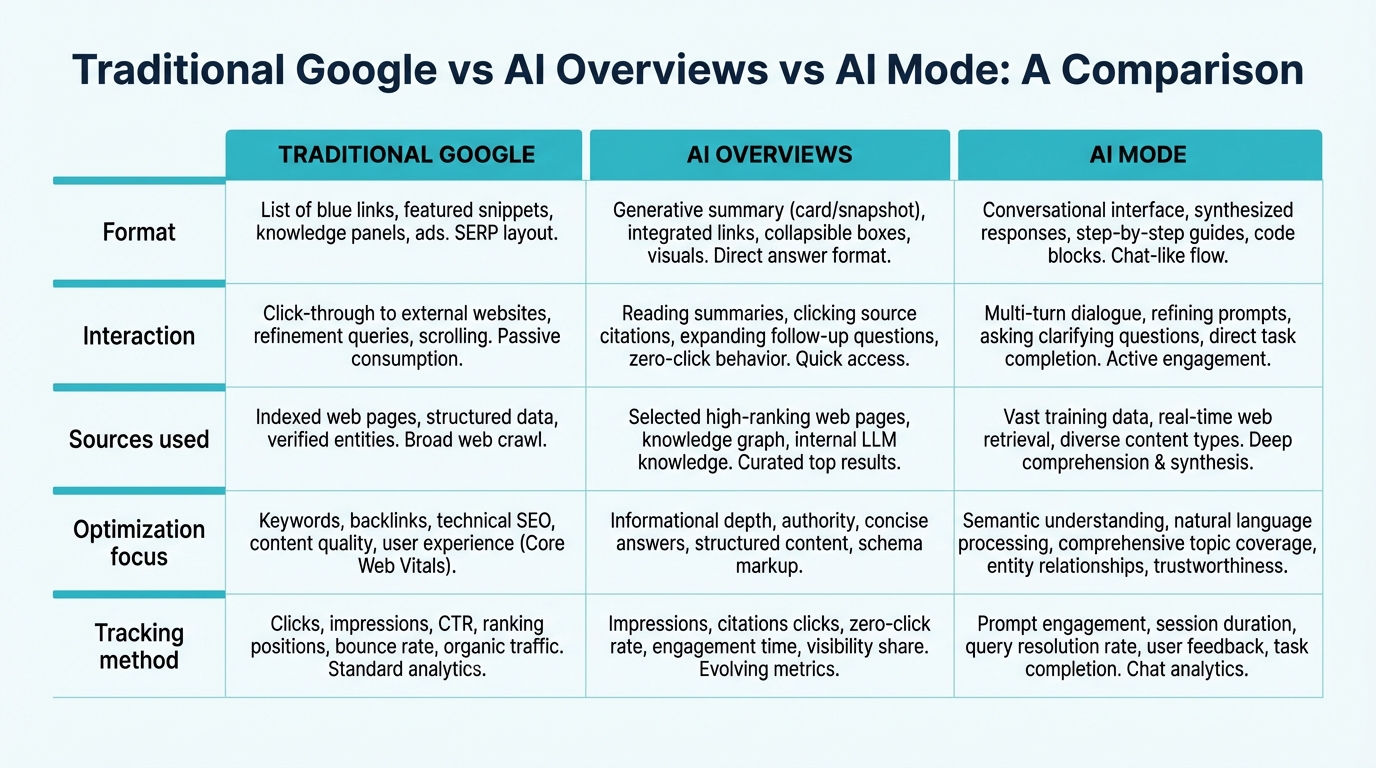
Here's how the three Google search experiences compare from a brand visiblity perspective.
| Dimension | Traditional Google | AI Overviews | AI Mode |
|---|---|---|---|
| Format | Blue links with snippets | AI summary above search results | Full conversational interface |
| User interaction | Click on results | Read summary, may click sources | Multi-turn dialogue with follow-ups |
| Source visibility | 10 results per page | 2-5 cited sources | Multiple inline citations per response |
| Content length consumed | Varies by user | Short summaries | Long-form, detailed answers |
| Follow-up capability | New search required | None (returns to search) | Built-in conversational follow-ups |
| Ranking signals | Traditional SEO factors | Content authority, relevance, structure | Topic depth, recency, entity signals |
| Brand mention format | Title + meta description | Brief citation with link | Inline citation within generated text |
| User intent stage | Varies (informational to transactional) | Primarily informational | Exploratory and research-heavy |
| Traffic impact | Direct click-through | Reduced CTR for informational queries | Citation-driven traffic |
The key takeaway: AI Mode represents a shift from ranking to citing.
In traditional Google, you compete for position. In AI Mode, you compete for inclusion. Being cited once in a detailed AI Mode response can carry more impact than ranking fifth in traditional results, because the citation comes with the AI's implicit endorsement.
Tracking AI Mode Citations
Tracking your brand's presence in AI Mode requires a different approach than traditional rank tracking.
Google Search Console doesn't currently break out AI Mode citations as a seperate data source. This is a known gap that Google may address as AI Mode matures. Until then, you need alternative tracking methods.
Manual monitoring. Enable AI Mode through Google Search Labs and run your target queries. Document which brands are cited, where in the response your brand appears, and how the citation is framed. This works for spot-checking but doesn't scale.
Query coverage mapping. Identify the 20-30 most important queries for your brand. Run each through AI Mode weekly and track whether you're cited, which competitors appear, and whether your citation rate is trending up or down.
Source page analysis. When you are cited in AI Mode, note which specific page on your site was referenced. This tells you which content formats and topics AI Mode favors from your domain, letting you produce more of what works.
For scalable monitoring across AI Mode and other platforms, friction AI tracks your brand's citations across Google's AI features, ChatGPT, Perplexity, and Claude. Instead of manually testing queries, you get automated tracking that shows your citation rate, competitive positioning, and trend data over time.
The brands that move early on AI Mode optimization will have a structural advantage. AI Mode is still rolling out, competition for citations is lower than it will be in twelve months, and the optimization fundamentals, deep content, strong entities, original data, are the same things that build long-term brand authority.
Related Articles
- How to Optimize for AI Overviews
- AEO Explained: The 2026 Guide
- What Is GEO? Generative Engine Optimization