D2C brands live and die by customer acquisition cost. You've spent years building a Shopify store, optimizing Meta ads, and fighting for Google Shopping placement. Now 37% of consumers begin product searches with AI tools instead of traditional search engines, and that number is climbing.
This changes the D2C equation. When a shopper asks ChatGPT "what's the best direct-to-consumer mattress" or "organic skincare brands that ship free," the AI generates a shortlist of 3-5 brands. No ad auction. No bidding war. Either you're on that list or you're not. For D2C brands running on tight margins, showing up in these zero-cost recommendations is the most efficient acquisition channel available.
This guide covers D2C-specific tactics for AI visibility: product feed optimization for Shopify and headless stores, review strategies for brands without Amazon listings, and how to compete with marketplace giants when AI models are choosing who to recommend.
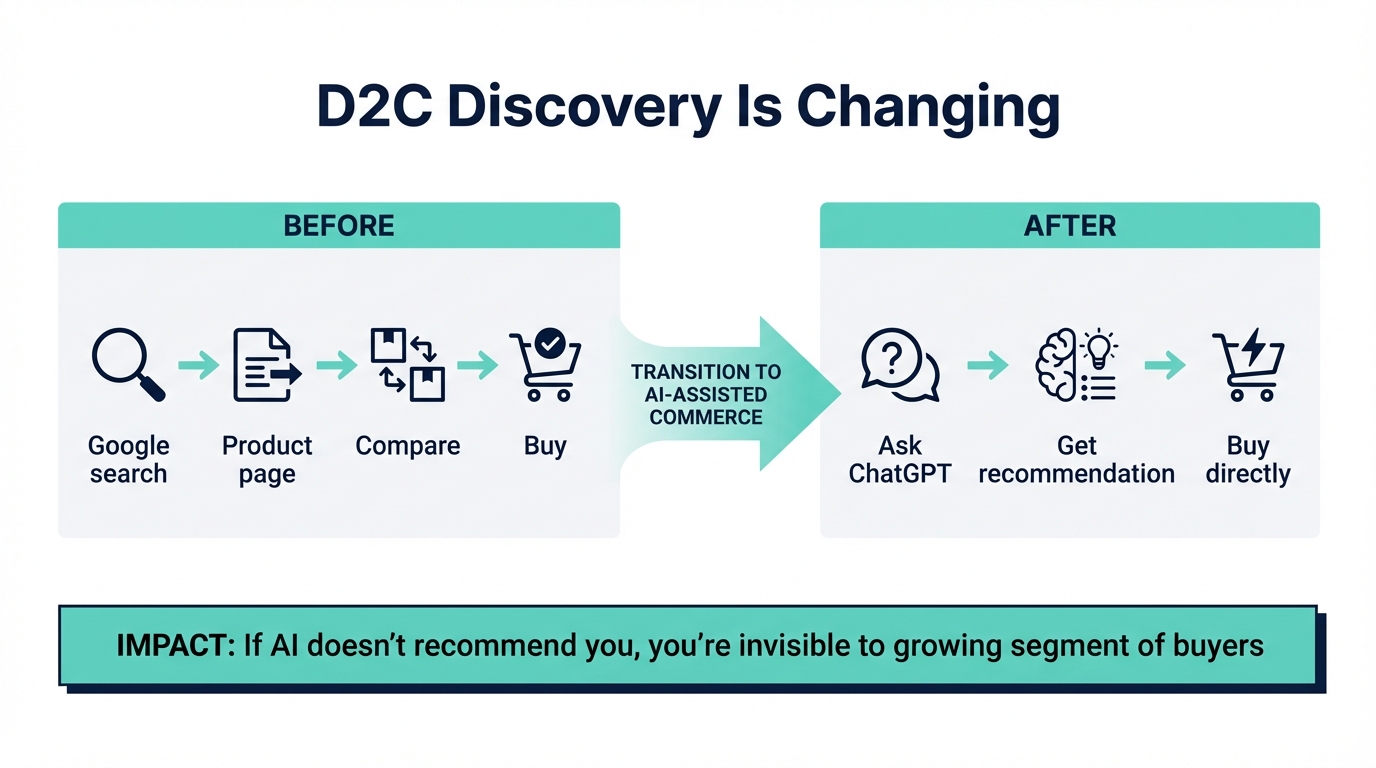
The Discovery Channel Is Changing
D2C discovery has historically been a three-channel game: paid social (Meta, TikTok), Google Shopping, and organic search. AI assistants are now a fourth channel, and unlike the others, you can't buy your way onto the shortlist.
McKinsey estimates that agentic commerce will unlock $240-390 billion in retail value as AI agents handle more of the shopping workflow. Shopify's research confirms the trend among Shopify merchants: AI is reshaping how consumers evaluate and choose products at every stage of the funnel.
For D2C brands, the advantage is structural. You own your brand story, your product pages, and your customer relationships. Legacy retailers have massive SKU counts but diluted brand signals. AI models don't rank by domain size.
They recommend brands with clear product identities, consistant review signals, and structured data that matches what shoppers ask for.
What AI Platforms Look For
AI models recommend products by synthesizing three types of information: review consensus, comparison context, and structured product data. Understanding each one tells you where to focus.
Review consensus
AI models don't read individual reviews the way a shopper does. They look for patterns across review sources. A product with 4.2 stars across six platforms sends a stronger signal than a product with 4.8 stars on a single site.
Comparison context
When a user asks "what's the best organic dog food for small breeds," AI models pull from articles, forum threads, and comparison pages that discuss multiple products together. If your product isn't mentioned on these pages, you're invisible to the recommendation.
Structured data
Product schema markup gives AI models machine-readable information about your product attributes, pricing, availability, and reviews. Without it, models have to infer these details from unstructured text, and they often get it wrong or skip you entirely.
The Review Signal Strategy
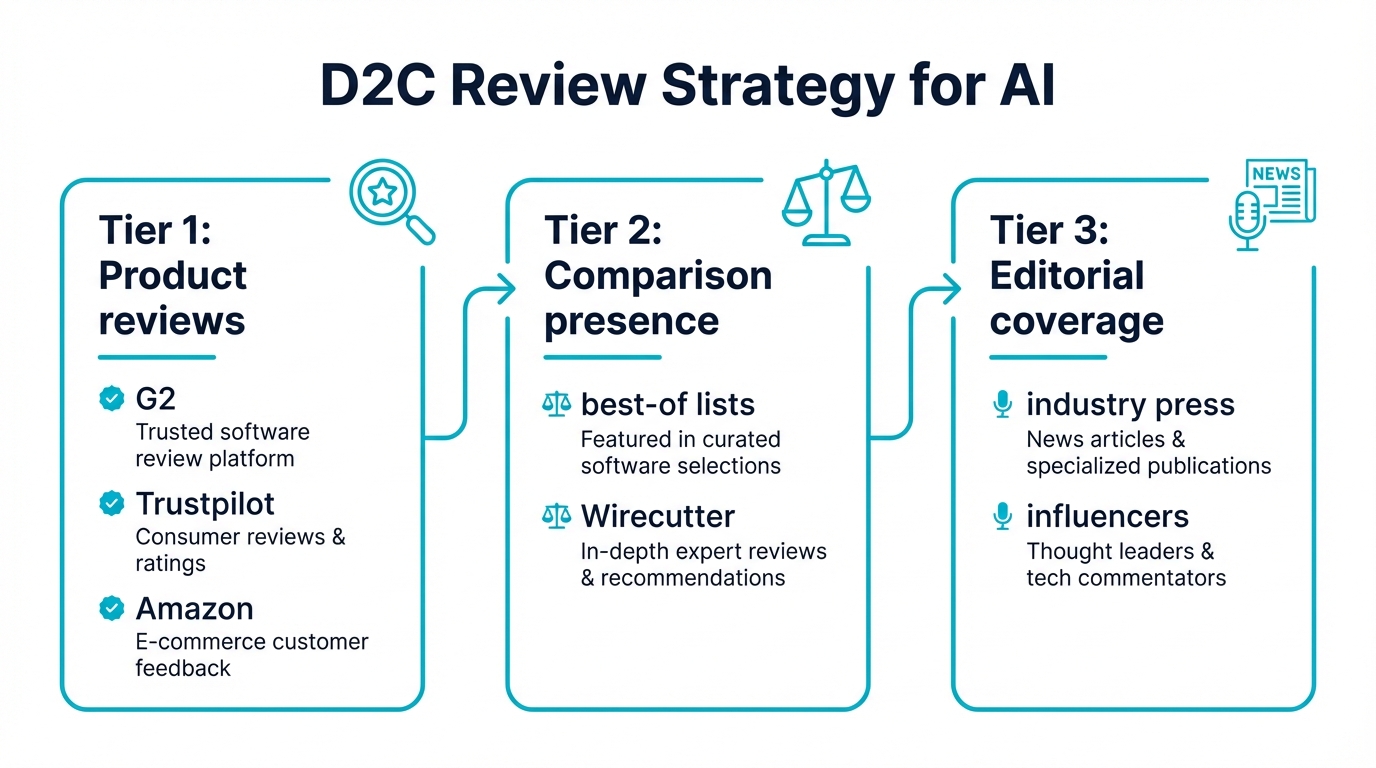
Aggregate review presence matters more than any single review score. AI models cross-reference multiple sources when building confidence in a product reccomendation, so your goal is breadth of coverage, not perfection on one platform.
Prioritize these review surfaces:
- Your own product pages with verified purchase reviews and star ratings
- Amazon and marketplace listings if you sell through any channel partners
- Google Business Profile reviews for brands with a physical or local presence
- Industry-specific review sites like Wirecutter, Reviewed, or vertical-specific publications
- Reddit and forum mentions where real users discuss your product category
Don't chase five-star ratings. A 4.3-star average across five platforms is more persuasive to an AI model than a perfect score on one. The models are trained to recognize authentic review distributions, and a mix of positive and constructive feedback reads as credible.
For D2C brands that sell exclusively through their own store (no Amazon, no retail partners), review breadth is your biggest gap. You may have hundreds of Shopify reviews that AI can't see because their rendered client-side. Ensure your reviews are crawlable, marked up with schema, and syndicated to at least one external platform like Google Business Profile or Trustpilot.
Research from SparkToro shows that AI recommendations are inconsistent and require 60-100 queries to establish patterns. This means a single missing review source could be the difference between appearing in half of relevant queries or none.
Comparison Content: Getting on the Pages AI Cites
AI models cite comparison content more than any other source type when recommending products. If your brand appears on a "Best X for Y" page, you're in the consideration set. If you're absent, you're not.
How to get there:
- Create your own comparison content. Publish honest "Brand X vs. Brand Y" pages on your blog. Include your product alongside competitors with transparent pros and cons. AI models reward balanced, informative comparisons.
- Pitch to existing comparison publishers. Identify the top 10 comparison articles ranking for your product category. Reach out to the editors with product samples and data sheets. Many comparison sites update their lists quarterly.
- Contribute to community discussions. Participate in Reddit threads, Quora answers, and niche forums where your product category is discussed. Don't shill. Answer questions with useful information and mention your product when it's relevant.
- Partner with micro-reviewers. YouTube creators and niche bloggers with 5,000-50,000 followers produce the detailed comparison content that AI models love to cite. Their content often ranks well because it's specific and thorough.
For a deeper look at which comparison sites AI models reference most, see our guide on comparison sites AI cites before recommending.
Product Schema and Feed Optimization
Structured data is the most underutilized tactic in AI visibility for D2C brands. Studies show that structured data increases AI citation rates by 3.2x, yet most D2C sites either lack schema markup or implement it incorrectly.
Start with the Schema.org Product type and include:
- Product name and description in clear, non-promotional language
- Price and currency with
priceCurrencyandpriceproperties - Availability using
InStock,OutOfStock, orPreOrdervalues - Aggregate rating with
ratingValue,reviewCount, andbestRating - Brand as a nested
Brandobject, not a plain text string - SKU and GTIN identifiers when available
- Product images with descriptive alt text
Beyond basic schema, optimize your product feeds for AI consumption. WordStream's schema guide for AI covers the implementation details, but the key principle is this: make every product attribute explicit, machine-readable, and consistent across channels.
Common mistakes to fix:
- Missing
AggregateRatingmarkup even when you display stars on the page - Using generic product descriptions that match manufacturer copy
- Inconsistent pricing between your schema markup and the visible page content
- Omitting the
offersproperty, which tells AI models whether your product is available to purchase
Building a 90-Day D2C AI Visibility Plan
You don't need to do everything at once. Here's a sequenced approach:
Weeks 1-3: Product Data Foundation
Audit every product page on your Shopify/headless store using Google's Rich Results Test. Fix schema errors. Ensure every SKU has complete Product markup with AggregateRating, Offers, Brand, and GTIN where available. If you use Shopify, check whether your theme outputs schema correctly (many don't include AggregateRating by default).
Weeks 4-6: Review Syndication If you're DTC-only with no Amazon presence, this is your highest-priority gap. Set up Trustpilot or Google Business Profile. Use post-purchase email flows to solicit reviews on at least two external platforms. Ensure your on-site reviews are server-rendered and crawlable, not loaded via JavaScript widgets that AI can't parse.
Weeks 7-9: Comparison Content and Outreach Publish three comparison articles targeting your specific product category ("best organic protein powder" not "best supplements"). Pitch to the top 5 comparison publishers in your niche with product samples. Submit to niche directories and gift guides relevant to your D2C vertical.
Weeks 10-12: Measurement Query ChatGPT, Perplexity, and Gemini for your product category and track how often your brand appears. Test variations: "best [category] brand," "[category] recommendations," "where to buy [product type] online." Document which sources are cited and double down on the channels driving mentions.
For more on building authority with AI shopping platforms, read our guide on building commerce authority AI platforms trust.
What Comes Next
This post covers the tactical foundation for D2C AI visibility. For broader context and related strategies, explore these resources:
- How to Build AI Visibility from Zero: The complete framework for brands starting fresh
- Track AI Visibility for Small Brands: Measurement approaches that don't require enterprise tools
- How to Get into AI Shopping Recommendations: A focused look at commerce-specific AI optimization
- How to Get Your Content Cited by AI: The complete framework for earning AI citations
- How to Write Content AI Will Reference: Writing techniques that make your content citable by AI models