When someone asks ChatGPT "what is the best laptop for video editing?" or tells Gemini "recommend a CRM for small teams," those AI tools do not guess. They search the web, scan the results, and build a recommendation from what they find.
If your product pages, buying guides, and landing pages do not show up in those search results, AI will recommend your competitors. Not because your product is worse. Because AI never found it.
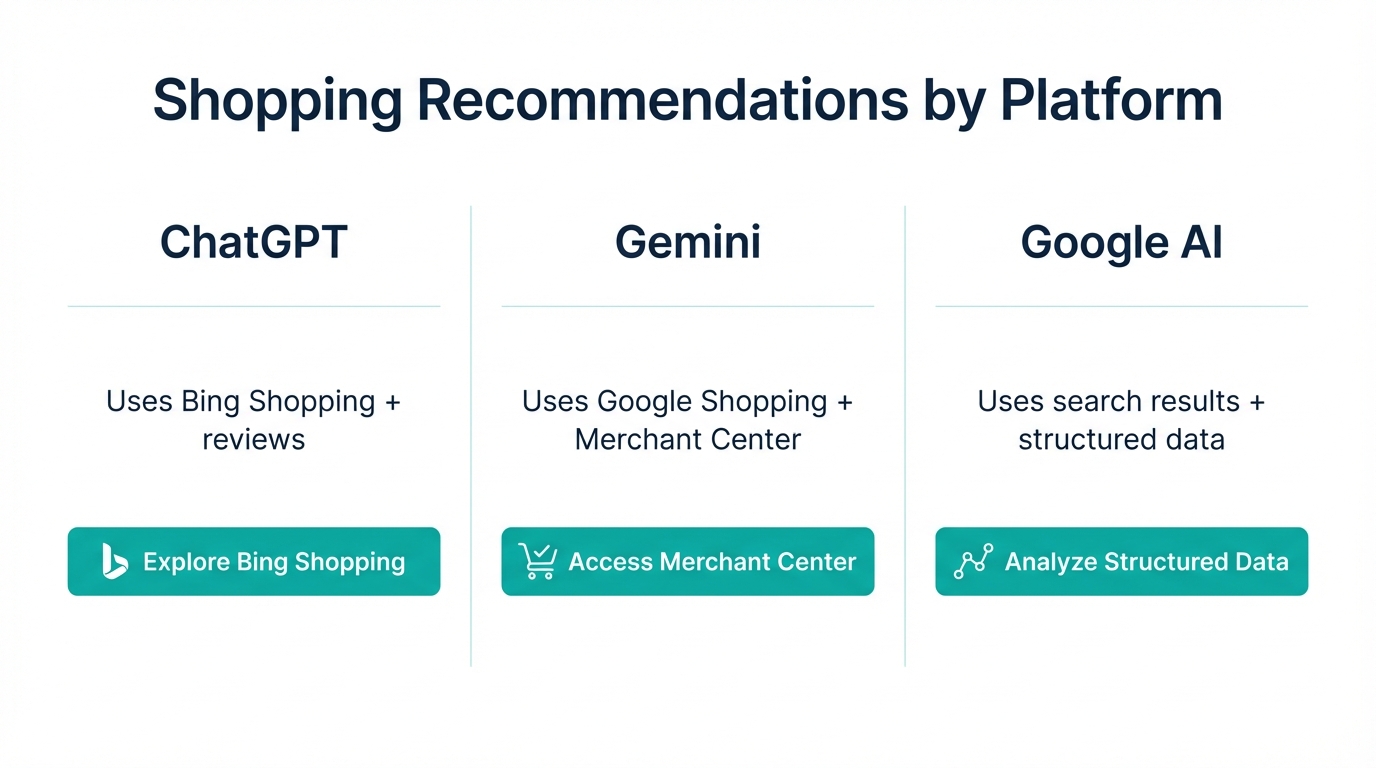
The fix depends on which AI platform you are targeting, because each one searches the web differently and pulls from different commerce ecosystems.
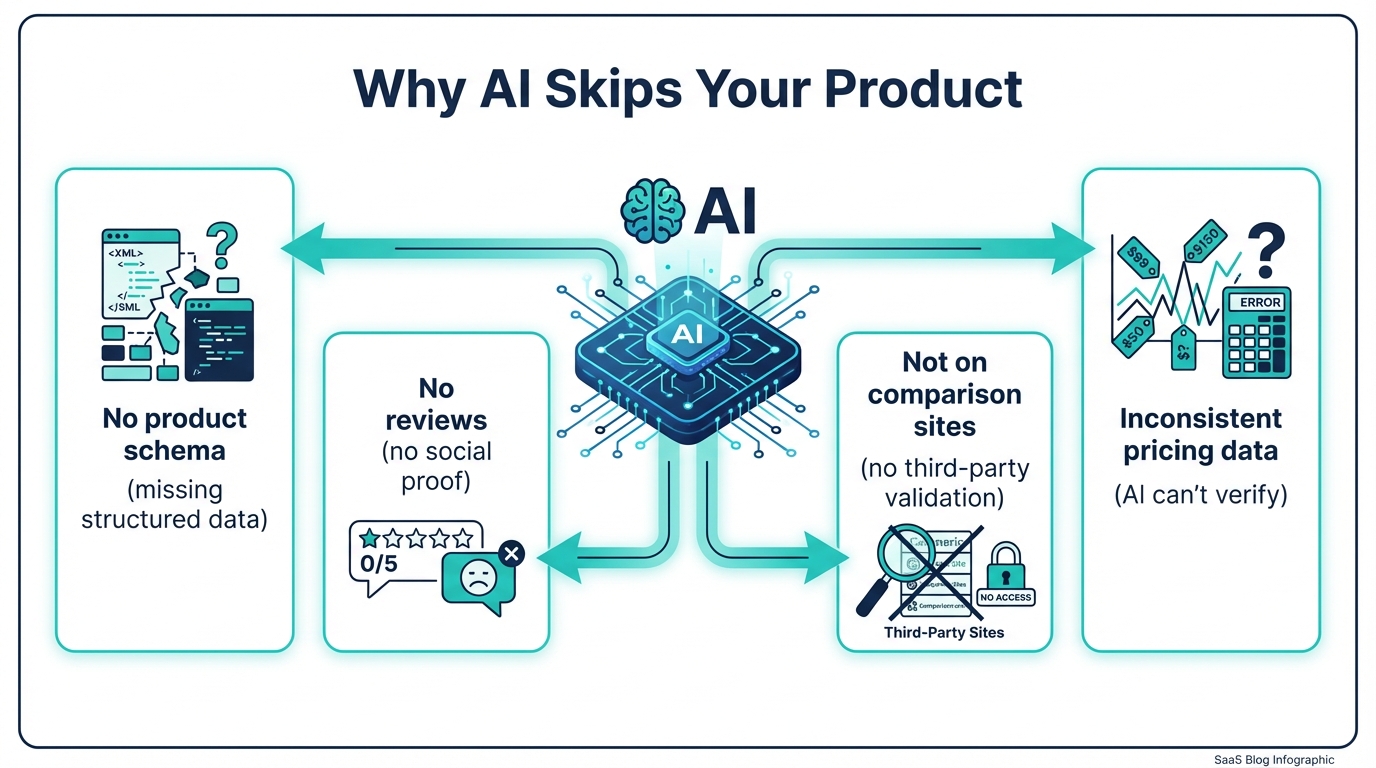
Why AI Skips Your Product
AI models are not browsing your website the way a customer does. They run a search query, get back a list of results, and extract product information from those results.
Your product needs to appear in that search result list, and the page needs to contain the right signals for the AI to pick it up.
Three things cause AI to skip your brand in shopping recommendations:
- Your product pages are not indexed by the search engine the AI uses (Bing for ChatGPT, Google for Gemini).
- Your content does not match buying intent. The AI searched for "best X for Y" and your page is a generic product page without comparison context or use-case specificity.
- No structured product data. The AI cannot extract price, availability, ratings, or product category from your page.
ChatGPT (Powered by Bing)
ChatGPT queries Bing when answering shopping and reccomendation questions. If your products are not visible on Bing, ChatGPT will never recommend them.
What to do:
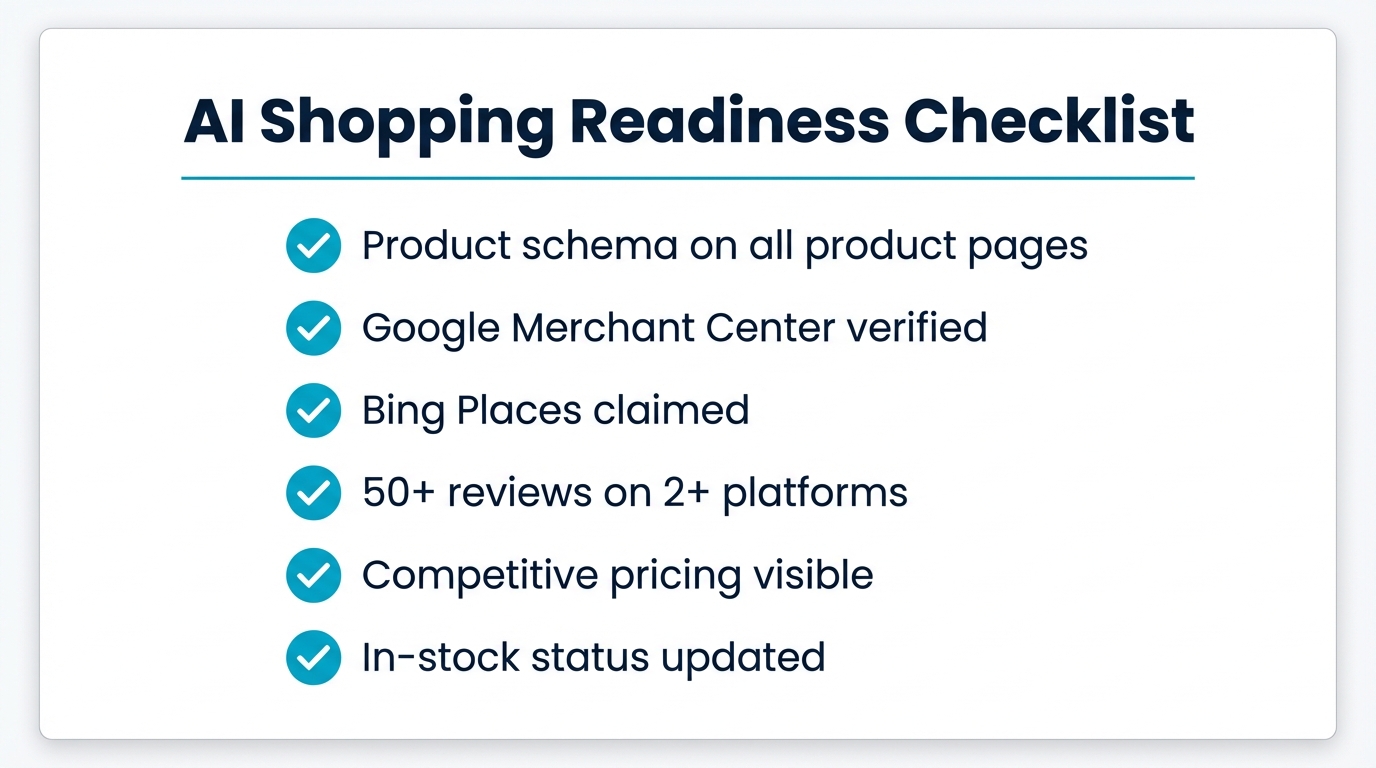
- Set up Bing Merchant Center. Submit your product feed with prices, availability, images, and product categories. This is the most direct way to get your products into Bing shopping results.
- Register with Bing Webmaster Tools. Submit your sitemap and verify that your product pages are indexed. Many brands optimize for Google and forget that ChatGPT uses Bing.
- Create buying guides that Bing can index. Pages titled "Best [category] for [use case]" with your product featured alongside competitors perform well. Bing indexes these and ChatGPT pulls from them when answering comparison questions.
- Optimize product landing pages for Bing. Bing values exact-match keywords, clear page structure, and semantic HTML more than Google does. Make sure your product titles, descriptions, and H1 tags contain the buying keywords people actually search for.
Gemini (Powered by Google Search)
Gemini uses Google Search, with a heavy emphasis on Google's commerce ecosystem. Google Merchant Center, Shopping results, and product structured data all feed into what Gemini recommends.
What to do:
- Set up Google Merchant Center. Submit a complete product feed with accurate pricing, availability, shipping info, and product categories. Gemini draws from Google Shopping data when making purchase recommendations.
- Add Product structured data to every product page. Include
name,price,availability,review, andbrandfields. This helps Gemini extract product information directly from your pages. - Build E-E-A-T signals on your product content. Gemini favors product pages from domains with strong Experience, Expertise, Authoritativeness, and Trustworthiness signals. Customer reviews, expert product descriptions, and detailed specs all contribute.
- Optimize for Google Shopping queries. Search for "[your category] best" and "[your product type] for [use case]" on Google. If your products do not appear in the Shopping tab or in organic results, Gemini will not find them either.
Google AI Overview (Google Search AI Summaries)
Google AI Overview pulls from top-ranking Google results when answering shopping questions. It favors content that directly answers purchase-related queries with structured, snippet-friendly formatting.
What to do:
- Target "where to buy" and "best X for Y" queries. Create pages that directly answer these questions with your product as the recommendation. Use the question as an H2 heading with a clear answer in the first paragraph below it.
- Add FAQ structured data for common buying questions. "How much does [product] cost?", "Where can I buy [product]?", "Is [product] worth it?" These feed directly into AI Overview answers.
- Include pricing and availability on the page. AI Overview extracts pricing data when generating shopping recommendations. If your price is buried behind a "Contact Sales" wall, AI has nothing to show.
Claude (Web Search)
Claude searches the web when answering product recommendation questions. It doesn't rely on a single search engine, so a broad web presence matters more than optimizing for one platform.
What to do:
- Build strong product pages on your own domain. Clear product descriptions, pricing, specifications, and customer reviews. Claude looks for comprehensive, trustworthy product information across the web.
- Get your products listed on major e-commerce platforms. Amazon, marketplace listings, and reseller pages all show up in web search results. The more places your product appears with transaction-ready information, the more likely Claude is to find and recommend it.
- Publish comparison content. "Our product vs [competitor]" pages, honest feature comparisons, and use-case guides help Claude understand where your product fits in the market.
Perplexity (Independent Web Crawler)
Perplexity crawls teh web independently and favors fresh, detailed product content on authoritative domains.
What to do:
- Keep product pages updated. Perplexity prioritizes recently updated content. Update your product pages regularly with new reviews, updated pricing, and fresh feature descriptions.
- Maintain active product listings on authoritative platforms. Perplexity favors well-established e-commerce and review domains. Active listings on Amazon, G2, Capterra, or industry-specific marketplaces help Perplexity find your products.
- Publish product-focused content regularly. Buying guides, product updates, and comparison articles on your blog give Perplexity fresh product content to index and cite.
What Comes Next
Getting your product content into AI search results is the first step. AI also looks at comparison and review sites that validate your product and evaluates your overall commerce authority before making a purchase recommendation. All three work together to determine whether AI recommends your brand when someone is ready to buy.
For the broader picture of how purchase intent works across AI, see our guide on what AI purchase intent means and how to improve it step by step.
Frequently Asked Questions
How can I make a product eligible for AI shopping recommendations?
Publish crawlable product pages with clear names, prices, availability, specifications, images, and policies. Keep merchant feeds and public product data current, then build independent review and comparison coverage where it is editorially appropriate.
Is optimization the same across ChatGPT, Gemini, and Perplexity?
No. These products can retrieve from different sources and present shopping information differently. Maintain accurate source data, then test the systems your customers actually use.
How do I verify whether my products appear?
Create a fixed set of category, use-case, comparison, and constraint prompts. Run each prompt several times, record the model and date, and track mentions, recommendation position, cited sources, and factual accuracy.