There is a difference between AI knowing your brand exists and AI recommending your brand for purchase. The first requires visibility. The second requires commerce authority.
Commerce authority is the collection of signals that tell AI "this brand sells real products that real people can actually buy." Without these signals, AI might mention your brand in a general context but will not recommend it when someone asks for a purchase recommendation.
Think of it this way: if someone asks ChatGPT "where can I buy [your product]?" and there is no pricing, no merchant presence, and no transaction-ready landing page, ChatGPT has nothing to work with. It will recommend a competitor that does have those signals.
What Commerce Authority Looks Like to AI
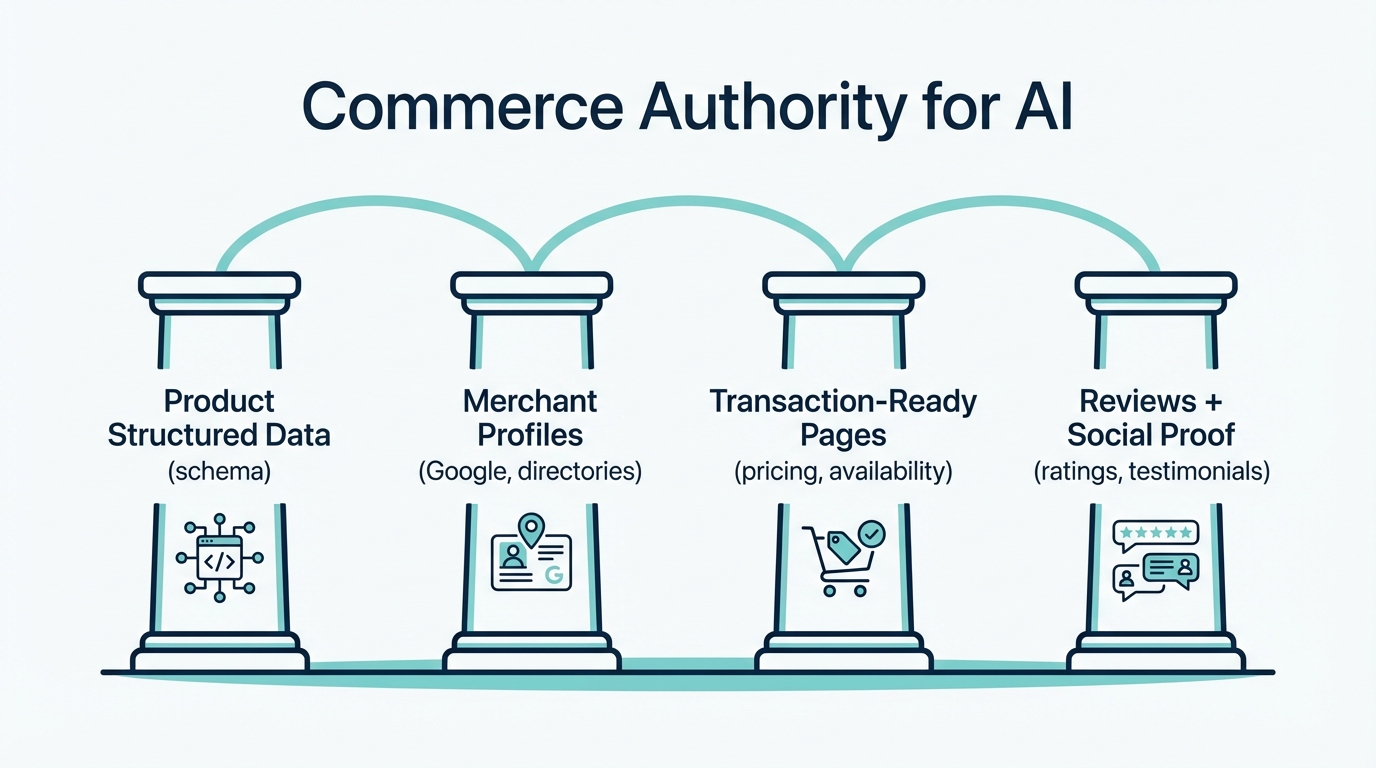
AI models piece together commerce authority from multiple sources. No single signal is enough.
The brands that get recommended consistently have all of these:
- Product structured data on their own website
- Active merchant profiles on commerce platforms
- Transaction-ready landing pages with pricing and availability
- Customer reviews tied to actual purchases
- Consistent product information across every platform
This is the commerce-specific version of brand authority. While brand authority is about being recognized as a legitimate entity, commerce authority is about being recognized as a legitimate place to buy things.
Product Structured Data
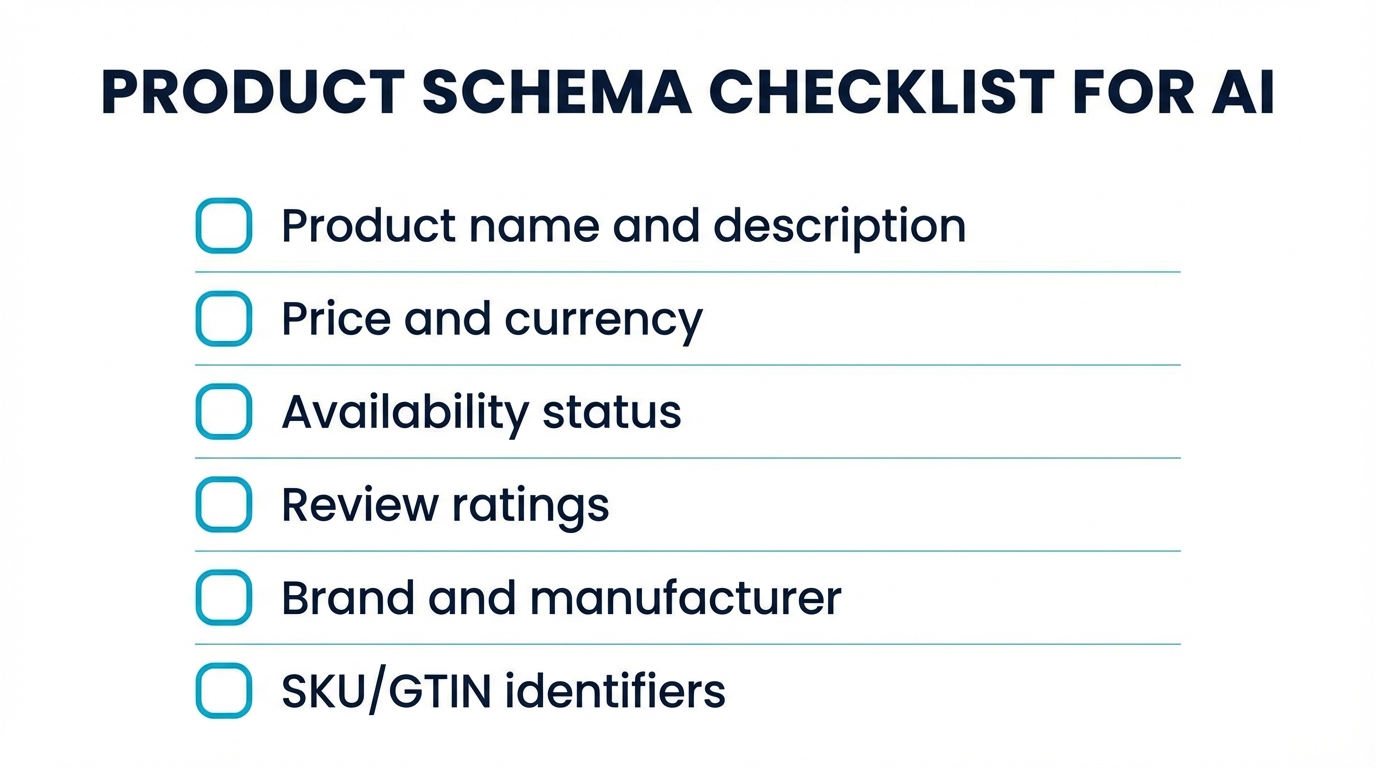
Structured data is teh single most impactful thing you can do for AI commerce authority. It gives AI a machine-readable description of what you sell, how much it costs, and whether it is available.
- Implement Product schema on every product page. Include
name,description,brand,sku,image, andurlat minimum. - Add Offer schema nested inside Product. Include
price,priceCurrency,availability(InStock, OutOfStock, PreOrder), andseller. This is what AI extracts when answering "how much does X cost?" questions. - Include AggregateRating when available. Star ratings and review counts from real customers signal that people actually buy this product. AI uses this as a trust signal.
- Add Review schema for individual reviews. Detailed, schema-marked reviews are more likely to be cited by AI than unstructured review text.
- Keep structured data accurate and current. Outdated pricing or incorrect availability damages trust with both AI and search engines. Automate your product feed updates where possible.
Merchant Profiles
Merchant profiles on commerce platforms serve as independent verification that your brand is a real seller with real products.
Google Merchant Center
- Set up Google Merchant Center with a complete product feed. This feeds directly into Gemini and Google AI Overview purchase recommendations.
- Enable free product listings. Google shows free organic product listings in Shopping results. These are the listings Gemini references.
- Keep your feed synced. Pricing, availability, and product descriptions should update automatically. Stale feeds get deprioritized.
Bing Merchant Center
- Set up Bing Merchant Center separately. ChatGPT uses Bing. If you only set up Google Merchant Center, ChatGPT will not see your product listings.
- Submit your product feed to Bing. The feed format is similar to Google's, but you need to submit it independently.
- Verify your store. Bing requires store verification before showing your products in shopping results.
E-Commerce Platforms
- Maintain active listings on major marketplaces. Amazon, eBay, Walmart Marketplace, Shopify storefront. Each platform appearance adds a commerce signal that AI can find.
- Keep listings complete. Full product descriptions, multiple images, accurate pricing, shipping information. Incomplete listings get less weight.
- Collect marketplace reviews. Reviews on Amazon and other marketplaces are cited by AI as purchase validation signals.
Transaction-Ready Landing Pages
A "transaction-ready" page is one where a visitor can understand the product, see the price, adn take action (buy, sign up, request a quote) without navigating elsewhere.
- Show pricing clearly. "Contact us for pricing" pages are invisible to AI. If you cannot show exact pricing, show starting prices or pricing tiers.
- Include a clear call to action. "Buy now", "Add to cart", "Start free trial", "Get a quote." AI looks for transaction intent signals on pages.
- Display shipping and return information. These signals tell AI that this is a real commerce operation, not just an informational page.
- Feature customer reviews on product pages. Reviews tied to product pages (not a separate testimonials page) create stronger commerce signals.
Provider-Specific Considerations
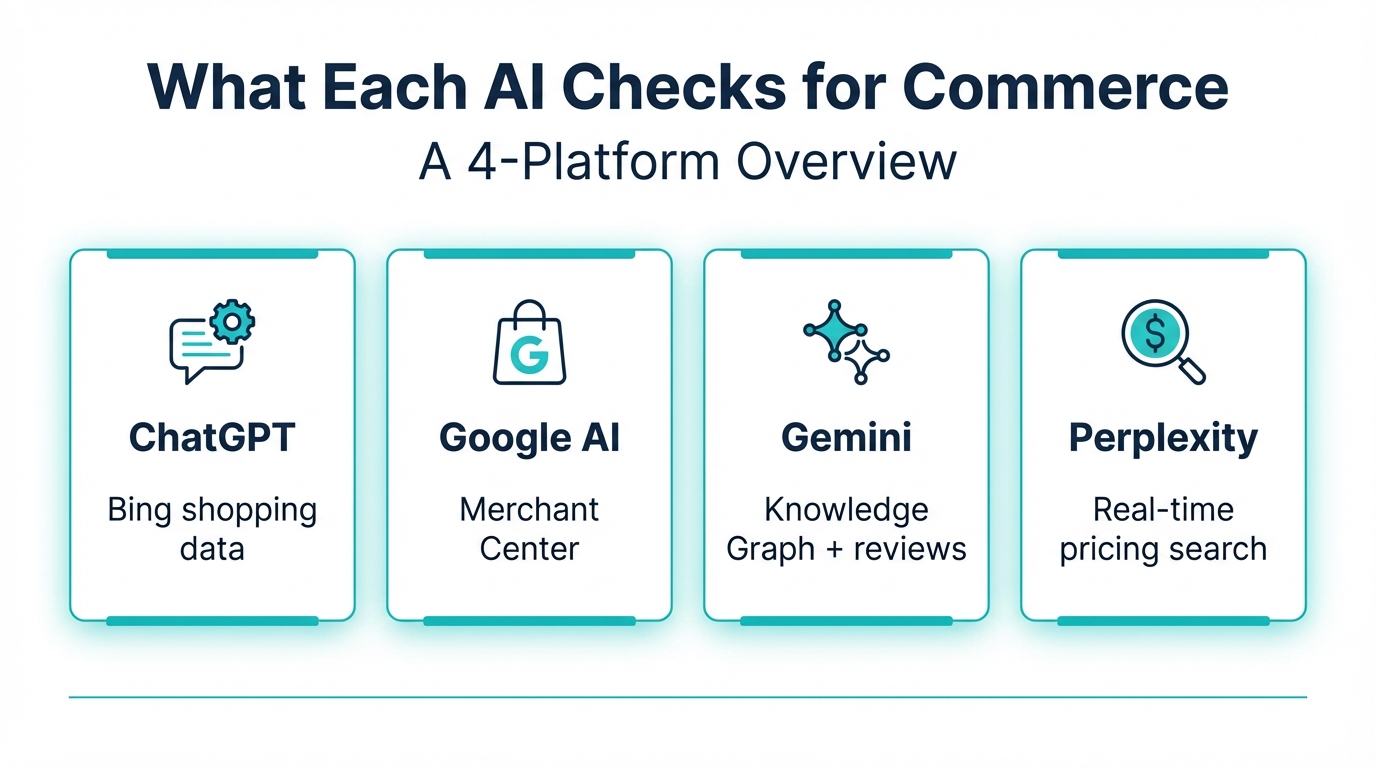
Each AI platform pulls commerce signals from different ecosystems:
- ChatGPT relies on Bing's commerce index. Bing Merchant Center, Bing Shopping results, and Bing-indexed product pages are your primary levers.
- Gemini uses Google's commerce ecosystem. Google Merchant Center, Google Shopping, Google Business Profile, and product structured data all feed into Gemini's purchase recommendations.
- Google AI Overview prioritizes product structured data, pricing transparency, and FAQ content about purchasing. FAQ schema with buying questions helps.
- Claude searches the web broadly. Strong product pages, active marketplace listings, and consistent product information across multiple sources matter most.
- Perplexity crawls independently. Active, frequently updated product listings on well-established e-commerce domains carry the most weight.
What Comes Next
Commerce authority works alongside two other levers: ensuring your product content appears in AI search results directly and getting your brand featured on the comparison sites AI cites when making recommendations.
For an overview of how purchase intent works across AI platforms, see our guide on what AI purchase intent means.
Frequently Asked Questions
What is commerce authority in AI platforms?
Commerce authority is how much AI models trust your brand for product recommendations and buying decisions. It's distinct from general brand authority. A brand can have high general authority (AI knows who you are) but low commerce authority (AI doesn't recommend you for purchases). Commerce authority drives purchase-intent queries specifically, where users ask AI what to buy.
How is commerce authority different from brand recognition?
Brand recognition is whether AI knows your brand exists and what category you're in. Commerce authority is whether AI recommends you for buying decisions within that category. Recognition is upstream; commerce authority is downstream. A recognized brand can still have weak commerce authority if its signals don't include review depth, comparison content, and use-case-specific endorsements.
What signals build commerce authority?
Four main inputs. First, review depth across G2, Capterra, Trustpilot, Amazon (whichever fits your category). Second, consistent comparison content positioning you favorably. Third, analyst and expert recognition (Gartner, Forrester, industry publications). Fourth, clear use-case matching in owned content ("best for [specific user] doing [specific task]"). Each signal reinforces AI's recommendation confidence.
How do I measure commerce authority in AI?
Run a purchase-intent query set monthly across ChatGPT, Claude, Gemini, and Perplexity. Queries like "best [category] for [use case]?", "should I buy [brand]?", "[brand] vs [competitor]?". Measure your appearance rate specifically on these buying queries versus informational queries. The gap between informational and purchase-intent visibility is your commerce authority shortfall.
Which AI platforms matter most for commerce authority?
Perplexity drives measurable purchase-intent traffic via GA4 referral. ChatGPT has the largest commerce user base but weaker measurement. Google AI Mode is where Google's shopping intent is consolidating. For most commerce brands, prioritize Perplexity for measurable impact, then ChatGPT for scale, then Google AI Mode for category coverage. Cover all four, weight by your audience's research pattern.