AI visibility for startups means being correctly identified and included when buyers ask AI systems about your category, problem, or alternatives. A startup does not need to match an established company page for page. It needs a clear identity, evidence for a narrow use case, and a repeatable way to measure what buyers see.
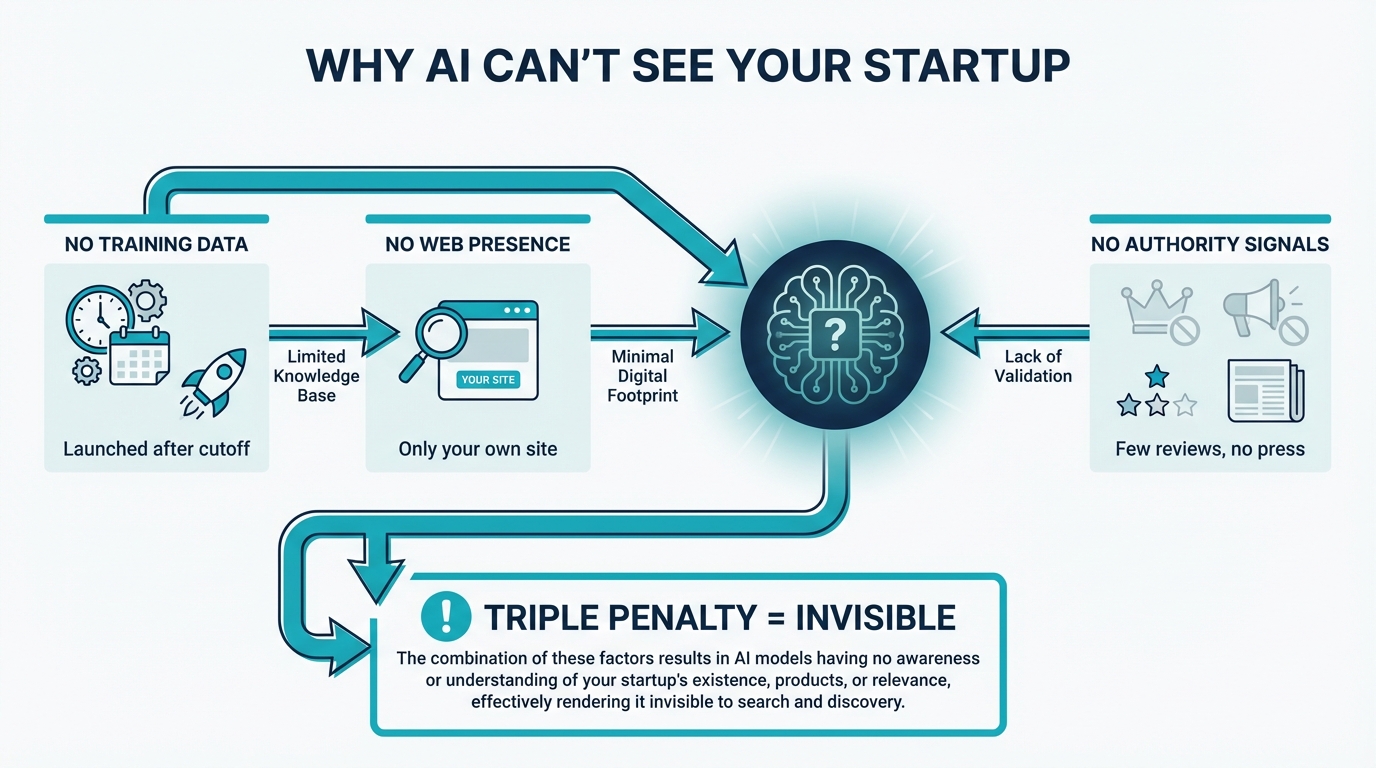
The usual startup constraint is not a lack of blog posts. It is that the public evidence is thin or contradictory. The homepage says one thing, a founder profile says another, and the product has changed since an old launch page was published.
A practical starting point: Make the company easy to identify, choose one category problem you can prove you solve, publish the missing evidence, and test the same buyer prompts each month.
If the company is starting without any measurement process, use the full 90-day AI visibility roadmap. This guide concentrates on the decisions that are specific to a small startup team.
What AI visibility includes
AI visibility is broader than a brand mention. Track four seperate outcomes:
| Outcome | Question to ask | Example measure |
|---|---|---|
| Recognition | Does the system identify the correct company? | Accurate answers to direct brand prompts |
| Category visibility | Does the brand appear for its actual category? | Mentions across a fixed category prompt set |
| Recommendation | Is the brand suggested for a relevant need? | Recommendations across buyer prompts |
| Accuracy | Are the product, audience, and website described correctly? | Factual errors per tested response |
A startup can perform well on one outcome and badly on another. If direct brand prompts are accurate but category prompts never include the company, recognition is not the main problem. The team needs better category evidence.
For the underlying definitions, read What Is AI Visibility? and What Is AI Brand Recognition?.
Why startups need a narrower playbook
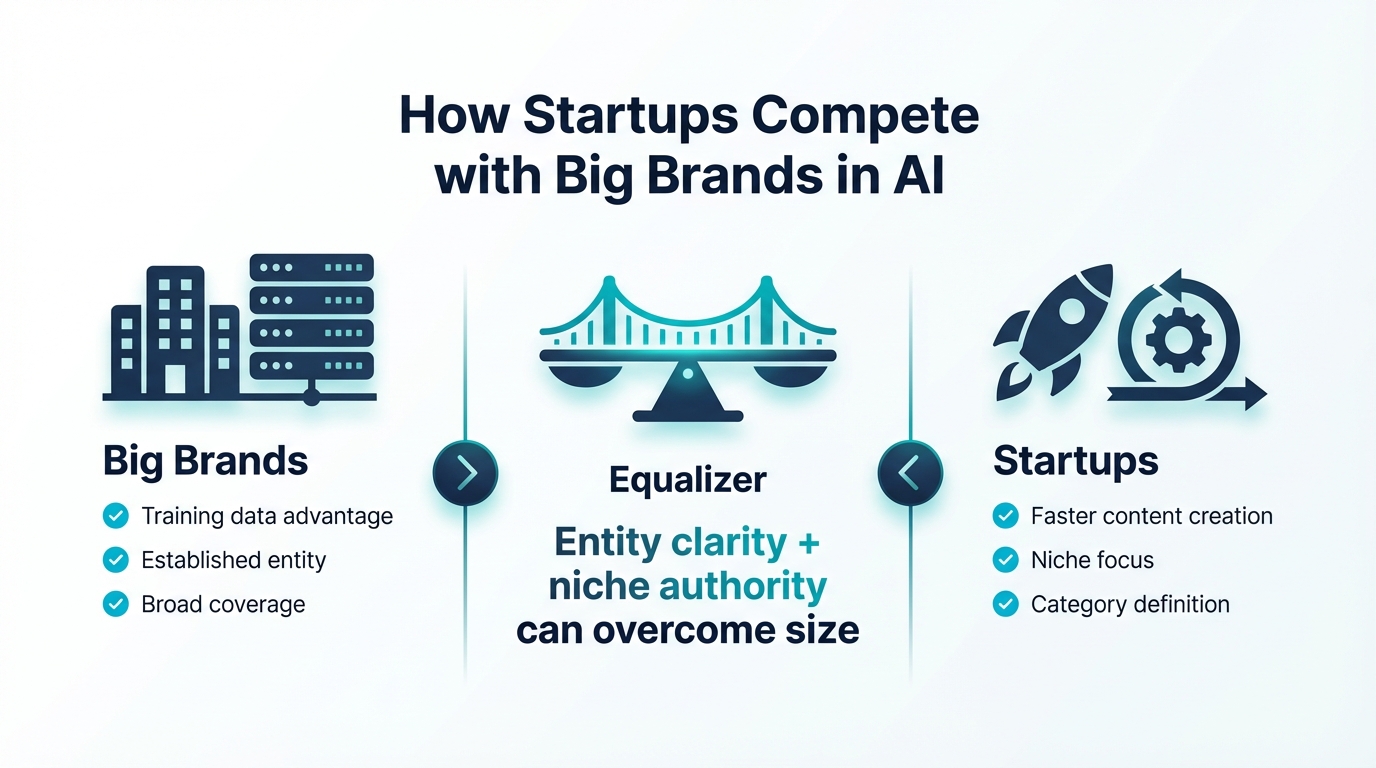
Established companies often have years of reviews, profiles, press, documentation, and customer discussion. A startup has less public history, but it can usually correct its owned pages faster and choose a more precise category position.
That tradeoff should shape the plan.
- Do not compete for the broadest possible category before you can prove a narrower use case.
- Do not publish at enterprise volume if the company facts are still inconsistent.
- Do not create profiles on every directory. Maintain the few that customers and partners actually use.
- Do not treat one favorable AI answer as a trend.
The advantage of a small team is focus. One accurate category page, one credible customer example, and one useful technical reference can answer more buyer questions than a large set of generic articles.
Find the actual constraint first
Run a small baseline before choosing the work. Ask the AI products your buyers use:
- What is [startup]?
- What does [startup] sell?
- What is its official website?
- Which companies offer [narrow category]?
- Which [category] products fit [specific buyer need]?
- What are the strengths and limitations of [startup]?
- [Startup] vs [closest alternative]
Record the provider, model, market, language, prompt, response, and cited sources where citations are available.
Repeat important prompts if you want to measure stability.
Then match the result to the right intervention:
| What the test shows | Likely constraint | First work item |
|---|---|---|
| The system identifies the wrong company | Name or entity ambiguity | Clarify the official name, domain, category, and similar-name relationship |
| The company is correct but the facts are old | Stale source pages or profiles | Update owned facts and priority external profiles |
| Direct prompts work but category prompts fail | Weak category association | Strengthen the category page and independent category evidence |
| The brand appears but is not recommended | Limited proof for the use case | Add customer evidence, constraints, and comparison context |
| Results change sharply between runs | Volatile or uneven evidence | Compare failed runs and sources before changing more pages |
This diagnosis prevents a common waste of time: publishing another article when the homepage still leaves the product category unclear.
Pick a category you can prove
A young company may describe itself with a broad market label because the market sounds larger. AI visibility work exposes the problem quickly. Broad labels create prompts with more established competitors and require more evidence.
Choose a primary category that matches the product customers can use today. Then define one or two narrower use cases.
For example, the planning exercise can use this structure:
| Level | Question | Your answer |
|---|---|---|
| Category | What type of product is this? | |
| Audience | Who buys or uses it? | |
| Job | What specific task does it help with? | |
| Constraint | When is it not a fit? | |
| Proof | Which page or customer example supports the claim? |
The constraint line matters. A page that explains when the product is not appropriate is more useful to a buyer than a page that claims universal fit.
Once the category is agreed, use it consistently on the homepage, About page, product pages, app listings, and founder profiles. The wording can vary. The underlying identity should not.
Build the minimum credible brand record
The company should have a small set of pages that answer basic factual questions.
Homepage
Open with the official brand name, product category, intended customer, and main job. A visitor should not need to decode a slogan to understand what the company sells.
About page
Explain the company, founding team, location or markets where relevant, and relationship between the legal company and product brand. Document former names or domains if they still appear publicly.
Product or category page
Describe the product, use cases, requirements, integrations, and limitations. Support claims with screenshots, documentation, or customer evidence where appropriate.
Organization structured data
Google's Organization structured data documentation describes properties that can help identify an organization, including name, url, logo, and relevant sameAs profiles. The markup should match the visible page and use only profiles that represent the company.
Structured data clarifies information. It does not create reputation or guarantee inclusion in an answer.
Check access without mixing up crawler controls
Important company and product pages should return a successful status, use the intended canonical URL, appear in the sitemap, and remain free of accidental noindex directives.
Review each provider's current documentation before editing robots.txt. Search crawling and potential model-training collection may use different controls. OpenAI documents OAI-SearchBot and GPTBot separately, for example.
A technical check should cover:
- homepage, About, category, pricing, and documentation URLs;
- HTTP status and redirect behavior;
- canonical tags;
- robots directives;
- sitemap inclusion and
lastmod; - whether essential text appears without a login or challenge.
Do not copy a generic list of bot names into production and forget it. Assign someone to review the policy when the site or provider documentation changes.
Build evidence in the order your startup can support
The right evidence depends on the company's stage.
| Startup stage | Evidence to prioritize | Avoid |
|---|---|---|
| Prelaunch or private beta | Accurate product pages, documentation, founder expertise, and a clear waitlist or access policy | Invented customer outcomes or premature review profiles |
| Early customers | Specific use cases, approved case studies, integration pages, and genuine reviews | Anonymous superlatives with no context |
| Funded growth | Category comparisons, partner evidence, public research, and current company profiles | Funding news presented as product proof |
| Expanding markets | Localized product facts, market-specific pages, and regional customer evidence | Translating claims that do not apply in that market |
Not every startup needs Wikipedia or Wikidata. Those projects have there own sourcing and notability rules. Creating an entry solely for marketing can lead to inaccurate or removed material. Maintain the sources you control and earn independent coverage through real work.
If the brand name is shared with another company or common term, use the full name plus category where context is limited. Explain the relationship on the About page rather than relying on repetition across low-quality directories.
Publish for buyer prompts, not content volume
Map each important prompt to the page type that can answer it properly.
| Buyer prompt | Best page |
|---|---|
| What is [startup]? | Homepage or About page |
| Does it support [requirement]? | Product documentation |
| Is it suitable for [use case]? | Use-case page with proof and constraints |
| [Startup] vs [alternative] | Balanced comparison page |
| How does [problem] work? | Practical guide or technical reference |
| What results has it produced? | Approved case study or published methodology |
Open the page with a direct answer. Follow with the evidence, assumptions, and limits a buyer needs. Avoid creating several articles that answer the same question with slightly different titles.
For evidence structure, see How to Get Your Content Cited by AI. For the difference between rankings and generated answers, read SEO vs AI Visibility.
Use founder expertise carefully
Founder-led content can help when it contains experience that the company can substantiate. Useful formats include:
- a technical explanation based on the product's implementation;
- a transparent comparison method;
- a customer problem the team has observed directly;
- original data with its sample and limitations;
- documentation for a difficult integration.
The founder's social post is distribution, not proof by itself. Link readers to a stable page that contains the full method or evidence.
Guest articles and podcast appearances can introduce the company to a relevant audience. Choose them for audience fit and editorial quality, not because a list labels them an "AI authority signal."
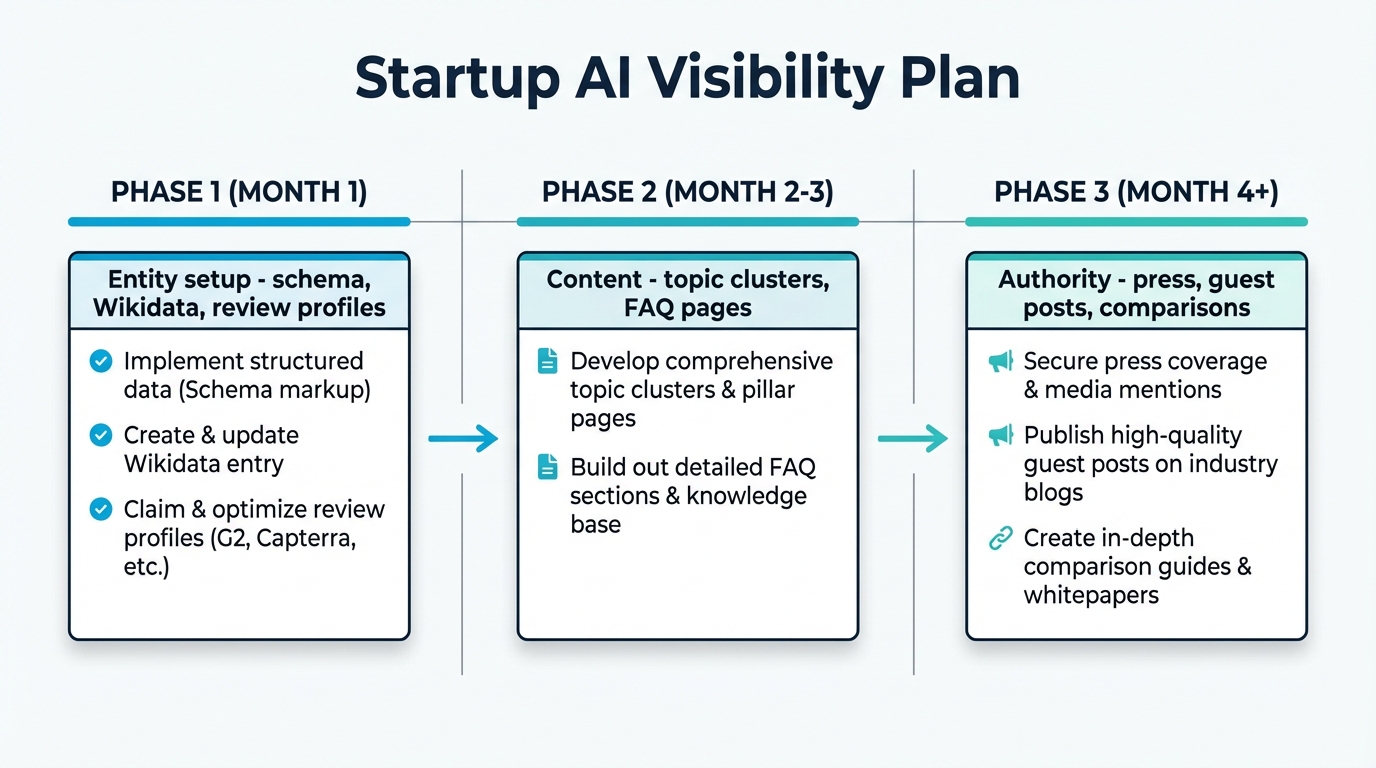
A lean 90-day operating plan
This is a work schedule, not a promise that an AI provider will update within 90 days.
Days 1 to 14: establish the baseline
- Approve the brand fact sheet.
- Run and save the seven baseline prompts.
- Fix material identity and factual conflicts.
- Verify access, canonical URLs, sitemap inclusion, and structured data.
- Choose one narrow category and use case.
Days 15 to 45: publish one missing proof
Choose the highest-impact evidence gap from the baseline:
- a product or category page;
- an approved customer case study;
- an integration reference;
- a comparison with stated criteria;
- a small research or benchmark page with a transparent method.
Publish one complete asset before starting several partial ones. Link it from the relevant product and educational pages.
Days 46 to 75: improve external accuracy
- Correct outdated profiles you control.
- Ask eligible customers for genuine reviews under the platform's rules.
- Give partners current descriptions and URLs.
- Offer factual corrections where an important article describes the product incorrectly.
- Share the new evidence with the audience it was built for.
Days 76 to 90: repeat the baseline
Use the same providers, prompts, markets, and scoring rules. Add exploratory prompts separately.
Compare recognition accuracy, category mentions, recommendations, factual errors, cited sources, and stability. Choose the next work item from the failed prompts rather than from a generic content calendar.
Keep a small scorecard
One row per prompt and provider is enough:
| Provider | Prompt | Mentioned | Recommended | Facts correct | Stable | Sources | Notes |
|---|---|---|---|---|---|---|---|
| Example | Which tools fit [use case]? |
Do not combine everything into one number without keeping the component metrics visible. A startup can improve factual accuracy while reccomendation coverage remains unchanged. That is still useful information, but it calls for a different next step.
For a fuller measurement framework, read How to Measure AI Visibility. Small teams can also use the lower-overhead process in How to Track AI Visibility for Small Brands.
What not to spend time on
Hundreds of generic directory submissions
Complete the profiles that buyers, partners, and search results already surface. A long tail of neglected listings creates maintenance work and more places for facts to drift.
A Wikipedia page the company cannot support
Wikipedia is not a company profile service. If independent sourcing and notability requirements are not met, focus elsewhere.
Publishing several near-duplicate guides
Assign one page to each buyer question. Consolidate overlapping pages or give them clearly different jobs.
Chasing one favorable answer
Generated answers vary. Save repeated observations and compare the same test over time.
Claiming that an edit trained a model
A changed answer after a site update doesn't prove that the edit retrained a model. The answer may reflect retrieval, a model change, prompt variation, or another source.
What a useful first cycle looks like
At the end of the first cycle, the startup should have:
- a consistent public identity;
- one tested category position;
- a saved prompt baseline;
- corrected high-priority profiles;
- one new piece of evidence tied to a buyer question;
- a list of remaining factual and recommendation gaps.
The result does not need to be universal visibility. It needs to be a cleaner public record and a measurement process that tells the team what to do next.
Frequently asked questions
How can a startup improve AI visibility?
Start with a factual baseline. Make the company easy to identify, choose a narrow category the product can support, publish the missing evidence, correct important external profiles, and repeat the same buyer prompts.
Can a startup compete with established brands in AI answers?
It can appear for relevant prompts, especially when the use case is specific and well supported. That does not guarantee recommendation coverage. Measure direct recognition, category mentions, recommendations, and factual accuracy separately.
Does a startup need Wikipedia or Wikidata?
No. Wikimedia projects have independent sourcing and notability requirements. Use accurate owned pages and legitimate profiles, then earn independent coverage through work that is useful to customers or the industry.
How much content should a startup publish?
Publish the pages needed to answer validated buyer questions. A complete product page, comparison, case study, or technical reference is usually more useful than several generic posts aimed at volume.
How long does startup AI visibility take to improve?
There is no reliable universal timeline. The team controls the quality and consistency of its public evidence. Crawling, indexing, source selection, and generated answers operate on provider-specific schedules.
Related articles
- How to Build AI Visibility From Scratch
- How to Measure AI Visibility
- How to Track AI Visibility for Small Brands