You can't edit what AI says about your brand. But you can control the inputs AI uses to form its answer: your structured data, your entity definitions, your knowledge graph presence, the press coverage you earn, and the consistency of your brand narrative across the web.
This post covers both sides of the equation. The proactive work of shaping your brand narrative before AI assembles its answer, through schema markup, llms.txt files, Wikidata entries, and content seeding strategies. And the reactive work of managing reputation when AI already has an opinion, through press coverage, thought leadership, social proof, and direct response strategies.
How AI Forms Brand Perceptions
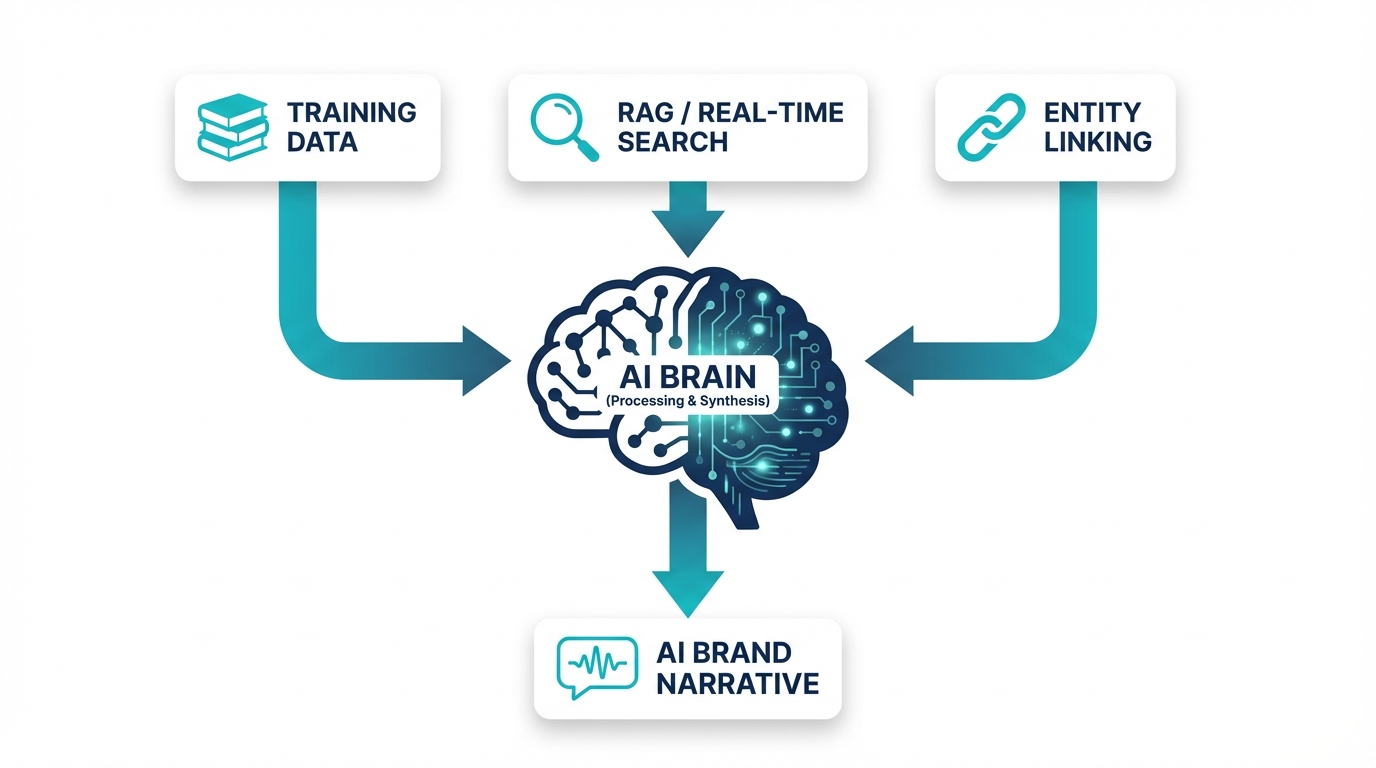
AI models build their understanding of your brand from three sources: training data, retrieval-augmented content, and entity linking.
Training data is the foundation. Large language models absorb billions of web pages during pre-training, forming associations between your brand name and the concepts, sentiment, and claims surrounding it. According to the Wikimedia Foundation, Wikipedia accounts for roughly 3% of GPT-3's training corpus and remains the single most-cited source in ChatGPT responses. Your Wikipedia article functions as a truth anchor for AI.
Retrieval-augmented generation (RAG) adds a real-time layer. Models like Perplexity and Bing Chat pull fresh web content to supplement their base knowledge. This means your published content can influence AI answers within days, not months.
Entity linking is how models connect your brand name to a specific identity. When your brand shares a name with common words or other entities, AI relies on structured signals to disambiguate. Without clear entity signals, models may confuse your brand with something else entirely.
Beyond these three sources, AI also pieces together an impression from:
- News coverage. Positive or negative press from established outlets carries significant weight.
- Social proof. Review scores, testimonials, customer success stories, and social media sentiment all contribute.
- Expert validation. Industry awards, analyst mentions, conference speaking slots, and thought leadership content build credibility.
- Complaint resolution. How you handle problems matters. AI models can detect whether a brand responds to criticism or ignores it.
- Consistency. Brands with a clear, consistent message across channels appear more trustworthy to AI models than those with fragmented or contradictory messaging.
Why Proactive Beats Reactive
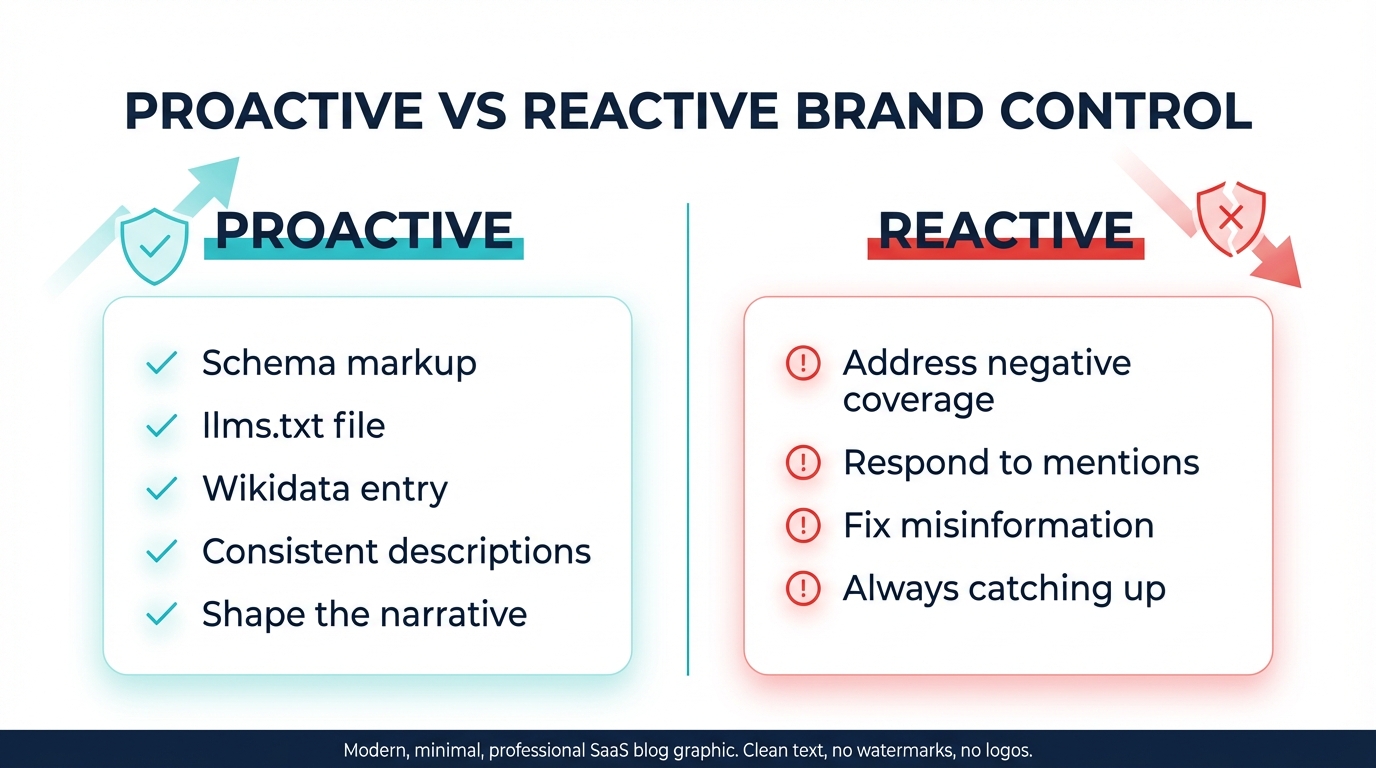
Waiting to see what AI says and then trying to correct it is a losing strategy. The data supports this. Research from MarTech found that owned media is cited 2x more often than earned media in branded AI queries.
That same research revealed a striking gap: only 21% of brands appear in 25% or more of relevant AI-generated answers. The opportunity is wide open.
Meanwhile, Gartner predicts a 25% drop in traditional search volume by 2026 as users shift to AI assistants. If your brand narrative lives only in SEO-optimized pages designed for Google's ten blue links, you're building on a shrinking foundation.
Structured Data as Narrative Control
Schema markup isn't a technical checkbox. It's a direct communication channel between your website and AI models.
Harvard Business Review frames this clearly: brands need to "structure content for machines, not just humans." When your Organization schema includes consistent facts about your company, founding date, leadership, products, and value propositions, you're giving AI a machine-readable version of your brand story.
A Search Engine Land study found that only well-implemented, non-contradictory schema appeared in AI Overviews. AI models treat contradictions as a credibility signal, and not in your favor.
What to Prioritize
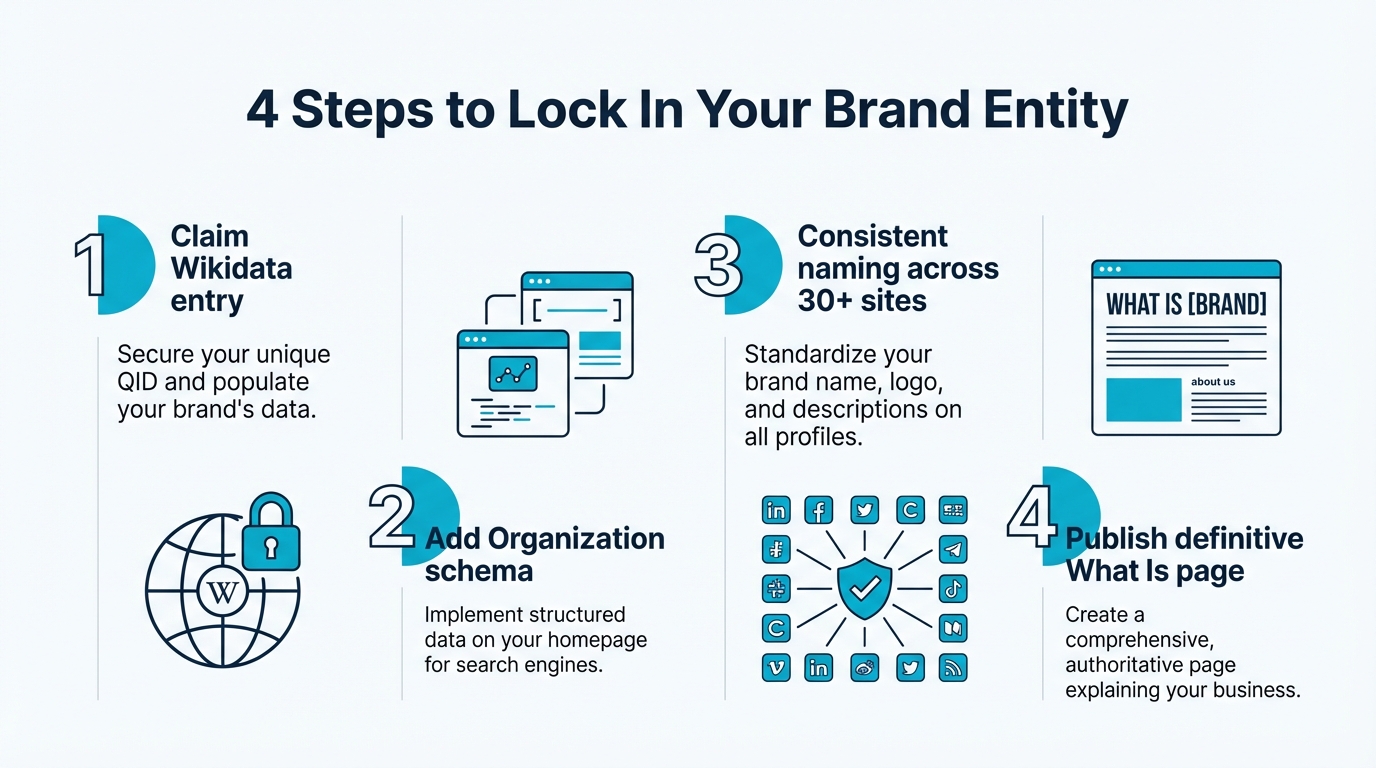
- Organization schema with your official name, description, and founding details
- Product/Service schema that matches the claims on your landing pages
- FAQ schema that preempts the exact questions users ask AI about your category
- Consistent facts across every schema block on your site
llms.txt and Direct AI Signals
A newer tactic is publishing an llms.txt file at your domain root. This file, modeled after robots.txt, provides AI crawlers with a structured summary of what your brand is, what you offer, and how you want to be described.
While adoption is still early and not all models honor it, llms.txt represents the direction the industry is heading: giving brands a sanctioned way to define themselves for AI consumption. Think of it as your brand's elevator pitch, written for an audience that reads every word literally and has no tolerance for ambiguity.
Pair llms.txt with a strong "About" page that uses declarative, factual language. AI models weight authoritative self-descriptions heavily when answering "What is [brand]?" queries.
Entity Definition and Knowledge Graph Presence
Your brand's Wikidata Q-ID is its passport in the knowledge graph that AI models reference for entity resolution. If your brand doesn't have a Wikidata entry, or has one with sparse or outdated information, you're leaving entity linking to chance.
Steps to Lock In Your Entity
- Claim or create your Wikidata item with accurate properties (industry, headquarters, founding date, official website)
- Use consistent naming across every platform: your website, LinkedIn, Crunchbase, Wikipedia, and industry directories should all reference the same brand name and description
- Optimize your Google Knowledge Panel by verifying your business and keeping the information current
- Cross-reference your entities so that your products, founders, and parent company all link to each other in structured databases
Proactive Reputation Building
Earn Positive Press Coverage
Media coverage is one of the strongest reputation signals for AI models.
- Build relationships with journalists in your space. Through genuine engagement, useful data, and expert commentary on trending stories.
- Use platforms like HARO to connect with journalists looking for expert sources. Being quoted as an industry expert builds both personal and brand authority.
- Create newsworthy moments. Product launches, research findings, partnership announcements give journalists a reason to write about you positively.
- Issue press releases for positive developments. Wire services like PR Newswire and Business Wire distribute to outlets that AI models reference.
Publish Thought Leadership
Thought leadership content positions your brand and its people as authorities in your space.
- Publish original research. Surveys, data reports, and industry analysis that others cite create a web of positive authority signals.
- Write for industry publications. Guest posts on established blogs and contributions to industry reports put your brand in a positive context on high-authority domains.
- Speak at conferences and webinars. Speaking slots are cited in event pages, recap articles, and attendee posts, all of which feed into AI knowledge.
- Build author expertise pages. Google's E-E-A-T framework evaluates who is behind the content.
Build Social Proof
- Collect and showcase customer testimonials with structured data where possible.
- Pursue industry awards and certifications. Award mentions on third-party sites create positive data points for AI models.
- Maintain active, positive social media profiles.
- Encourage user-generated content. Customer stories, unboxing videos, and community discussions create organic positive signals.
Reactive Reputation Management
Proactive work is not enough if you have existing negative coverage.
Address Negative Coverage Directly
- Publish your side of the story. A well-written blog post addressing a controversy can outrank or balance the original negative piece over time.
- Do not try to suppress or hide. AI models aggregate information from multiple sources. Trying to bury negative content without addressing it rarely works.
- Update your narrative. If past issues have been resolved, make sure the resolution is documented online.
Monitor and Respond to Brand Mentions
- Set up alerts for your brand name. Google Alerts, social listening tools, and review monitoring services help you catch negative mentions early.
- Respond to criticism professionally. Whether on review sites, social media, or forums, a professional response demonstrates accountability.
- Engage constructively on forums. If negative discussions exist on Reddit, Quora, or industry forums, participate constructively.
Why Does Gemini or Claude Ignore My Brand?
AI platforms like Gemini and Claude ignore brands that lack clear entity signals. If your brand doesn't have a Wikipedia page, consistent descriptions across third-party sites, and structured data on your website, these models can't confidently identify who you are. The fix is platform-specific because each model draws from different data sources.
- ChatGPT draws from Bing search results. Focus on ranking positive content on Bing and maintaining good scores on Bing-indexed review platforms. Use Bing Webmaster Tools to track your brand's Bing presence.
- Gemini relies heavily on Google's E-E-A-T signals. Build your Google Business Profile, pursue a Google Knowledge Panel, and earn mentions from industry authorities that Google trusts.
- Google AI Overview synthesizes from top Google results. Optimize your positive content for featured snippets and direct-answer formats.
- Claude searches the web in real-time. Build a positive presence in well-indexed, high-authority publications, Wikipedia, and industry sources that rank well.
- Perplexity favors fresh, authoritative content. Maintain an active publishing cadence with positive brand narratives on high-authority domains.
The Bigger Picture
Reputation management works alongside two other levers: the content that ranks for your brand queries and your review scores on the platforms AI cites. Together, these three factors determine how AI talks about your brand.
For a structured approach to ongoing reputation tracking, see our guide on AI Brand Monitoring and how to catch AI reputation issues before they spread.
If your brand's issue is not sentiment but visibility (AI does not mention you at all), start with getting into AI search results, building third-party source presence, and establishing brand authority.
Related Articles
- How to Catch AI Reputation Issues Before They Spread
- How to Fix Negative AI Brand Sentiment (Step-by-Step)
- AI Brand Monitoring: How to Track What AI Says About Your Brand