When ChatGPT starts telling users your product has a security flaw it doesn't have, or that your service was discontinued, or that a competitor is "better in every way," the damage is already happening at scale. Every user who asks a related question gets the same misinformation, and unlike a social media post you can report, there is no mechanism to correct an AI response directly.
This post is about early warning and issue detection: how to spot AI reputation problems before they reach your customers at scale. For the full reputation recovery playbook once an issue is confirmed, see managing your brand reputation in the age of AI. This page covers what to watch for, how to build detection systems, and the severity-based response framework.
AI reputation issues are different from social media crises in two critical ways. First, they're invisible: you won't know about them unless you're monitoring. There's no notification, no trending hashtag, no alert from your PR tool. Second, they're persistent: once an AI model absorbs incorrect or negative information, it can take weeks or months to change. The information keeps reaching users while you're figuring out what happened.
Harvard Law School's Corporate Governance Forum found that 191 S&P 500 companies disclosed AI reputation risks in 2025, up 350% from 2023. The risk is real enough that enterprises are reporting it to shareholders. And the speed matters: AI Overview content changes 70% of the time for the same query, with 45.5% of citations getting replaced in each new answer. A reputation issue can spread and mutate faster than traditional media crises.
Early detection is the only viable defense. By the time an AI reputation issue becomes obvious, it has already shaped thousands of conversations.
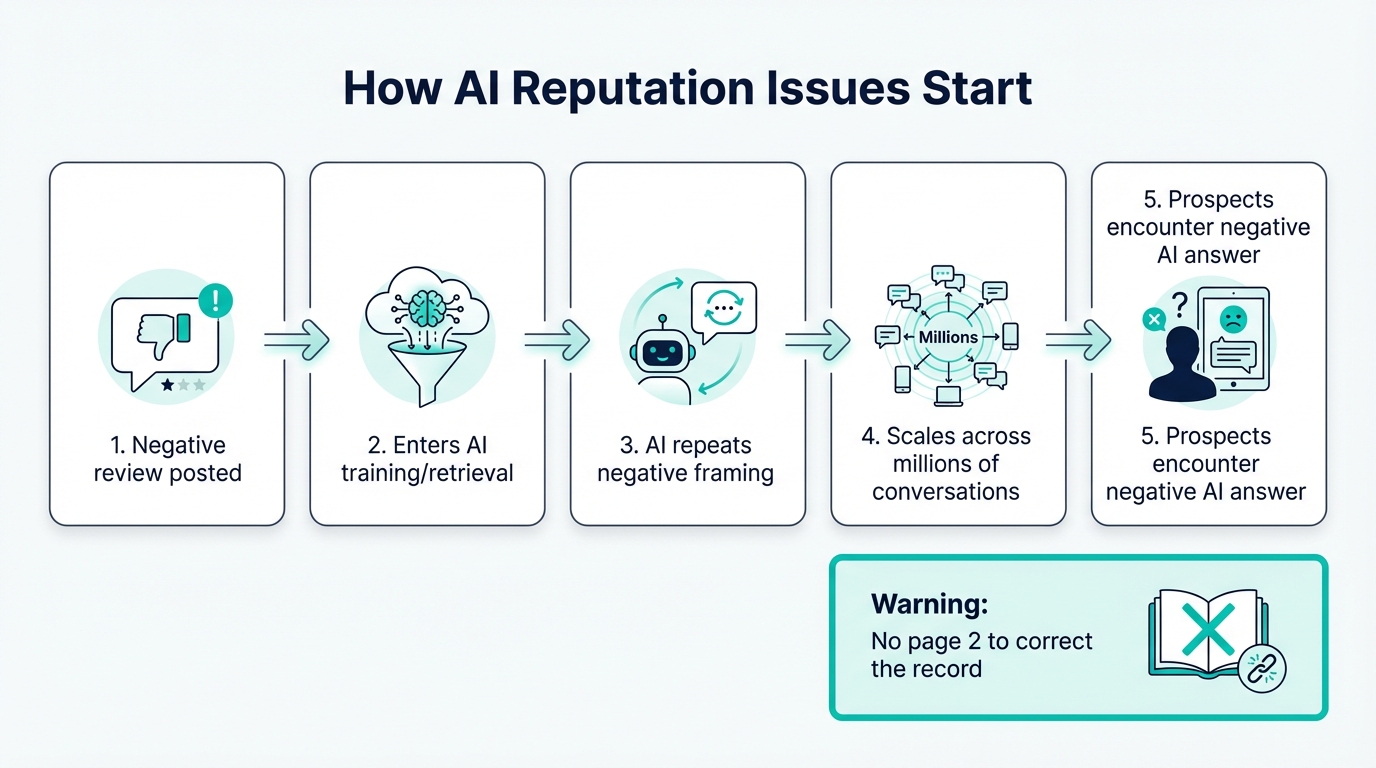
How AI Reputation Issues Start
Understanding the origin patterns helps you know where to watch.
Misinformation Absorption
AI models absorb information from the web without editorial judgment. A single incorrect blog post, an outdated article, or a forum comment that misrepresents your product can become part of how AI describes you.
Without retrieval grounding, GPT-4o hallucinates citations 78-90% of the time. Even with grounding, models can synthesize information incorrectly, combining accurate statements about your brand with inaccurate claims from unrelated sources.
Negative Review Cascades
A wave of negative reviews on G2, Trustpilot, or Google Reviews doesn't just affect your rating on those platforms. AI models that use retrieval-augmented generation can surface review sentiment within their answers. If users suddenly ask "is [your brand] worth it?" and AI starts saying "reviews have been mixed, with some users reporting issues with..." your reputation is shifting in a channel you might not be watching.
Competitor Content
Competitors who publish comparison content positioning themselves favorably against you can influence AI responses.
If a competitor publishes "Why [Your Brand] falls short" and it ranks well enough to enter AI retrieval pipelines, that narrative can show up in AI answers about your brand.
Outdated Information
Products evolve. Pricing changes. Features get added or removed. If your website doesn't clearly reflect current information, AI models may serve outdated facts to users. An old pricing page cached in training data, a discontinued feature mentioned in a review, or a changed policy described in an article can all create reputation issues.
Building an Early Warning System
Define Your Critical Brand Queries
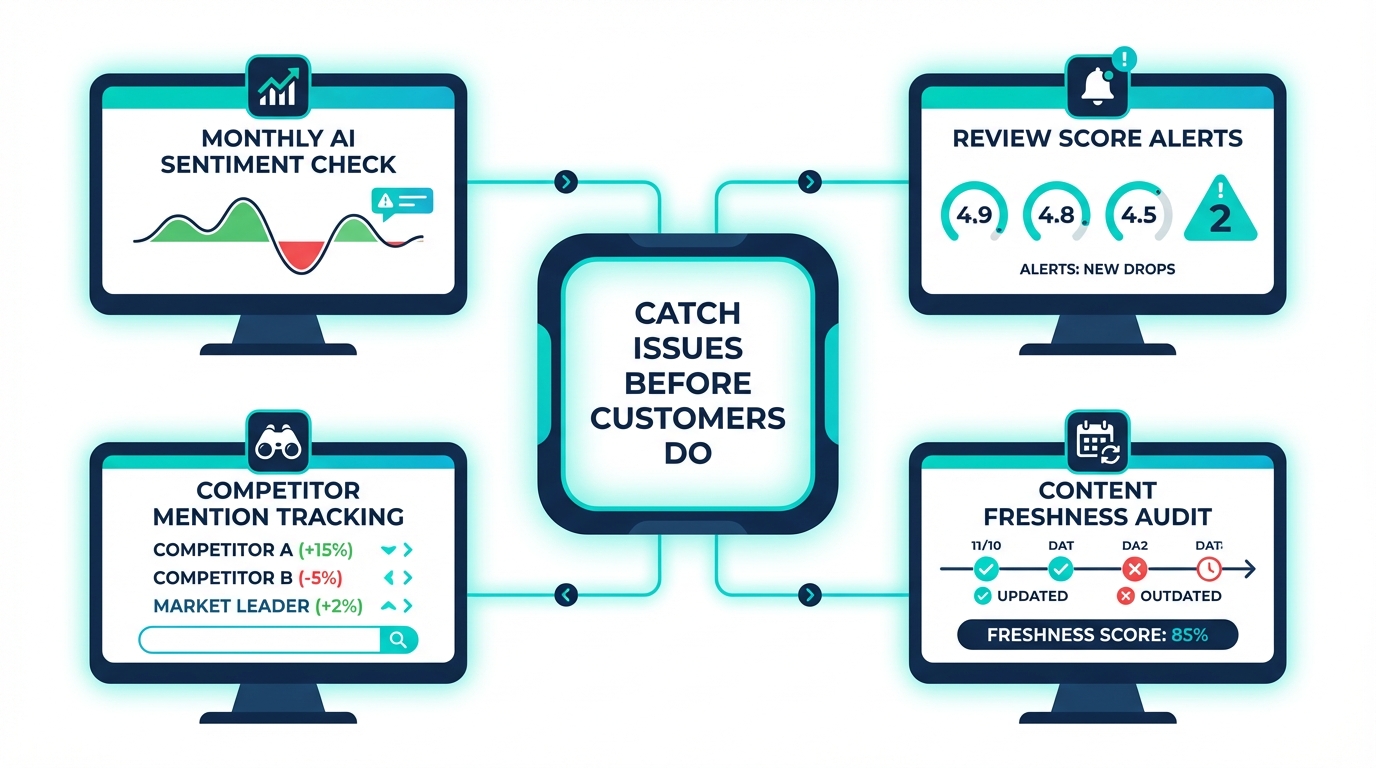
Not every query matters equally for reputation monitoring. Focus on the queries where negative or incorrect responses would cause the most damage.
High-stakes queries to monitor weekly:
- "Is [your brand] safe/secure/reliable?"
- "[Your brand] problems" or "[your brand] issues"
- "[Your brand] vs [competitor]" (check for unfair framing)
- "Should I cancel [your brand]?" or "alternatives to [your brand]"
- "[Your brand] reviews" (check sentiment and accuracy)
These queries represent moments where a potential or current customer is evaluating your brand. Incorrect information here directly impacts revenue.
Monitor Review Platforms Proactively
Don't wait for review sentiment to flow into AI. Monitor the source platforms so you can address issues before AI absorbs them.
Set up alerts on G2, Trustpilot, and Google Business Profile for new reviews below 3 stars. Respond to negative reviews promptly and publicly. This doesn't just help on teh review platform; it creates a counter-narrative that AI can also pick up.
Track Source Changes
Identify the sources AI currently cites when discussing your brand. Monitor those sources for changes. If a comparison article that previously rated your product highly updates to a lower rating, that change will flow into AI responses on the next retrieval cycle.
Google Alerts, Mention, adn similar tools can track changes to specific pages and domains that matter for your AI reputation.
Run Negative Query Probes
Deliberately query AI models with adversarial prompts to surface problems before your customers do.
- "What are the downsides of [your brand]?"
- "Why did [your brand] get bad reviews?"
- "What's wrong with [your brand's product]?"
These queries reveal the negative associations AI has formed about your brand. If the responses contain misinformation or outdated issues, you've found a problem to fix proactively.
Response Playbook
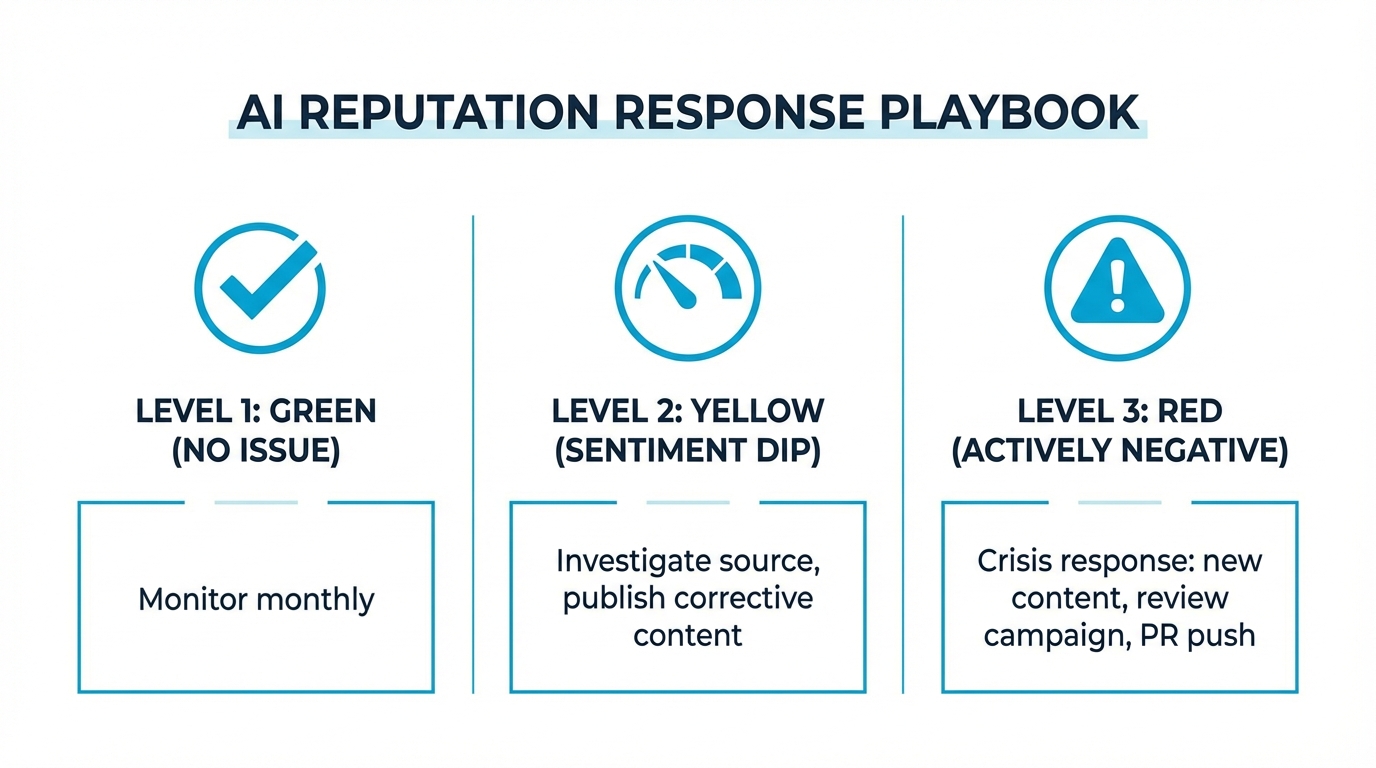
When your early warning system detects an issue, speed matters. Here's the response framework.
Severity 1: Factual Error
AI is stating something demonstrably wrong about your brand (wrong pricing, incorrect features, confused with another company).
Response time: Within 48 hours.
Actions: 1. Document the error with screenshots across all platforms where it appears 2. Identify the likely source (search for the incorrect claim on the web) 3. Correct the information at the source if possible 4. Update your own website with clear, structured content that addresses the topic 5. Submit updated information through Google Search Console, Bing Webmaster Tools, and relevant structured data updates 6. Monitor for correction on the next retrieval cycle
Severity 2: Negative Sentiment Shift
AI is framing your brand more negatively than before, but the information isn't factually wrong.
Response time: Within one week.
Actions: 1. Trace the shift to its likely cause (new reviews, press coverage, competitor content) 2. Address the root cause (respond to reviews, issue corrections to press, publish counter-content) 3. Reinforce positive positioning through new content and structured data updates 4. Track recovery over 2-4 monitoring cycles
Severity 3: Competitive Displacement
A competitor is appearing where you used to, or AI is positioning them favorably against you.
Response time: Within two weeks.
Actions: 1. Analyze what the competitor did differently (new content, press, reviews, structured data) 2. Create or update content that strengthens your positioning for the affected queries 3. Pursue the same or similar sources the competitor is benefiting from 4. Track competitive share of voice recovery monthly
For detailed competitive response tactics, see our guide on monitoring competitor mentions in AI answers.
Prevention: Reducing Future Risk
The best early warning system catches fewer issues over time becuase you're preventing them at the source.
Keep your website current. Every page should reflect your current product, pricing, and positioning. Outdated pages are the #1 source of AI misinformation about brands.
Maintain structured data. Schema markup, Wikidata entries, and Google Knowledge Panel information serve as authoritative anchors for AI. When these are current, AI models are less likely to rely on unreliable secondary sources.
Build a positive content moat. The more authoritative, accurate content exists about your brand, the harder it is for a single negative source to shift AI's overall framing. Invest in owned content, earned media, and third-party citations that reinforce your desired positioning.
Engage with review platforms. Respond to every negative review. Not just for the reviewer, but because that response becomes content that AI can surface alongside the criticism.
What Comes Next
Reputation protection is one component of a broader AI brand monitoring practice:
- AI Brand Monitoring: The complete guide to tracking what AI says about your brand
- How to Track AI Sentiment Changes Over Time: Methodology for measuring and responding to sentiment shifts
- Managing Your Brand Reputation in the Age of AI: The broader reputation management framework
- How to Control What AI Says About Your Brand: Proactive tactics for shaping your AI narrative
Frequently Asked Questions
How do I detect an AI reputation issue early?
Run a fixed set of brand, product, comparison, and risk prompts on a schedule. Save the answer, model, date, sentiment, and cited sources. Flag factual errors, new negative framing, and sudden competitor displacement separately.
How often should priority brand prompts be checked?
Use a cadence that matches the risk. A weekly review is practical for priority prompts, with an extra check after a product launch, rebrand, public incident, or major model release.
What should I do when an AI answer is factually wrong?
Document the answer and its citations first. Correct the inaccurate first-party page or external source where possible, make sure the corrected page is crawlable, and repeat the same prompt in later review cycles.