By Joao da Silva and Maryanna Franco (BrilliantSEO) · June 6, 2026
TL;DR. Before an AI decides whether to recommend you, it has already decided what you are. We call this Category Coding: every model carries one internal category label for your brand, and a "best [category]?" query only considers the brands inside that box. The labels are remarkably consistent: across ChatGPT, Gemini, Claude, Perplexity, and Google AI Overview, 9 of our 12 brands were coded into the same category by all five. If the box is wrong, you are invisible in that category no matter how much you spend on marketing.

An AI recommendation query has a hidden first step. Ask "what are the best athleisure brands?" and before the model picks anything, it filters to the brands it has filed under "athleisure." Everything else is invisible to that question. The filtering happens silently, and most brands never learn which box they are in.
This is the first of five mechanisms behind the recognition-recommendation gap we measured across 14,140 AI answers. The full reframe is in the pillar, Brand Strength Gets You Recognized, Not Recommended. This piece is about the box itself: how AI assigns it, how consistent it is, and how to find yours.
What Category Coding is
Category Coding is the internal category label an AI attaches to your brand. It isn't something you set, and it is not always what you think you are. It is what the model inferred from everything written about you, compressed into a single answer to "what kind of company is this?"
You can ask the models directly, and they will tell you. We probed all five with a forced-choice prompt ("categorize this brand into one of: athletic footwear, athleisure apparel, performance sportswear, yoga and wellness"). The answers were not mushy. They were specific, confident, and overwhelmingly consistent across models.
The models agree on your category
This is the part that surprised us most. 9 of the 12 brands came back unanimous, all five models the same, or four with one naming a near-synonym. The five systems don't just share facts about brands. They share the same mental filing cabinet, and that filing cabinet acts like a cage.
Where the models disagreed, the disagreement was itself predictive:
- Gymshark split 2-2 between sportswear and athleisure. Its real-world athleisure recommendation rate landed right in the middle, at 40.5%. A brand the models can't agree on gets recommended at an in-between rate.
- lululemon came back 3 of 4 athleisure, 1 of 4 yoga (Claude), reflecting its yoga heritage inside the broader athleisure box.
- Alo Yoga was the mirror image: 3 of 4 yoga, 1 of 4 athleisure.
The practical takeaway: your category code is consistent across models and queryable in one prompt. You don't have to guess. And because it's shared across the major systems, fixing it (or being stuck with it) affects all of them at once.
You can't out-market your category code
The hardest version of this lesson is Outdoor Voices. It built its whole identity as the athleisure brand, the pioneer of "Doing Things" in matching sets. The models didn't get the memo. They code it 28% athleisure and 81% sportswear, and they recommend it accordingly: it shows up far more for sportswear questions than athleisure ones.
That gap between how a brand markets itself and how AI files it is the thing to internalize. Your category code is set by the published web (what third parties write about you, in which contexts), not by your campaigns or your homepage copy. You can run athleisure ads all year; if the corpus of writing about you reads "sportswear," that's the box you're in.
Proof: change the category, change the brands
The cleanest demonstration that category is the gate, not strength, is to hold everything constant and swap only the category register of the prompt. We did this in a small follow-up: same brands, same model, same day, but asking for the best athletic footwear brands instead of the best athleisure brands.
The pattern flipped completely. New Balance, near-invisible on athleisure (about 1%), jumped to roughly 90% on footwear. lululemon, the athleisure prototype at about 90%, dropped to 0% on footwear. The brands didn't change. The box the question opened did.
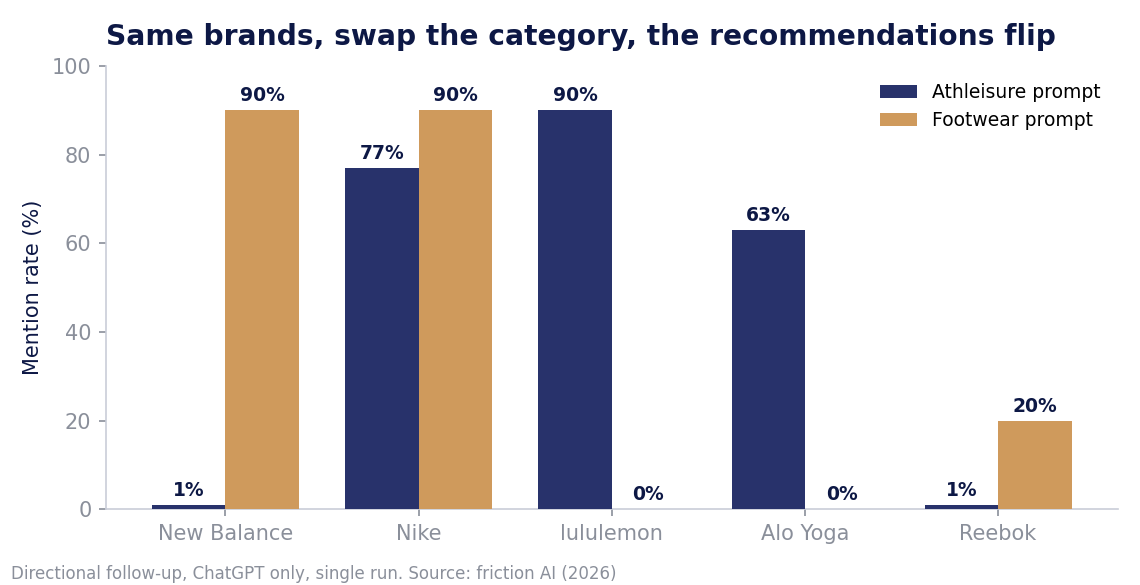
A caveat worth stating plainly: this flip experiment was a single run on one model (ChatGPT) and is not part of the main 14,140-run dataset. Treat it as a direction, not a measured result. It lines up with the rest of the study, but it hasn't been run at scale yet.
Where your category code comes from
Here is the honest version of the mechanism, including the part that's easy to oversimplify.
The cleanest single signal we found is the Google Knowledge Graph short-description field, the one-line "X company" descriptor Google attaches to your entity. The categories the models assigned lined up with it closely:
| KG short-description | Example brands | AI category |
|---|---|---|
| "Footwear company" | Nike, New Balance | athletic footwear |
| "Sporting goods company" | Reebok | athletic footwear |
| "Apparel company" | lululemon, Alo Yoga | athleisure / yoga |
| "Fashion company" | Outdoor Voices | athleisure (partial) |
| "Financial services company" | TALA | wrong entity entirely |
| generic "Company" / none | Gymshark, Rhone, Varley, LNDR | no clear anchor |
But the description is a proxy, not the cause. Nike, New Balance, and Reebok all carry footwear-flavored descriptions, yet they behave completely differently in recommendations (Nike crosses into athleisure; New Balance and Reebok don't). So the label can't be the whole story. The actual driver is the distribution of third-party content about you: what fraction of the writing the models learned from positions you in wich category. The KG description and the AI's category both descend from that same upstream signal.
The description is just the most legible readout of it.
That distinction matters for what you do next. The description tells you your diagnosis. The fix lives in the third-party corpus, which is the subject of two later pieces in this series: Sub-Stream Strength (how Nike built enough apparel coverage to cross the boundary) and The Coverage Gap (why earned third-party coverage, not your own site, is what moves recommendations).
And when the description points at the wrong entity entirely, like TALA's "Financial services company," you have a different problem with a different fix. That's the KG-Hijacked Entity, covered next.
How to find your category code
You can run this today, in two steps:
- Probe the models. Ask each of ChatGPT, Gemini, Claude, and Perplexity the same forced-choice question: "In one label, what category does [your brand] belong to? Choose the single best fit." Run it a few times per model. Agreement across models is your category code. Disagreement is a signal you sit on a boundary (like Gymshark), which usually means a middling recommendation rate.
- Check your Knowledge Graph description. Search your brand on Google and read the one-line descriptor in the knowledge panel, or query the Knowledge Graph entry directly. If it reads as the wrong category, or as generic "Company," or as a different entity, that's your diagnosis. A wrong or missing description is a structural cap on your category recommendations.
If your category code is correct but you still don't surface, the problem is downstream (coverage density, covered later). If your category code is wrong, fix that first. Nothing else moves until the box is right.
This is one of five mechanisms. Start with the pillar for the full picture: Brand Strength Gets You Recognized, Not Recommended. For a broader catalog of ways AI overlooks brands, see Why AI Ignores Your Brand.
FAQ
What is Category Coding? It's the single internal category an AI model assigns to your brand. A "best [category]?" recommendation query only considers brands inside that category, so your code determines which questions you can even appear for.
How do I find what category AI puts my brand in? Ask each major model the same forced-choice question ("what one category does [brand] belong to?") and check your Google Knowledge Graph short-description. Models agree most of the time (9 of 12 brands in our study were unanimous), so one round of probes usually reveals it.
Can I change my category code with marketing? Not directly. Outdoor Voices marketed itself as athleisure for years and is still coded 81% sportswear. Category coding follows the third-party content written about you, not your own campaigns or website.
Is the Knowledge Graph description the cause of my category? It's the cleanest proxy, not the root cause. Nike, New Balance, and Reebok share footwear-style descriptions but behave differently, becuase the real driver is the distribution of third-party content about each brand. Use the description to diagnose; fix the underlying coverage.
Part of the Beyond KG Strength series (Franco & da Silva, 2026, DOI: 10.5281/zenodo.20331344). Pillar: Brand Strength Gets You Recognized, Not Recommended. Next: The KG-Hijacked Entity.