By Joao da Silva and Maryanna Franco (BrilliantSEO) · June 6, 2026
TL;DR. If a larger company shares your name, its Knowledge Graph entry can sit on top of yours, and AI ends up describing the wrong company or skipping you altogether. In our study, TALA, a UK athleisure brand, had a Google Knowledge Graph description that reads "Financial services company" (that's a same-named fintech). The result: TALA was recognized at 0.32 when every other brand sat near 0.99, and it earned 0% athleisure recommendations. This isn't a content problem. The fix is a Knowledge Graph disambiguation request.

Most of the recognition-recommendation gap is about which category box AI files you in. This one is worse: AI has the wrong company in the box with your name on it.
We call it a KG-Hijacked Entity: your brand shares a name with a larger entity, Google's Knowledge Graph resolves that name to the other one, and every downstream AI inherits the confusion. It's the most damaging failure mode we found, because it breaks the foundation, recognition, that every other layer is built on. This is part of the Beyond KG Strength series; if Category Coding is about being in the wrong box, this is about the box belonging to someone else.
What a KG-Hijacked Entity is
When an AI answers a question about a brand, it leans on a structured entity record, and Google's Knowledge Graph is the most influential one. Each entity carries a short free-text description ("Apparel company," "Footwear company," and so on). When two companies share a name, the Knowledge Graph resolves that name to a single entity, usually the larger or older one.
The smaller brand doesn't get a weaker version of its own entry. It effectively doesn't have one. Its name points somewhere else.
That's the hijack. Note the word is just shorthand: nobody did anything wrong. Both companies legitimately exist and both have a real claim to the name. Mechanically, though, the Knowledge Graph only resolves to one, and AI follows it.
TALA: invisible in its own category
TALA is a UK athleisure brand. Its Google Knowledge Graph description reads, verbatim, "Financial services company," because a larger Philippines-based fintech of the same name owns the entity. The numbers that follow from that are stark:
- Recognition: 0.32. Across our 12 brands, every other brand except one sat at 0.99 or higher. Ask an AI "what is TALA?" and it frequently describes the fintech, or hedges, because the entity it resolves to isn't the apparel brand.
- Athleisure recommendation: 0%. The lowest in the sample. TALA never surfaces when someone asks for the best athleisure brands.
What makes this especially frustrating: when we probed the models directly ("is TALA an athleisure brand?"), they could place it correctly. The knowledge exists somewhere. But the default resolution, the one that fires on an unprompted query, lands on the fintech. The brand is doing the marketing; the namesake is collecting the entity.
It breaks recognition, not just recommendation
Every other mechanism in this series operates at the recommendation layer, the brand is known but not surfaced. The KG hijack is worse because it corrupts recognition itself. You can see it in the sources AI cites for the name. The fintech's domain (tala.co) shows up far more than the athleisure brand's actual domain (wearetala.com).
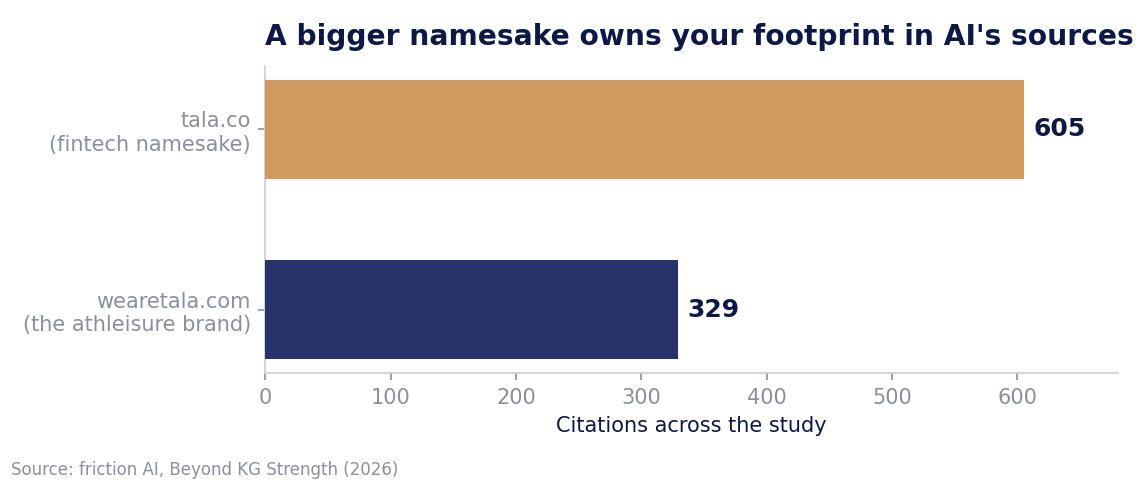
When the most-cited source for your brand name is a different company, no amount of athleisure content fixes the underlying problem. AI isn't failing to find good content about you. It's resolving your name to someone else before it even looks.
How to tell if you're hijacked
This one is quick to diagnose:
- Read your knowledge panel. Search your brand on Google. If the knowledge panel (or the one-line descriptor under your name) shows a different company, a different industry, or a different country, your name is resolving to another entity.
- Probe recognition. Ask ChatGPT, Gemini, Claude, and Perplexity "what is [your brand]?" If any of them confidently describe a different company, the hijack is live at the recognition layer, which is the one that matters most.
- Check the cited domain. When AI does mention your name, see which domain it cites. If it's not yours, a same-named entity owns your footprint.
A hijack looks different from ordinary weak recognition. A small brand with no Knowledge Graph entry gets vague, hedged answers. A hijacked brand gets confident, detailed answers about the wrong company. Confidence plus wrongness is the tell.
The fix: a Knowledge Graph disambiguation request
This is the rare AI-visiblity problem you don't solve with more content. You solve it by getting Google to recognize your brand as a distinct entity. Two parts:
File for disambiguation. Google has a process for suggesting corrections to knowledge panels and for claiming an entity you represent. For an entirely missing or misattributed entity, this means establishing your brand as its own node, not editing the namesake's. Set expectations honestly: this is slow (often months) and not guaranteed. Knowledge Graph corrections propagate on Google's timeline, and AI models pick them up only on later training or retrieval cycles.
Strengthen your own entity signals so Google can tell you apart. This is the work that makes the disambiguation stick: clean schema.org Organization markup with a sameAs block linking your verified profiles (LinkedIn, Crunchbase, your social accounts), a Wikidata entry, consistent name-and-location signals across the web, and ideally independent coverage that names you with enough context to separate you from the namesake. The more uniquely-identifying structured data points to your real domain, the easier it is for Google, and then for AI, to resolve your name to you.
Until that resolves, paid and organic marketing both leak value: you build demand for a name that AI hands to someone else. The disambiguation request is the unlock that lets every other layer (category coding, coverage, recommendation) start working.
This is one of five mechanisms behind the recognition-recommendation gap. Start with the pillar, Brand Strength Gets You Recognized, Not Recommended, and see the box-assignment mechanism in Category Coding.
FAQ
What is a KG-Hijacked Entity? It's when your brand shares a name with a larger company, and Google's Knowledge Graph resolves that shared name to the other entity. AI then describes the wrong company or skips you, becuase it has no distinct record for your brand.
How do I know if my brand is hijacked in AI? Search your brand and read the knowledge panel, then ask the major AI models "what is [brand]?" If they confidently describe a different company, or your knowledge panel shows the wrong industry, your name is resolving to a namesake. Confident-but-wrong answers are the signature.
Can I fix a Knowledge Graph hijack with content or SEO? Not directly. Content helps category coverage, but a hijack is an entity-resolution problem. The fix is a Knowledge Graph disambiguation request plus stronger entity signals (schema.org sameAs, Wikidata, consistent identifiers) so Google can distinguish you from the namesake.
How long does it take to fix? Expect months, and there's no guarantee. Knowledge Graph corrections move on Google's schedule, and AI systems only reflect them after later retrieval or training cycles. Strengthening your structured-data signals in parallel improves the odds.
Part of the Beyond KG Strength series (Franco & da Silva, 2026, DOI: 10.5281/zenodo.20331344). Pillar: Brand Strength Gets You Recognized, Not Recommended. Previous: Category Coding.