By Joao da Silva and Maryanna Franco (BrilliantSEO) · June 6, 2026
TL;DR. AI files both Nike and New Balance as footwear. Yet Nike gets recommended for athleisure 71.8% of the time and New Balance 3.4%, with Reebok (also footwear-coded) at 0.7%. Same category code, opposite outcomes. The difference is not brand strength (New Balance actually has the higher Knowledge Graph score). It's Sub-Stream Strength: Nike has a deep body of apparel coverage that puts it in the athleisure conversation (co-mentioned with lululemon 482 times, versus 21 for New Balance). You can bridge into an adjacent category, but only by building density there, not by relabeling yourself.

Most of this series is about why brands stay stuck in one box. This piece is about the exception: the rare brand that crosses into a neighboring category and gets recommended there anyway. Nike is that brand in our data, and how it does it is the most useful playbook for anyone trying to expand.
This is the fourth mechanism in the Beyond KG Strength series. Category Coding explained the box; the Category Prototype explained the cluster. This is about crossing from one cluster into the next.
What a Bridge Brand is
A Bridge Brand is a brand AI files in one category that still surfaces strongly in an adjacent one. In our athleisure study, the footwear-coded brands (Nike, New Balance, Reebok) should all have been invisible on athleisure queries, the way Category Coding predicts. Two of them were. Nike wasn't. It bridged.
Nike is the only footwear-coded brand in our set that crosses the wall. That makes it the test case for a precise question: what does a brand need to surface in a category it isn't filed under?
Same category code, opposite outcomes
Start with the outcome. All three brands carry a footwear-flavored Knowledge Graph description and all three are coded as athletic footwear by every model. Their athleisure recommendation rates could not be more different.
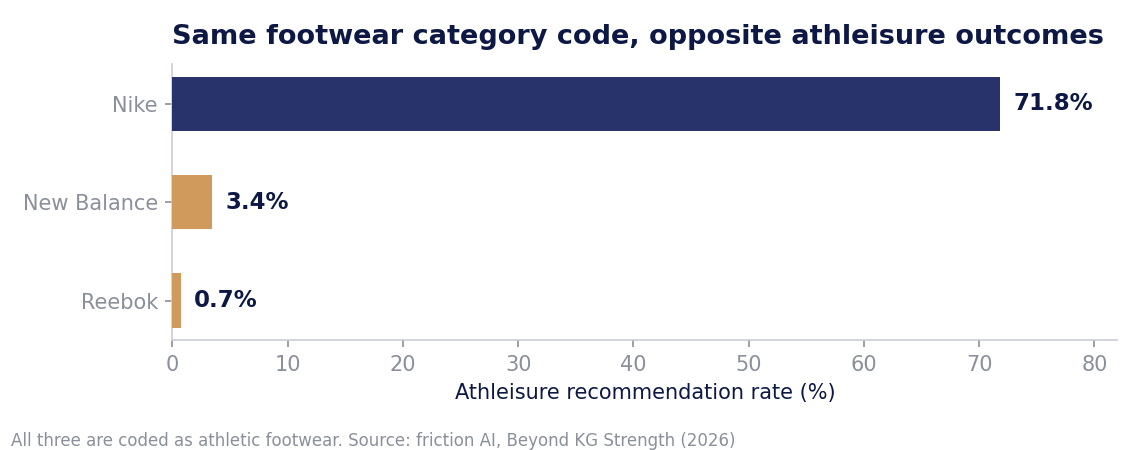
If category code alone decided this, all three would be near zero. If brand strength decided it, New Balance would lead, it has the highest Knowledge Graph score in the entire sample, about 2.5 times Nike's. Neither explains the result. Something else is doing the work.
What Nike has that New Balance doesn't
The thing Nike has is a deep apparel sub-stream: decades of third-party content about Nike clothing, sportswear, leggings, and training apparel, not just shoes.
That coverage places Nike inside the athleisure cluster. New Balance's apparel coverage is a thin layer on top of a footwear brand; the third-party web mostly writes about its shoes.
You can see the gap in co-mention density. Nike is named alongside lululemon, the athleisure prototype, 482 times across recommendation answers. New Balance is named with lululemon 21 times. Nike is a member of the athleisure conversation. New Balance is a footwear brand that occasionally wanders past it.
We call this depth Sub-Stream Strength: the volume and density of category-aligned third-party content you have in the target category, as distinct from your overall brand strength or your primary-category authority. It's category-specific. Nike has huge sub-stream strength in apparel and even more in footwear. New Balance has it in footwear and almost none in apparel. The KG score doesn't see that split. The recommendation behavior does.
You can't bridge by relabeling
The tempting move, once you see this, is to try to change your category: rebrand, update your messaging, tell the market you're an athleisure company now. It doesn't work, for the same reason Outdoor Voices can't out-market its category code. The category you surface in is set by the third-party content written about you, not by what you call yourself.
Brand strength doesn't transfer across the boundary either. Across all 12 brands, Knowledge Graph strength correlated with the recognition-recommendation gap at -0.10, statistically zero. Strength buys you recognition and durability in your home category; it doesn't buy you a seat in the next category over. Only sub-stream density does that, and density has to be built where you want to show up.
That's the hard truth of bridging: its the slowest of the five mechanisms to move. Nike's apparel sub-stream is the product of decades. But it's also the most durable, because once you're genuinely in the adjacent cluster, the same compounding that protects the prototype starts working for you.
How does a brand become a bridge? (a hypothesis)
Here is the honest limit of the data. Our study is a snapshot: it shows that Nike has a deep apparel sub-stream and bridges, and that New Balance doesn't and doesn't. It does not show how Nike got there, the path over time, or the threshold it had to cross. Nike is also the only bridge brand in our 12-brand set. So treat what follows as a hypothesis, not a measured finding.
We think becoming a bridge brand takes five things, in roughly this order:
- Real product participation. Nike actually makes apparel at scale. You can't manufacture third-party coverage for a category you don't operate in, so this is the precondition, and it isn't a marketing lever.
- Sustained category-aligned coverage. Independent content in the target category that repeatedly names you alongside that category's brands, above all it's prototype.
- A density threshold. Below it, your adjacent-category coverage reads as noise against your primary code; above it, the model treats it as a separate signal. Where that line sits, we don't yet know.
- Compounding. Once your in enough lists you get into more, the same dynamic that protects the prototype. Slow at first, then self-reinforcing.
- Adjacency. Nike crossed between two neighboring categories. A jump into a distant one likely needs much more, and we didn't test that.
Confirming this needs work we haven't done: tracking a brand's sub-stream and recommendation rate over time, across many brands, to see what actually predicts who bridges. It's the priority follow-up.
How to build a sub-stream
If that hypothesis is right, the work is concrete:
- Confirm the target cluster is real. Run the Category Prototype mapping on the category you want to enter. Identify its prototype and co-anchors. That's the company you need to be cited alongside.
- Earn category-aligned third-party coverage there. Get featured in the target category's publications, round-ups, and comparisons, the content that already co-mentions its established brands. This is the Coverage Gap mechanism applied with intent: build the corpus that positions you in the new category.
- Be consistent and patient. Sub-stream strength accumulates; it doesn't spike. One placement won't move it. A sustained stream of category-aligned coverage, over quarters and years, is what eventually registers as cluster membership.
- Don't rebrand to fake it. Messaging follows coverage, not the other way around. Spend on getting written about in the target category, not on telling people you belong there.
This is one of five mechanisms behind the recognition-recommendation gap. The full picture is in the pillar: Brand Strength Gets You Recognized, Not Recommended.
FAQ
What is a Bridge Brand? A brand that AI files in one category but still gets recommended strongly in an adjacent one. Nike is footwear-coded yet earns 71.8% of athleisure recommendations, the only footwear brand in our study to cross over.
What is Sub-Stream Strength? The volume and density of category-aligned third-party content a brand has in a specific category, separate from its overall brand strength. Nike has deep apparel sub-stream strength; New Balance has almost none, which is why Nike bridges into athleisure and New Balance doesn't.
Why does Nike bridge into athleisure but New Balance can't, with the same KG description? Because bridging depends on sub-stream density, not Knowledge Graph strength. Nike has decades of apparel coverage (co-mentioned with lululemon 482 times); New Balance's apparel coverage is thin (21 co-mentions). New Balance actually has the higher KG score, which proves strength isn't the lever.
Can I bridge into a new category by rebranding? No. Category surfacing is set by third-party content, not self-description. You bridge by earning sustained coverage in the target category, which takes time, not by relabeling yourself.
Part of the Beyond KG Strength series (Franco & da Silva, 2026, DOI: 10.5281/zenodo.20331344). Pillar: Brand Strength Gets You Recognized, Not Recommended. Previous: The Category Prototype.