By Joao da Silva and Maryanna Franco (BrilliantSEO) · June 6, 2026
TL;DR. On recommendation queries ("best [category] brands?"), a brand's own website is 0-3% of the sources AI cites, topping out at 2.8%. Recommendation runs almost entirely on earned third-party coverage in your category. lululemon has 3,736 third-party citations behind its recommendations; New Balance has 144. We call that distance the Coverage Gap, and you can see it most clearly when it's total: when New Balance does get cited for athleisure, the sources are dictionaries.

When New Balance turns up in an athleisure answer at all, look at what the model cites. Merriam-Webster. Cambridge. Collins. The AI, with no real athleisure content about New Balance to pull from, falls back to looking up what the words "new balance" mean. It's an empty drawer, on display.
That's the tell for the last and most expensive mechanism in the recognition-recommendation gap: the Coverage Gap, the distance between what you publish about yourself and what AI actually cites when it recommends. This is the fifth piece in the Beyond KG Strength series, and it's the one that redirects the most marketing budget.
What the Coverage Gap is
The Coverage Gap is the gap between your owned content and your earned coverage, as AI sees it. Most brands pour effort into the first (their website, their blog, their product pages) and assume that's what makes them visible. For reccomendation queries, it barely registers. What registers is the second: independent third-party content in your category that an AI can retrieve and cite.
The reason is structural, not a quirk. A "best [category]?" question is comparative. Your own site cannot answer "is X better than Y?", it only ever argues for X. So the model reaches for sources that can compare: category round-ups, comparison articles, publications, listicles. If those exist about you, you surface.
If they don't, you don't, no matter how good your website is.
Your own site barely counts (for recommendations)
The numbers are blunt. On recommendation queries, the brand's own domain is 0-3% of all citations, with the single highest being 2.8% (Reebok). Across the board, AI almost never cites your homepage when it's deciding what to recommend.
This flips on recognition queries. Ask "what is [brand]?" and your own site jumps to the dominant source, 49% of citations on ChatGPT, 36% on Perplexity, 23% on Claude, 21% on AI Overview, 13% on Gemini. Same brand, same site, two completely different roles. Your website is your most-quoted document when someone already typed your name. It's nearly irrelevant when they didn't.
That split is the strategic core of this whole series: recognition runs on your own pages, recommendation runs on third-party coverage in your category. Optimizing the wrong one is the most common AI-visiblity mistake we see.
The Coverage Gap, brand by brand
The amount of earned coverage behind each brand varies enormously, and it tracks recommendation almost perfectly. This is the gap made visible.
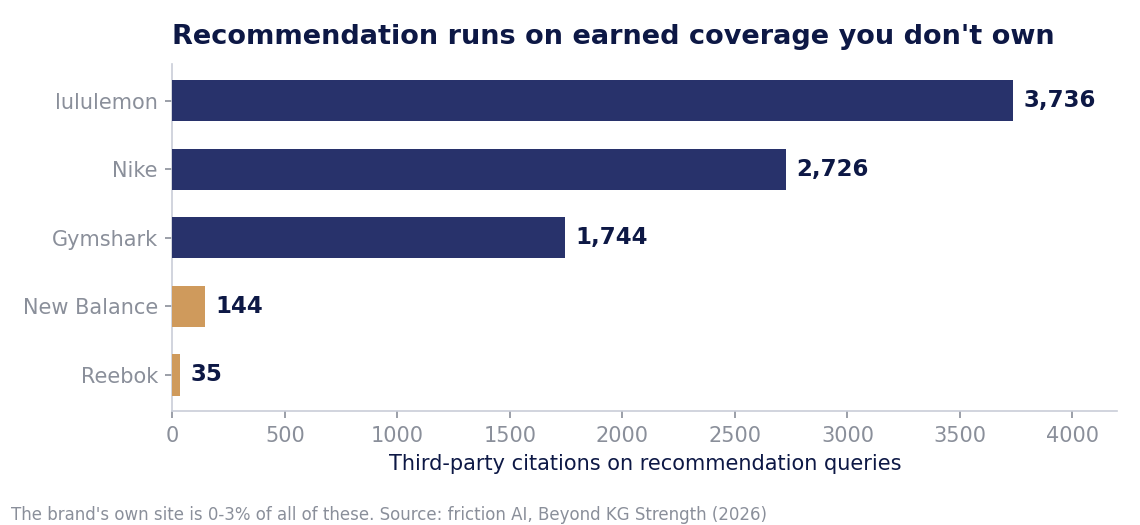
lululemon has 3,736 independent sources behind its recommendations. New Balance has 144, and Reebok 35. Gymshark, a low-Knowledge-Graph brand, has 1,744, far more than New Balance, which is the strongest brand in the sample by KG score. Earned coverage, not brand strength, is what fills the drawer the model opens.
The dictionary tell
The clearest diagnostic in the whole study is what an AI cites when your coverage is zero. For New Balance in athleisure, the cited sources are dominated by dictionary sites: merriam-webster.com, dictionary.cambridge.org, collinsdictionary.com. There is no body of third-party athleisure content about New Balance to retrieve, so the model does the only thing it can and looks up the phrase.
If you ever see AI citing generic reference sites, dictionaries, definition pages, Wikipedia disambiguation, when it talks about your brand in a category, that's the signature of a Coverage Gap. The model isn't choosing those sources. It's settling for them becuase nothing better exists.
A note on where the coverage lives
Earned coverage isn't one thing, and the engines don't all read the same sources. Each has a citation personality: Gemini and AI Overview lean on shopping listicles and Wikipedia, Perplexity on brand domains and Instagram, Claude on company-research databases and LinkedIn. So a placement strategy that only targets one publication type reaches only some of the engines. Spread earned coverage across category publications, comparison and listicle sites, and the reference sources each engine trusts.
What to do: close the gap
- Stop optimizing your own site for category visibility. It's 0-3% of recommendation citations. Keep your site sharp for recognition (your entity description, your About page), but don't expect it to win "best [category]" answers.
- Invest in earned coverage in your category. The sources AI cites are category round-ups, comparisons, publications, and listicles. Getting written about in those, alongside the category prototype, is what surfaces you.
- Measure corroboration density, not output. The metric that matters is how many independent third-party sources reproduce your positioning, not how much content you publish or how many inbound links you count. lululemon doesn't dominate because it has the highest KG score (it doesn't); it dominates because it has the deepest earned coverage in athleisure.
- Spread placements across engines. Match the citation personalities above so you're not visible to only one model.
This is the last of five mechanisms behind the recognition-recommendation gap. The full picture, and the other four, are in the pillar: Brand Strength Gets You Recognized, Not Recommended. For a broader catalog of why AI overlooks brands, see Why AI Ignores Your Brand.
FAQ
Does my website matter for AI visibility? For recognition, yes, it's the dominant source when someone asks "what is [brand]?" (up to 49% of citations). For recommendation ("best [category]?"), almost not at all: your own domain is 0-3% of cited sources. The two surfaces need different work.
What is the Coverage Gap? The distance between the content you own and the earned third-party coverage AI actually cites when it recommends brands. Recommendation runs on independent category coverage; if you don't have it, you don't surface.
What is the "dictionary tell"? When AI cites dictionaries or generic reference pages for your brand in a category, it's a sign there's no real third-party content about you in that category. New Balance's athleisure citations are dominated by dictionary sites, the signature of a total Coverage Gap.
How do I close the Coverage Gap? Earn third-party coverage in your category, round-ups, comparisons, listicles, and publications, especially content that names you alongside the category leader. Measure corroboration density (independent sources reproducing your positioning), not your own content output or raw link counts.
Part of the Beyond KG Strength series (Franco & da Silva, 2026, DOI: 10.5281/zenodo.20331344). Pillar: Brand Strength Gets You Recognized, Not Recommended. Previous: Bridge Brands and Sub-Stream Strength.