As generative AI systems become the primary interface for discovery, comparison, and decision-making, brand visibility is no longer about presence alone. McKinsey research shows 50% of consumers now use AI-powered search, and standards from Google Search Central and Schema.org provide the technical foundation for entity clarity. What matters now is correct interpretation. This is the domain of AI brand recognition.
What was once a theoretical issue inside language models is rapidly becoming a market-level risk.
From Information Retrieval to Interpretation
Traditional search engines retrieved documents. Generative AI systems synthesize answers.
In systems like ChatGPT, Claude, Gemini, and Perplexity, users no longer browse sources. They consume interpretations.
In this environment:
- Brands are inferred entities, not links
- Context is compressed into a single response
- Ambiguity is resolved silently
The model decides who a brand is before the user ever sees an answer.
Why Entity Ambiguity Is No Longer a Minor Error
In legacy systems, ambiguity caused inconvenience. In generative systems, ambiguity causes substitution.
If an AI model resolves a brand incorrectly:
- The wrong entity may be presented confidently
- The correct brand may be excluded entirely
- The user may never realize an error occurred
At scale, this creates quiet misrepresentation rather than visible failure.
The Market Shift: AI as the Primary Discovery Layer
AI tools are no longer experimental. They are becoming default research assistants and discovery surfaces.
As generative systems are embedded into browsers, operating systems, and productivity tools, the surface area for brand interpretation expands.
If AI doesn't recognize a brand clearly, it may never introduce it at all.
From SEO Competition to Entity Competition
In traditional search, brands competed on:
- Keywords
- Rankings
- Share of voice
In generative systems, competition shifts to:
- Entity clarity
- Contextual relevance
- Probabilistic preference
Visibility becomes a question of whether a brand exists coherently inside the model's worldview.
Why Modern Brands Are Especially Exposed
Digitally native and emerging brands face higher risk due to:
- Shorter public histories
- Fewer authoritative references
- Name collisions with common language
- Rapidly evolving positioning
In probabilistic systems, weakly defined entities are often omitted entirely.
The Emergence of Brand Governance for AI
This shift introduces a new discipline.
Just as brands learned to manage:
- Search presence
- Social identity
- App store representation
They must now manage how machines interpret and represent them. For a practical guide, see How to Improve Your Brand Recognition in AI.
This is not about persuasion. It is about structural clarity.
Why the Timing Matters
AI adoption is accelerating while entity representations are still unstable.
Early signals compound. Later corrections become harder.
Brands that act early influence how they are understood. Brands that wait inherit whatever interpretation the models converge on.
How to Monitor Entity Clarity
Tools like friction AI help brands track whether AI models correctly identify and describe them, measuring the entity clarity that determines AI visibility.
The Bottom Line
Generative AI does not eliminate branding fundamentals. It exposes them.
In an AI-mediated world, brands are interpreted before they are chosen. Entity clarity is no longer optional. It is foundational to market participation.
For a deeper dive, see our structured data for AI search guide.
Knowledge Graphs: The Entity Database AI References
When AI needs to determine whether "Copper" means the CRM or the metal, it doesnt guess randomly. It references entity databases, the most important being Google's Knowledge Graph and Bing's Satori.
Google's Knowledge Graph contains billions of entities with properties and relationships. Each entity gets a machine ID (KGMID) and a confidence score based on how much the web agrees on what that entity is. When you search for a brand and see an info panel on the right side of Google, that's the Knowledge Graph at work.
Bing's Satori serves the same function for Microsoft's ecosystem, wich includes ChatGPT's browsing mode. Satori draws heavily from LinkedIn (Microsoft owns it), Wikidata, and Bing's own index.
Both Knowledge Graphs feed the AI models built on top of them. Gemini draws from Google's KG. ChatGPT's browsing uses Bing's index and Satori.
Perplexity runs web searches that reference both. When your brand has a strong entry in both Knowledge Graphs, every AI platform benefits.
How to Check Your Knowledge Graph Presence
You can query Google's Knowledge Graph Search API directly. Search for your brand name and look at what comes back:
- A result with a high score (500+) means Google confidently identifies your entity. AI will use factual language when describing you.
- A result with a low score (<100) means Google sees your brand but isn't confident. AI will hedge.
- No result at all means you're not in the Knowledge Graph. AI has to infer everything from context, which is where misidentification happens.
We tested this across the AI visibility tools category:
| Brand | KG Score | Entity Status |
|---|---|---|
| Otterly AI | 1,797 | Confidently identified as software company |
| Writesonic | 1,134 | Recognized corporation |
| Searchable | 405 | Known but thin description |
| AthenaHQ | 217 | Recognized as company, minimal details |
| AirOps | 18 | Barely registered |
| Peec AI | 12 | Skeleton entry, no description |
| Profound | 0 | Not in Knowledge Graph |
The brands that AI recommends most confidently correlate with the highest KG scores. This isnt coincidence. It's the system working as designed.
The Entity Signal Stack
Knowledge Graph entries aren't built from a single source. They're assembled from cross-references across the web. Each source that independently confirms the same facts about your brand increases your entity confidence.
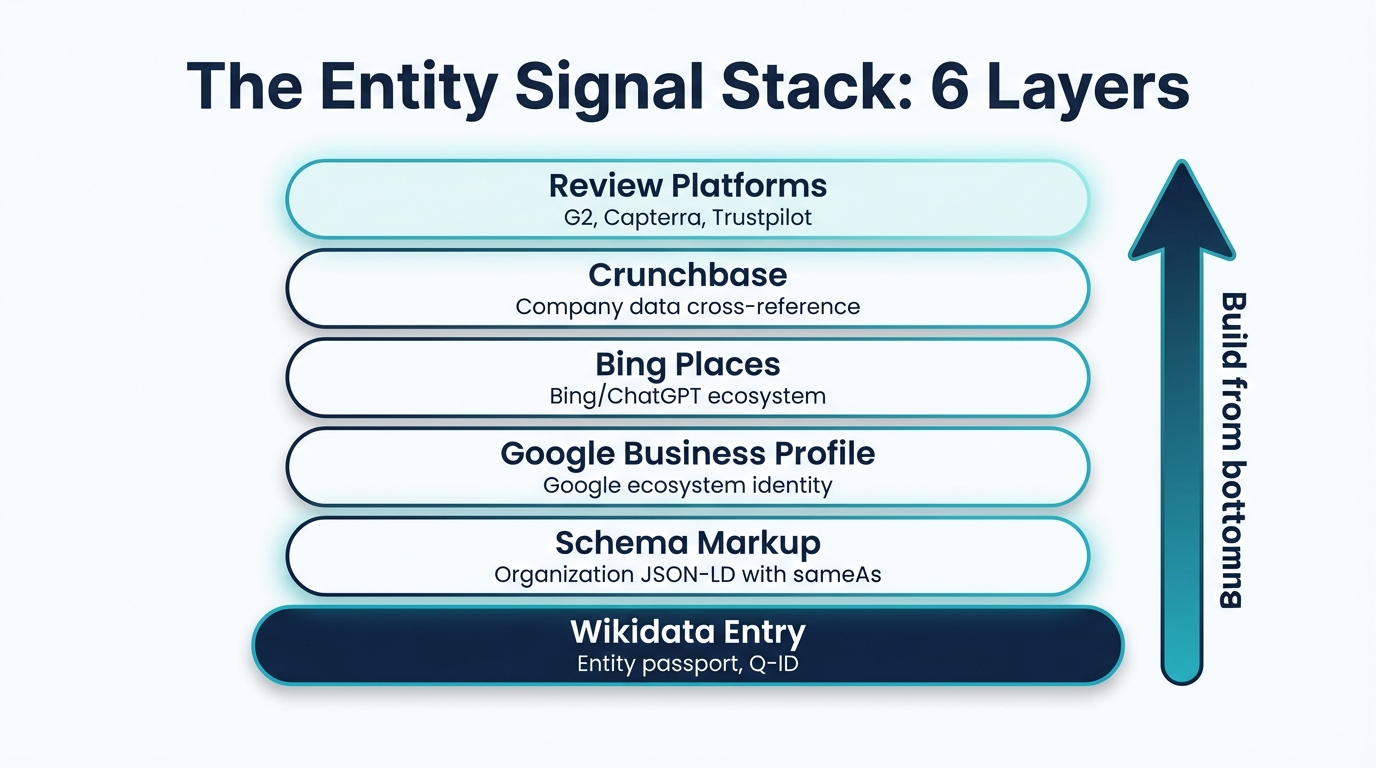
The stack, from foundation to top:
Wikidata is your entity passport. A Q-ID in Wikidata gives both Google and Bing a canonical reference point for your brand. Without it, your entity is unanchored.
Schema markup (Organization JSON-LD on your website) is your self-declaration. When it includes sameAs links to your Wikidata entry, LinkedIn, Crunchbase, and G2, you're creating machine-readable cross-references that Knowledge Graphs can verify.
Google Business Profile establishes your identity within Google's ecosystem. Even for online-only businesses, GBP gives Google a verified entity to associate with your brand.
Bing Places does the same for Bing's ecosystem, which feeds ChatGPT's browsing mode. Most SaaS companies skip this. That's a missed signal.
Crunchbase is a primary data source for both Google and Bing when resolving company entities. A complete Crunchbase profile (founding date, team, funding, description) provides structured data that KGs consume directly.
Review platforms (G2, Capterra, Trustpilot) serve double duty: they're authority signals AND entity signals. Each review that names your brand and describes what you do reinforces the entity resolution.
Build the stack from the bottom up. Wikidata first, then schema, then business profiles, then directory completeness, then reviews.
Frequently Asked Questions
What is entity theory in AI search?
Entity theory is the SEO concept that search and AI systems don't just index keywords; they resolve specific entities (brands, people, products) and link information to those entities. An entity is a canonical identity in a knowledge graph. When AI recommends your brand, it's recommending an entity, not a keyword. Strong entity resolution means AI confidently attributes content to you rather than treating your brand as ambiguous text.
How do I make my brand an entity AI recognizes?
Four moves. First, get a Wikidata entry with consistent properties (founding date, location, category). Second, add Organization schema to your site linked to Wikidata via sameAs. Third, build citations on high-authority sites (news, reviews, analyst reports) that reinforce the same properties. Fourth, ensure Google Business Profile and Crunchbase entries match. Entity clarity compounds with signal consistency.
What's the difference between entity SEO and keyword SEO?
Keyword SEO optimizes pages for specific search terms. Entity SEO optimizes your brand's identity so AI and search systems confidently link content to you. A well-entitied brand ranks for its name with zero keyword optimization. A badly entitied brand fights for every mention even with strong content. For AI visibility, entity strength is foundational; keywords matter less.
Why is entity resolution harder for AI than for Google?
Google uses the Knowledge Graph as a known anchor. AI models use it too but also rely on training data and real-time retrieval. If a brand has weak Knowledge Graph presence, AI models fill the gap with inference, which often produces wrong or generic descriptions. Consumer brands with generic-word names (Copper, Honey, Grain) hit this wall frequently.
How long does entity building take?
Six to twelve months for meaningful Knowledge Graph confidence. A Wikidata entry helps within weeks, but training data absorption takes months, and review-platform authority takes quarters. Track entity strength monthly. If your brand's KG confidence score is climbing and AI descriptions of your brand are getting more specific, the work is compounding.
Related Articles
- Entity Recognition: The Hidden Variable in AI Search Rankings
- Why ChatGPT Gets Your Brand Wrong (And How to Fix It)
- How to Train LLMs to Understand Your Brand (Step-by-Step)
- What is AI Visibility? Definition, Examples & Why It Matters