HubSpot AEO has a clear entry proposition: 25 prompts, daily tracking across three answer engines and a $50 monthly price without requiring another HubSpot subscription. For Marketing Hub customers, the case becomes stronger because CRM data can inform which buyer prompts deserve attention. A team considering alternatives is usually deciding whether that ecosystem advantage outweighs broader model coverage, more prompts or a more specialized diagnostic workflow.
One disclosure before the comparison: we build friction AI, one of the products below. We link the vendor pages behind volatile pricing claims and do not place friction AI first automatically. HubSpot AEO is the better purchase when its price, CRM context and three-engine scope match the program.
Last verified: August 3, 2026.
HubSpot AEO pricing and capabilities at a glance
HubSpot AEO costs $50 per month after its free trial, or $45 per month with annual payment. The standalone plan includes 25 prompts and daily visibility tracking across ChatGPT, Perplexity and Gemini. It reports a visibility score, competitor share of voice, citation patterns and recommendations. Additional prompt packs are available.
The standalone product does not require a HubSpot subscription. Marketing Hub Professional and Enterprise include premium AEO capabilities, and HubSpot says CRM data can surface prompts tied to actual buyers. That connection is the product's most defensible difference. It is not only another visibility dashboard when the company already runs its marketing and customer data in HubSpot.
What HubSpot AEO does well
- A low published monthly price for daily monitoring
- A simple allowance of 25 prompts across three major answer engines
- Competitor visibility, share of voice and citation analysis
- No separate HubSpot subscription requirement for the standalone product
- CRM-informed prompt suggestions for eligible Marketing Hub customers
- A familiar buying and reporting environment for existing HubSpot teams
Why teams consider an alternative
- Three engines may not be enough. Teams tracking Claude, Copilot, Google AI Overviews or other surfaces need another configuration.
- Twenty-five prompts can become tight. Several products begin with 50 or more prompts, or use credits that allow a different mix.
- The team may not use HubSpot. Without CRM and Marketing Hub context, the ecosystem advantage shrinks.
- Visibility may be too broad a metric. Some teams need recommendation accuracy, purchase intent, crawler behavior or page-level technical evidence.
- Enterprise requirements vary. APIs, regions, languages, SSO, raw exports and data retention need to be compared separately.
Quick comparison
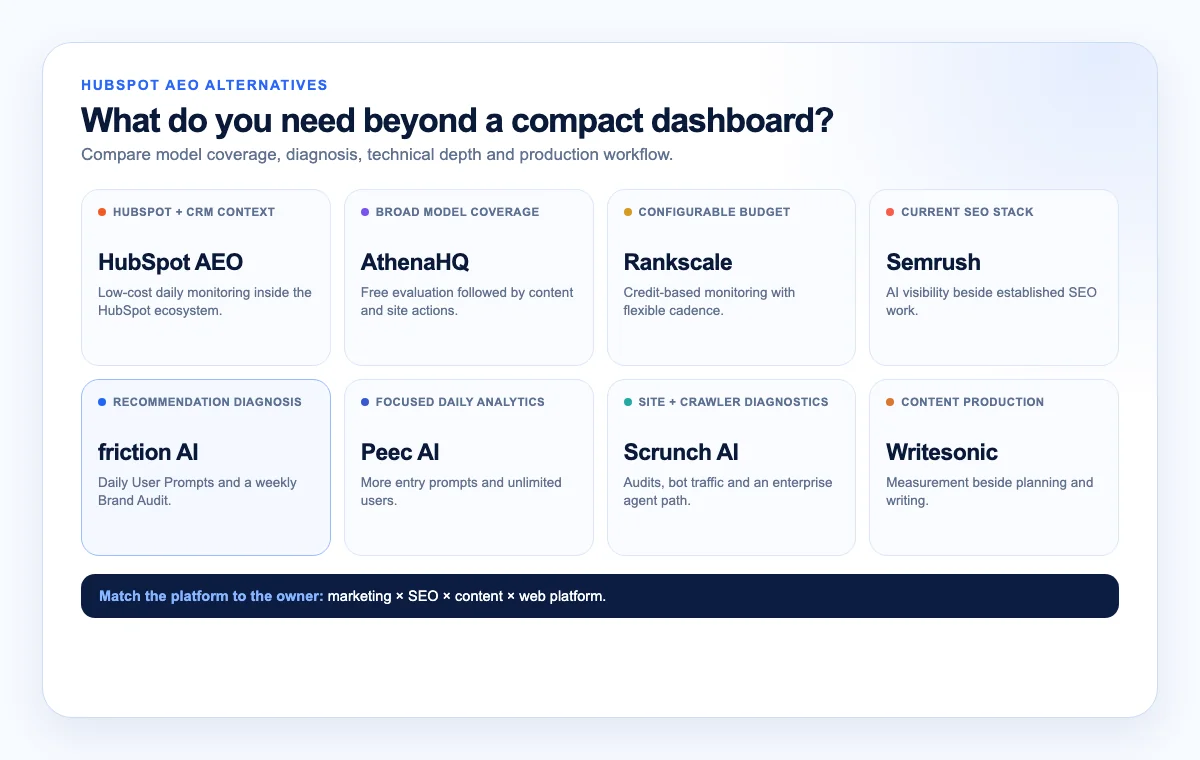
The entry prices below do not buy equivalent answer volume. Normalize prompts, models, regions, frequency, domains and users before deciding.
| Platform | Published entry point | Entry-plan shape | Best fit |
|---|---|---|---|
| HubSpot AEO | $50/mo | 25 prompts across ChatGPT, Perplexity and Gemini | HubSpot users and compact daily programs |
| AthenaHQ | Free; Starter $295/mo | 300 free credits; Starter has 3,600 credits and 9-model visibility | Broad model coverage and content actions |
| Rankscale | $20/mo | Credit-based monitoring with flexible cadence | Configurable, budget-sensitive monitoring |
| Semrush AI Visibility | $99/mo per domain | 25 prompts plus AI competitor and prompt research | AI visibility inside an SEO stack |
| friction AI | $69/mo | Weekly Brand Audit plus daily User Prompts | Recommendation diagnosis and prioritized actions |
| Peec AI | $95/mo | 50 prompts, choose 3 models, unlimited users | Focused daily analytics |
| Scrunch AI | $250/mo | 125 prompts, 4 LLMs, 5 audits and 5 users | Monitoring plus crawler and site diagnostics |
| Writesonic | $79/mo | 50 tracked prompts plus content workflows | Content planning and production teams |
AthenaHQ: for broader model coverage and actions
AthenaHQ has a free Essential tier with 300 credits across ChatGPT, Perplexity, Google AI Overviews, Gemini and Claude. Starter costs $295 per month and includes 3,600 credits, nine-model visibility, API access, CSV export, integrations and on-page and off-page actions.
AthenaHQ is the stronger HubSpot AEO alternative when the program needs more answer surfaces or a dedicated action environment. The free plan can also test five surfaces before the team commits to Starter. HubSpot's advantage is price and CRM proximity. Its standalone plan costs much less and has a simpler 25-prompt brief.
Choose AthenaHQ when the wider model set and content action layer are the point of the purchase. Choose HubSpot when ChatGPT, Perplexity and Gemini cover the audience and the team values a compact daily workflow.
Rankscale: for configuration control
Rankscale starts at $20 per month and uses credits. Teams can schedule terms hourly, daily, weekly or monthly across a broad engine list that includes ChatGPT, Gemini, Perplexity, Claude, DeepSeek, Mistral, Grok and Copilot. The product includes visibility tracking, competitor benchmarks, citation and sentiment analysis, prompt research and page audits.
Rankscale is the better alternative when the buyer wants to tune engines and cadence instead of accepting HubSpot's fixed three-engine daily package. Its low entry price is attractive, though the final bill depends on credit use and the selected models.
HubSpot is easier when 25 daily prompts are enough and the team wants one fixed monthly price. Rankscale deserves a closer look when the program spans less common engines, several cadences or many regions.
Semrush AI Visibility: for SEO teams
Semrush AI Visibility costs $99 per month per domain with annual billing. It tracks 25 custom prompts and reports mentions from ChatGPT, Google AI, Gemini and Perplexity. Competitor analysis, prompt research and an AI-readiness site audit are included.
Semrush and HubSpot solve the same integration question from different sides. HubSpot connects AI visibility to CRM and marketing operations. Semrush connects it to SEO research, site audits and reporting. A team already working daily in one of those platforms may save more time through ecosystem fit than it gains from a longer standalone feature list.
Semrush covers a Google AI surface in addition to the three named by HubSpot, but it prices per domain and may add user or reporting costs. Compare the whole account, not only the AI add-on.
HubSpot AEO vs friction AI
HubSpot AEO gives a team a daily visibility layer with a low entry price. It measures whether the brand appears, how it compares with competitors and which sources are cited. Marketing Hub customers can relate that work to there CRM and buyer data.
friction AI starts from recommendation behavior. User Prompts run daily. A separate weekly Brand Audit uses a repeated buying-oriented prompt set to measure recognition, visibility, sentiment and purchase intent against competitors. Improve translates detected gaps into prioritized work. Growth adds Commerce Prompts. Professional raises the User Prompt allowance and adds controlled prompt experiments. The friction AI pricing page lists Starter at $69 per month, Growth at $299 and Professional at $699.
| Decision factor | HubSpot AEO | friction AI |
|---|---|---|
| Starting price | $50/mo | $69/mo |
| Included answer surfaces | ChatGPT, Perplexity and Gemini | Five answer surfaces listed across the product |
| Prompt cadence | 25 prompts refreshed daily | Daily User Prompts plus weekly Brand Audit |
| Existing-data advantage | HubSpot CRM and Marketing Hub | Consistent competitor and recommendation diagnostics |
| Primary strength | Affordable visibility in a marketing ecosystem | Measurement-to-action loop for recommendations |
| Higher-tier direction | Marketing Hub features and prompt add-ons | More prompts, Commerce and controlled experiments |
Choose HubSpot AEO when
- The team already works in HubSpot and wants CRM-informed prompt suggestions.
- Twenty-five daily prompts across three engines cover the initial measurement plan.
- A $50 fixed monthly entry is more useful than a broader diagnostic product.
- Visibility, share of voice and citation analysis are the main requirements.
Choose friction AI when
- The team needs to separate being mentioned from being recommended.
- Recognition, sentiment and purchase intent need a repeated competitor benchmark.
- Findings should become a prioritized queue rather than a general recommendation feed.
- Commerce visibility or controlled positioning experiments are likely to enter the program.
- The team wants daily custom questions beside a stable weekly brand baseline.
HubSpot has the better ecosystem argument. friction AI has the more specialized recommendation-diagnosis argument. A team centered on inbound marketing and CRM data may get more from HubSpot even when another tool has more AI-specific features.
Peec AI: for more prompts and unlimited users
Peec AI starts at $95 per month with 50 prompts, one project, three selected models, unlimited users and daily tracking. Higher self-serve plans increase prompts and projects, while Enterprise adds the broadest model and integration options.
Peec is the stronger HubSpot alternative when 25 prompts are not enough and many colleagues need access without seat management. Both products offer a focused daily monitoring experience. HubSpot costs less and connects to it's marketing ecosystem; Peec begins with twice the prompt allowance and unlimited users.
The model choice is different rather than simply larger. Peec lets the buyer select three models from its available set. HubSpot fixes the standalone coverage to ChatGPT, Perplexity and Gemini.
Scrunch AI: for site audits and AI crawlers
Scrunch AI Core costs $250 per month. It includes 125 prompts, four LLMs, five page audits, one brand workspace and five users. Enterprise expands to nine LLMs and adds full-site audits, SSO, a data API and the Agent Experience Platform, which serves a lightweight machine-readable site experience to AI agents.
Scrunch is the better alternative when the problem extends from answer monitoring into bot traffic, crawl errors, page diagnostics or agent delivery. HubSpot remains the lighter and cheaper tool for marketing teams that primarily want daily visibility and competitor context.
The products can also coexist. HubSpot may own marketing and CRM reporting while Scrunch is evaluated by web, technical SEO or platform teams. Consolidation only helps if the same group owns both jobs.
Writesonic: for content execution
Writesonic combines AI visibility tracking with content strategy and production. Its entry GEO package has been listed at $79 per month with 50 tracked prompts across ChatGPT, Gemini and Google AI Overviews. Higher tiers expand monitoring and content features.
Writesonic is the stronger alternative when the team wants to move directly from a visibility gap into research, drafting and optimization. HubSpot provides recommendations and CRM context, but it is not primarily an article production platform.
Choose Writesonic when content throughput is the bottleneck. Choose HubSpot when the team cares more about buyer context, marketing operations and a compact visibility dashboard.
How to choose a HubSpot AEO alternative
1. Test whether CRM context changes the prompts
Ask HubSpot to show which prompts came from actual buyer and customer data. If those suggestions are meaningfully better than the team's own prompt research, the ecosystem advantage is real. If not, compare HubSpot as a standalone 25-prompt tracker.
2. List the answer surfaces that matter
Do not buy model count for its own sake. Identify where customers ask buying questions and whether Google AI Overviews, Claude, Copilot or other surfaces need seperate measurement.
3. Price the next six months
Include prompt add-ons, domains, users, markets, API access and reporting. A low starting price can remain low, but only when the entry plan matches the operating brief.
4. Compare raw answers and entity detection
Visibility scores compress many judgment calls. Review the underlying answers, citations and brand matches. A clean 40 percent can be less useful than a messy 30 percent if the first number counts incidental mentions as recommendations.
5. Decide who owns the next action
HubSpot, AthenaHQ, friction AI, Scrunch, Semrush and Writesonic send findings into different workflows. Choose the product whose next step belongs to the team that will actually do the work.
Frequently Asked Questions
What is the best HubSpot AEO alternative?
It depends on the program. AthenaHQ fits broad model coverage and content actions. Rankscale fits configurable credit-based monitoring. Semrush fits SEO teams. friction AI fits recommendation diagnosis and prioritized work. Peec fits focused daily analytics with more prompts, Scrunch fits crawler programs, and Writesonic fits content production.
Is HubSpot AEO the cheapest option?
No. Rankscale publishes a $20 starting tier. HubSpot AEO at $50 is still one of the lowest fixed-price daily options in this comparison, below friction AI at $69, Writesonic at $79, Peec at $95, Semrush at $99 per domain, Scrunch at $250 and AthenaHQ Starter at $295. Plan shapes differ substantially.
How does HubSpot AEO compare with friction AI?
HubSpot AEO tracks 25 prompts daily across ChatGPT, Perplexity and Gemini and connects especially well with HubSpot's customer data. friction AI runs daily User Prompts and a weekly Brand Audit focused on recognition, recommendation visibility, sentiment and purchase intent, then prioritizes improvements. HubSpot fits ecosystem-led monitoring; friction AI fits specialized recommendation diagnosis.
Do I need Marketing Hub to use HubSpot AEO?
No. HubSpot sells AEO as a standalone product without requiring another HubSpot subscription. Marketing Hub Professional and Enterprise customers receive premium AEO features and the stronger CRM connection.
Should I replace HubSpot AEO if I need more prompts?
Not automatically. HubSpot sells prompt add-ons, so compare their complete price with a 50-prompt or credit-based alternative first. Switching becomes more compelling when the team also needs different engines, raw evidence, site diagnostics or another action workflow.
Related guides
- Peec AI Alternatives: 7 Platforms Compared by Use Case
- Best AI Visibility Tools Compared 2026
- How to Compare AI Visibility Platforms
- Best AEO Platforms 2026
- Writesonic AI Visibility Review