Peec AI is good at what it does. Its self-serve plans include daily tracking, unlimited users and a clean way to compare brand visibility across selected AI models. Most teams looking elsewhere are not rejecting Peec wholesale. They usually need one thing packaged differently: more models on the entry plan, a clearer path from measurement to action, a lower starting price, or AI visibility inside an existing SEO or content workflow.
One disclosure before the comparison: we build friction AI, one of the products below. We have linked the vendor pages behind the volatile pricing claims, and we do not rank friction AI first by default. There are several situations where Peec is the more sensible purchase.
Last verified: August 2, 2026.
Peec AI pricing and capabilities at a glance
Peec's public brand plans start at $95 per month for 50 prompts, one project and a choice of three models. Pro increases that to 150 prompts and two projects for $245 per month. Advanced includes 350 prompts and five projects for $495 per month. All three list unlimited users and daily tracking. Enterprise adds custom prompt tracking, API access, SSO, unlimited projects and access to as many as 11 models.
Peec also sells additional-model add-ons. That matters when comparing prices: the entry price is not necessarily the price of the final model mix you want. See Peec's current pricing page before making a budget decision.
What Peec does well
- Unlimited users on its self-serve brand plans
- Daily prompt tracking
- Clear prompt and project allowances
- Model selection rather than paying for an undifferentiated bundle
- Country and language support without a separate regional price
- Agency plans and enterprise controls for larger deployments
Why teams consider an alternative
The most common reason is not that Peec is bad. It is that its packaging does not match the job.
- You need more than three models on a self-serve plan. Peec lets you add models, but the total cost changes with the plan and prompt volume.
- You need a different action layer. Monitoring identifies visibility gaps. Some teams want content workflows, experiments, site remediation or a more prescriptive list of next steps in the same product.
- You already pay for an adjacent platform. Semrush and Writesonic can be easier to justify when the team already uses their SEO or content tooling.
- You need a different operating model. A free baseline, a lower entry price or a more enterprise-heavy implementation can matter more than a nominal feature count.
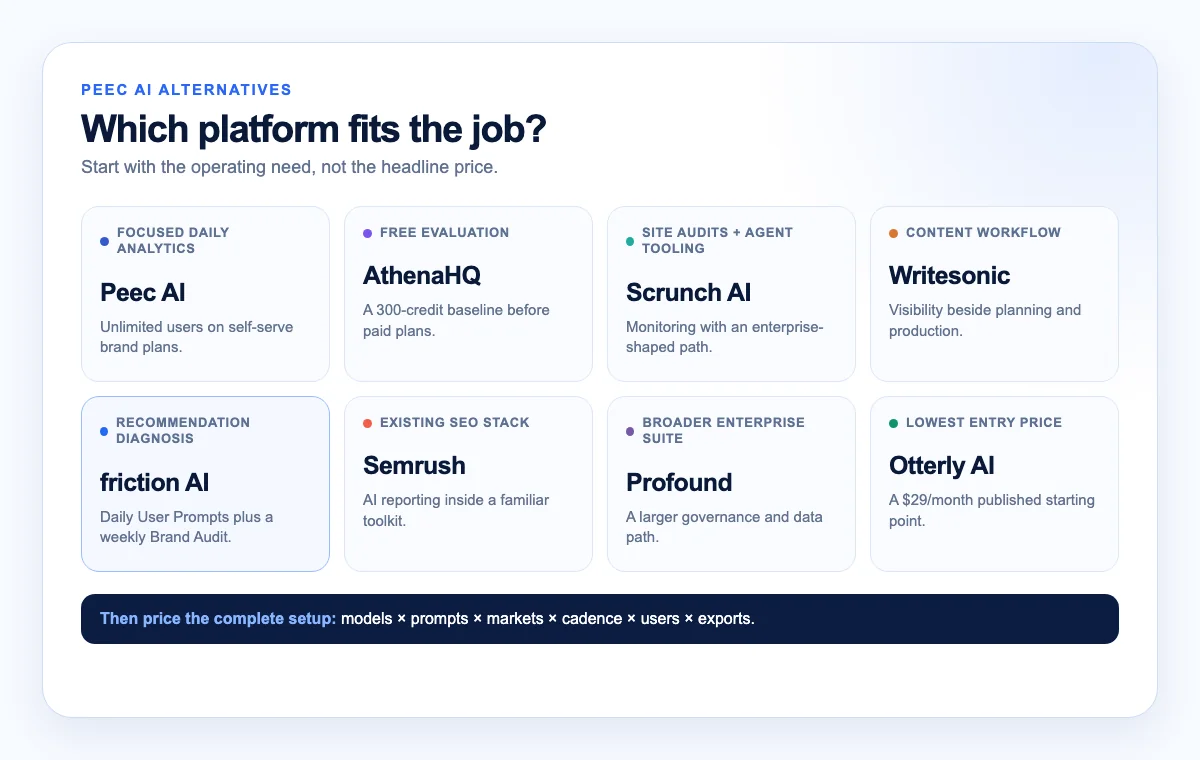
Quick comparison
Entry prices are not directly equivalent. Prompt definitions, model coverage, markets, refresh cadence, users and exports vary by vendor.
| Platform | Published entry point | Entry-plan shape | Best fit |
|---|---|---|---|
| Peec AI | $95/mo | 50 prompts, choose 3 models, unlimited users | Focused daily analytics with a polished self-serve workflow |
| AthenaHQ | Free; Starter $295/mo | 300 free credits; Starter includes 3,600 credits and 9 models | Free evaluation or a broader action platform |
| Scrunch AI | $250/mo | 125 prompts, 4 AI platforms, 1 workspace, 5 users | Brand teams that want monitoring plus site audits |
| Writesonic | $79/mo | 50 tracked prompts across ChatGPT, Gemini and Google AI Overviews | Content teams joining visibility and production workflows |
| friction AI | $69/mo | Weekly Brand Audit plus daily User Prompts | Recommendation accuracy, competitor diagnostics and prioritized actions |
| Semrush AI Visibility | $99/mo per domain | 25 custom prompts plus competitor and prompt research | Existing Semrush users and combined SEO/AI analysis |
| Profound | $99/mo billed annually | 50 prompts on ChatGPT at Starter | Teams evaluating a broader enterprise product path |
| Otterly AI | $29/mo | Lightweight multi-platform monitoring | Lowest-cost starting point |
AthenaHQ: a free baseline and credit-based action platform
AthenaHQ's Essential tier is free and includes 300 credits across ChatGPT, Perplexity, Google AI Overviews, Gemini and Claude. It also lists unlimited members, prompt and response analysis, source and competitor insights, content recommendations and its AI agent.
Starter costs $295 per month and includes 3,600 credits, visibility across nine models, API access, CSV export, integrations, on-page and off-page actions, and content optimization. Enterprise adds multi-region and multilingual support, governance controls and white-glove setup. Athena defines one credit as one AI response. See AthenaHQ plans for the current limits.
Athena is the better shortlist candidate when a free initial workspace matters, when response-based credits make more sense to your team, or when you want monitoring and content actions together. Peec is easier to justify if you prefer prompt allowances, want a lower paid entry point than Athena Starter, and do not need the broader action platform.
Scrunch AI: for larger brand and agent-experience programs
Scrunch Core costs $250 per month. It includes 125 unique prompts, four AI platforms, five site audits per month, one brand workspace and five user licenses. The supported Core platforms are ChatGPT, Perplexity, Google AI Overviews and Microsoft Copilot.
Scrunch Enterprise expands model coverage and adds API access, integrations, SSO, larger audits and its Agent Experience Platform. That creates a different path from Peec: Scrunch can move from monitoring into how AI agents consume and interact with a site. The trade-off is a higher starting price and a more enterprise-shaped product. See Scrunch pricing for current details.
Scrunch belongs on the shortlist when site audits, enterprise integrations and agent-experience infrastructure are central requirements. Peec is the simpler buy when you want lower-cost self-serve analytics, unlimited users and more prompt capacity before an enterprise procurement process.
Writesonic: for content teams
Writesonic combines AI visibility tracking with content strategy, an SEO and Content AI Agent, and article production. Its Starter plan is listed at $79 per month and tracks 50 prompts daily across ChatGPT, Gemini and Google AI Overviews. Higher tiers expand the visibility and action features.
This is less a pure replacement decision and more a workflow decision. If the team already plans and produces content in Writesonic, keeping visibility signals close to production can reduce handoffs. If the team wants a dedicated measurement product, Peec's narrower focus may be preferable. See Writesonic pricing for its current SEO and GEO plan matrix.
For a content team already using Writesonic, that integration may decide the comparison. Peec makes more sense when independent tracking and competitive analytics matter more than producing content in the same platform.
Peec AI vs friction AI
Peec AI and friction AI overlap on scheduled AI visibility tracking, competitor analysis and brand performance reporting. The practical difference is what each product treats as the end of the workflow.
Peec is analytics-led. Its self-serve plans make prompt volume, projects, model selection and daily tracking easy to understand. Unlimited users are valuable for marketing teams that want broad dashboard access without assigning seats carefully.
friction AI puts more weight on repeated recommendation measurement and diagnosis. Its weekly Brand Audit evaluates recognition, visibility, sentiment and purchase intent against competitors. User Prompts run daily, while Improve turns detected gaps into prioritized actions. Growth adds shopping-prompt tracking. Professional increases the User Prompt allowance and adds controlled prompt experiments. Current plan details are on the friction AI pricing page.
| Decision factor | Peec AI | friction AI |
|---|---|---|
| Starting price | $95/mo | $69/mo |
| Entry-plan model structure | Choose 3 models | Five answer surfaces listed across the product |
| Scheduled measurement | Daily tracking | Weekly Brand Audit plus daily User Prompts |
| Team access | Unlimited users on self-serve brand plans | Tiered team plans |
| Primary strength | Focused analytics and share-of-voice tracking | Recommendation diagnostics and prioritized actions |
| Higher-tier direction | More prompts, projects, integrations and enterprise controls | More User Prompts, Shopping analysis and controlled prompt experiments |
Choose Peec AI when
- Unlimited seats are important from the first paid tier.
- You want daily tracking with a clear prompt allowance.
- Choosing three core models is enough for your initial measurement plan.
- Your team wants a focused analytics product without adopting a broader experimentation workflow.
Choose friction AI when
- You care about whether AI recommends the brand, not only whether it mentions it.
- Competitor substitution, recognition and purchase intent are part of the measurement brief.
- You want findings translated into a prioritized improvement queue.
- Shopping prompts, a larger User Prompt allowance or controlled messaging experiments are likely to become part of the program.
Neither product is universally better. Peec has the cleaner proposition for teams centered on daily monitoring and broad internal access. friction AI is the better fit when the measurement program needs diagnosis, action prioritization and experiments around how the brand is recommended.
Semrush AI Visibility: for existing Semrush users
Semrush sells its AI Visibility toolkit for $99 per month per domain when billed annually. It includes 25 custom prompts, AI competitor analysis, prompt research, AI-readiness checks and visiblity reporting across ChatGPT, Google AI, Gemini and Perplexity.
The advantage is ecosystem fit. SEO teams can relate AI visibility to familiar keyword, competitor, audit and reporting workflows. The constraint is packaging: one domain, a smaller custom-prompt allowance and additional costs for more domains, users or prompts. See Semrush AI Visibility pricing for the current plan.
Semrush is the practical choice when the team already lives there and wants AI data in the same environment. Peec has the cleaner package when AI-search tracking is the primary requirement and the team wants 50 prompts plus unlimited users at the starting tier.
Profound: for a broader enterprise evaluation
Profound's public Starter plan costs $99 per month billed annually and tracks 50 prompts on ChatGPT. Growth costs $399 per month billed annually and broadens the model coverage. Enterprise adds Profound's wider analytics and governance product set.
Profound and Peec therefore serve different buying motions. Peec offers a direct self-serve path with unlimited users and a choice of models. Profound is relevant when the evaluation includes its broader enterprise products, datasets and implementation model. Check Profound pricing for current plan limits.
For a deeper post-decision shortlist, read Profound Alternatives: 5 Platforms to Evaluate.
Otterly AI: for the lowest-cost starting point
Otterly AI starts at $29 per month. Its lower entry price makes it suitable for teams establishing a basic AI visibility baseline before committing to a larger prompt set. The trade-off is that meaningful monitoring across more prompts, workspaces or advanced workflows can require a higher plan or add-ons.
Otterly wins on the size of the initial commitment. Peec is a better fit when 50 prompts, unlimited users and a clearer path into larger daily tracking programs matter more.
For a full evaluation, read Best Otterly AI Alternative for AI Brand Monitoring.
How to choose the right Peec AI alternative
Use the same normalized brief for every demo. Otherwise, vendors with different billing units will appear comparable when they are not.
1. Define the answer volume
Write down the number of prompts, models, countries and refreshes you actually need. A prompt tracked daily across five models is not equivalent to one response credit or a prompt checked weekly on one model.
2. Separate monitoring from action
Decide whether the product only needs to report visibility or must also prioritize changes, create content, test positioning, audit the site or connect results to other systems.
3. Price the complete configuration
Include model add-ons, domains, users, markets, exports and integrations. Entry prices are useful only when the entry plan matches the intended program.
4. Run tools in parallel before switching
Different products use different prompts, model versions, locations and scoring methods. Run the old and new systems together for at least two reporting cycles. Compare raw responses and brand-detection accuracy before comparing headline scores.
5. Keep the history you may need
Export prompts, raw responses, competitor definitions and time-series data before cancelling a tool. Historical scores often cannot be recreated becuase the underlying model response has already changed.
Frequently Asked Questions
What is the best Peec AI alternative?
It depends on the job. AthenaHQ fits a free baseline or credit-based action platform. Scrunch fits enterprise monitoring and site-audit programs. Writesonic fits content teams. friction AI fits recommendation diagnostics and prioritized actions. Semrush fits existing SEO workflows, Profound fits broader enterprise evaluations, and Otterly offers the lowest-cost entry point.
Is friction AI cheaper than Peec AI?
At the published starting price, yes: friction AI starts at $69 per month and Peec starts at $95 per month. The plans are not identical, so compare model coverage, prompt volume, cadence, users and higher-tier features before deciding from price alone.
How does Peec AI compare with friction AI?
Peec emphasizes daily analytics, selected-model tracking and unlimited users. friction AI combines daily User Prompts with a weekly Brand Audit, competitor diagnostics, prioritized improvements, higher-tier prompt allowances, Shopping prompts and controlled experiments. Peec is a strong fit for focused monitoring; friction AI fits teams that want a wider measurement-to-action loop.
Is Peec AI still a good choice?
Yes. Peec is a credible choice when 50 or more prompts, daily tracking, unlimited users and a focused analytics experience match the team's requirements. Looking at alternatives is about operating fit, not declaring Peec ineffective.
Can I preserve my Peec AI history when switching?
You can export the data Peec makes available, but another platform will calculate its own metrics from its own prompt runs. Keep the rawest export available and run both products in parallel before treating the new series as continuous with the old one.
Related guides
- Best AI Visibility Tools Compared 2026
- How to Compare AI Visibility Platforms
- Best AEO Platforms 2026
- Profound Alternatives: 5 Platforms to Evaluate
- Best Otterly AI Alternative