Why Competitor Analysis in AI Search Is Different
AI assistants like ChatGPT increasingly act as comparison engines. When users ask questions such as "Which brand should I choose?" or "What are teh best alternatives?", AI systems do not simply list options. They rank, frame, and recommend competitors based on how clearly each brand fits the question.
This makes competitor analysis in AI search fundamentally different from traditional SEO competitor analysis.
This article explains how to analyze competitors in AI-generated answers in a structured and repeatable way.
1. Define What Competitor Analysis in AI Search Means
Competitor analysis in AI search is not about backlinks, keywords, or rankings.
It's about understanding wich brands AI systems recommend, in what order, and for which use cases.
A competitor in AI search may not be a traditional SEO competitor. AI systems often recommend substitutes, adjacent categories, or niche brands that better match user intent.
For analysis purposes, competitors should be defined as any brand that AI systems position as an alternative to you in decision-oriented answers.
2. Identify the Prompts Where Competition Happens
AI-driven competition emerges around specific prompts. These typically include:
- "Best option" questions (
best CRM for startups) - Product or service comparisons (
Notion vs Asana) - Alternatives to a known brand (
alternatives to Salesforce) - Use-case specific recommendations (
project management for remote teams)
Competitor analysis should focus on these prompts rather than broad informational queries.
The goal is to understand where decisions are being influenced, not where information is being summarized.
3. Analyze How Competitors Are Framed
Competitors are not only recommended, they are framed.
AI systems often explain why a competitor is suitable, for example by highlighting strengths, ideal users, or trade-offs.
Key framing questions to analyze include:
- Is the competitor positioned as a default or a niche option?
- Are they recommended unconditionally or with caveats?
- Which attributes are emphasized?
This framing often explains why competitors are chosen even when products are similar.
4. Compare Recommendation Strength, Not Just Presence
Presence alone does not indicate competitive strength. See Harvard Business Review on competitive strategy for the underlying framework.
Some brands appear as minor mentions, while others are strongly recommended. Competitor analysis should distinguish between:
- Passive mentions
- Conditional recommendations
- Primary or default recommendations
Comparing recommendation strength reveals which competitors truly dominate AI-driven decisions. Learn more about AI visibility metrics.
5. Identify the Signals Driving Competitor Advantage
Competitor dominance in AI answers is rarely accidental. Common drivers include:
- Clearer positioning or category ownership
- Stronger association with specific use cases
- More consistent descriptions across sources
- Stronger perceived authority or credibility
Identifying these signals helps explain why competitors outperform rather than simply observing that they do. Understanding entity recognition is key to this analysis.
6. Track Competitive Shifts Over Time
Competitive positioning in AI search changes. AI models update. Content changes. New competitors emerge.
Tracking competitors over time helps identify:
- When a competitor gains or loses recommendation strength
- Whether changes are model-driven or signal-driven
- Emerging substitutes entering the decision set
Without temporal tracking, competitive analysis remains anecdotal.
7. Implementing This in Practice
Manual competitor analysis across AI prompts is time-consuming adn difficult to scale.
AI visibility platforms, including friction AI, automate this process. They benchmark brands against competitors across structured prompt sets, then track recommendation strength, framing, and visibility over time across models like ChatGPT, Gemini, and Claude.
This allows teams to understand not just who wins, but why.
Conclusion
Competitor analysis in AI search reveals a different competitive landscape than traditional SEO.
Brands win AI-driven decisions not by ranking higher, but by being clearer, more relevant, and more confidently recommended.
Teams that understand why competitors are chosen can act deliberately instead of guessing.
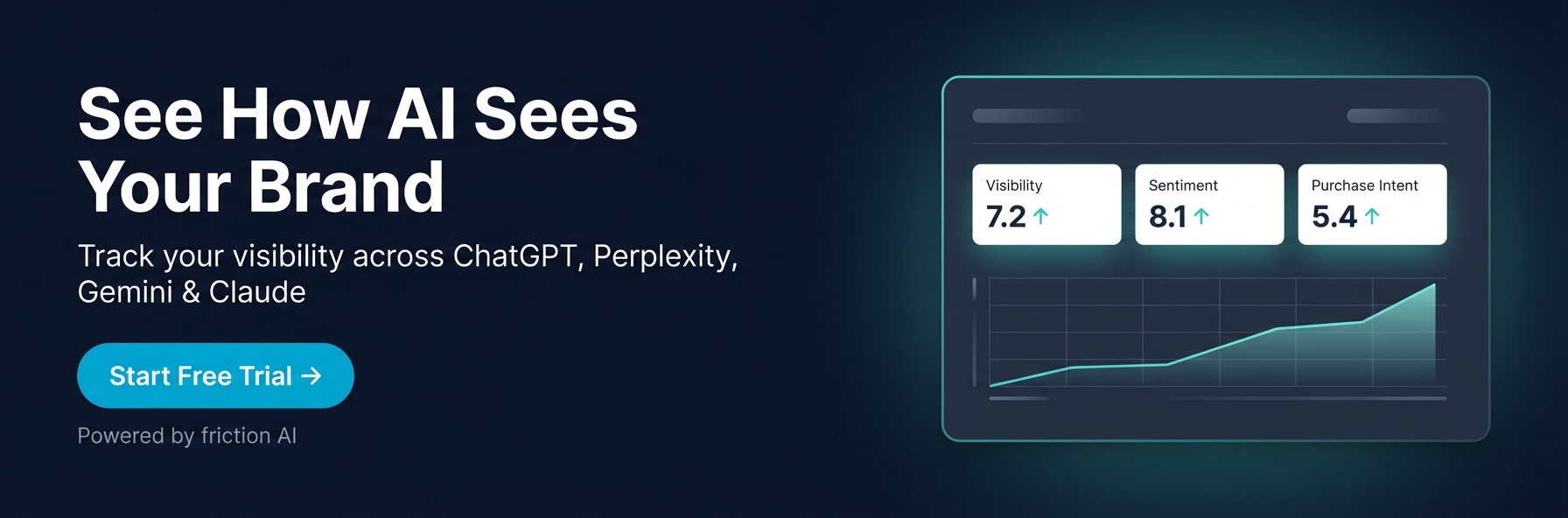
Benchmark your brand against competitors across ChatGPT, Claude, and Gemini. Compare competitors across key metrics: visibility, brand recognition, sentiment, and purchase intent.
Frequently Asked Questions
How can I track if AI search engines are mentioning my competitors instead of my company?
Run the same queries across ChatGPT, Claude, Gemini, and Perplexity for both your brand and competitors. Compare who gets mentioned, who gets recommended, and how each is framed. AI visibility platforms, including friction AI, automate this comparison across structured prompt sets.
Why are my competitors outranking me in AI-generated shopping recommendations?
Competitors likely have stronger signals: more reviews, better third-party coverage, clearer positioning, or more consistent messaging. McKinsey research shows brand-owned pages make up only 5-10% of AI sources, so AI recommends the brands it can confidently identify and trust from everyone else.
How can I see which competitors are beating me in AI search results?
Ask AI buying questions in your category: best [category] for [use case]. Note who appears first, who gets recommended, and what language is used. Do this across multiple models to spot patterns.
How can I track my competitors' visibility in ChatGPT shopping recommendations?
Monitor competitor mentions in commercial queries. Ask Which [category] should I buy? and variations. Track who AI recommends and how positioning changes over time.
Can I get competitive analysis showing how my brand compares to rivals in AI search results?
Yes. friction AI provides competitive benchmarking showing your visibility, sentiment, and purchase intent versus competitors across ChatGPT, Claude, Gemini, and Perplexity.
Why do some competitors appear more often in AI recommendations than we do?
Usually it's authority signals: more reviews, more media coverage, more third-party mentions, better presence on platforms AI indexes. Audit where competitors are present that you aren't.
Related Articles
- AI Competitive Intelligence: Tracking Your Brand vs. Competitors
- How to Monitor Competitor Mentions in AI Answers
- How to Measure AI Visibility: Key Metrics and KPIs (2026)