Whose experience does AI visibility tracking measure?
AI visibility measurement starts with answers from a specific setup. It shows which brands appeared for your tracked questions and chosen models. To interpret that report, you also need to know something about the account behind those answers.
Imagine asking an AI assistant which HR software to consider. Someone starting a business and a CEO replacing an old system might type the same question. But their earlier chats could give the model different clues about what they need.
That raises a measurement question: does your brand keep appearing across those account histories, or does the picture depend on which account you use?
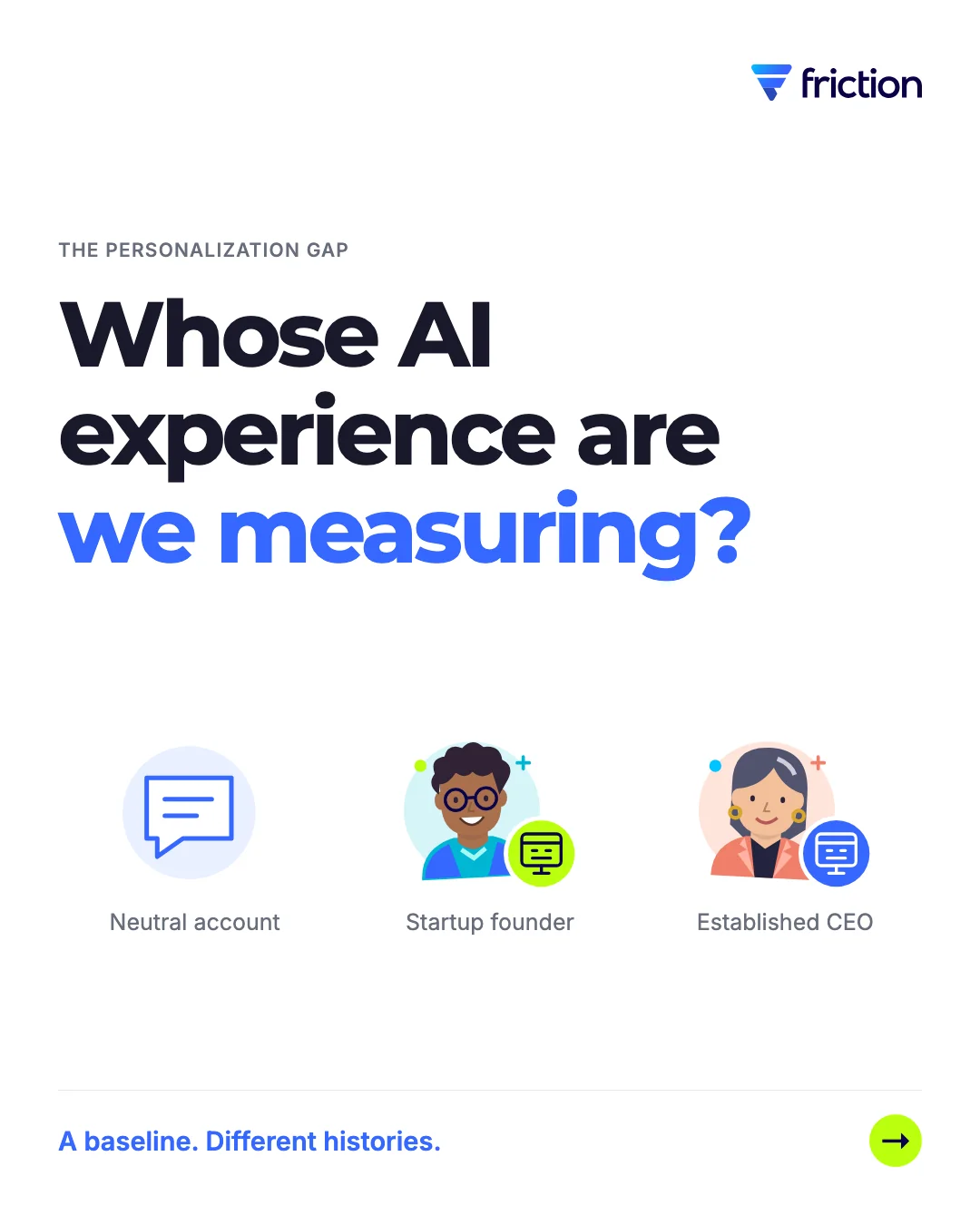
The question behind this follow-up: what does each account setup add to your view of AI brand recommendations?
What did the study establish?
We tested 6 planned personas, paired across skincare, HR software and children's gifts, in 1 market: the UK. We collected answers from ChatGPT, Claude, Gemini and Perplexity twice a day for 9 days in June 2026. The total includes API responses, temporary chats and accounts with planned histories. Study method, sections 4.1 to 4.4.
Most of the brands that kept appearing were shared between the browser setups. ChatGPT and Gemini showed clear differences beyond normal answer variation. The evidence for Perplexity was less certain, while Claude showed no clear change in its recurring brand list. These results describe the models and accounts we tested. They aren't fixed ratings of each platform. Results, section 6.
I'd keep the neutral baseline and test other account histories when there's a useful business question to ask. That's my takeaway from the research. It doesn't mean every brand needs the same set of personas.
Why keep a neutral baseline?
A neutral baseline gives you a consistent reference for change. If you keep the questions and account setup stable, you can follow which brands appear over time. Answers can still vary. Keeping the setup steady gives you fewer changes to untangle when you review the results.
For our neutral browser test, we used temporary chats while logged in. These chats had no retained history. We also collected answers through an API, where software sends the question directly to the service. We kept that as a separate test. Temporary chats and API calls aren't the same setup.
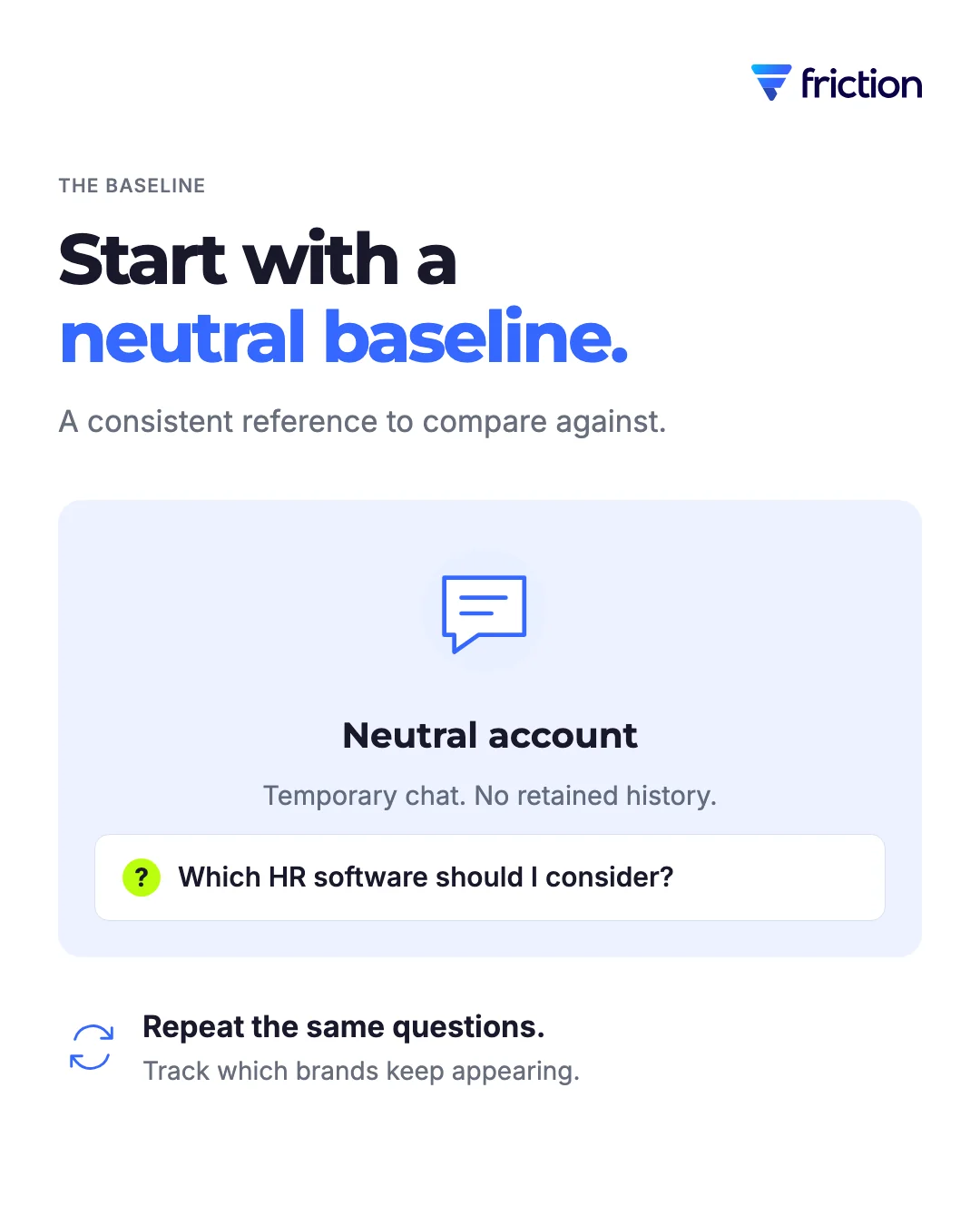
A neutral setup gives you a reference. Repeated answers show which brands keep appearing within that setup.
Suppose a competitor starts appearing more often in your tracking. A steady baseline lets you check whether that pattern lasts across later runs. If you change the account, prompt wording and model at the same time, the comparison becomes much harder to explain.
A neutral account still has a setup. The model, market, search settings and date can all matter. Record them so the next person reading the report knows how you collected the answers.
Our guide to tracking brand mentions across AI platforms covers the collection workflow. Keep that foundation when you add persona comparisons. You need an ongoing reference alongside the extra views.
What do accounts with different histories add?
An account with a planned history lets you test AI personalization for a specific background. Keep the question the same and check which brands keep appearing. Choose a background that matters to a buying decision, then see whether the answers support what you expected.
The HR software pair makes this concrete. One study persona was a startup founder choosing software. The other was an established CEO switching providers. We gave the accounts different chat histories before asking the study questions. Persona design, section 4.3.
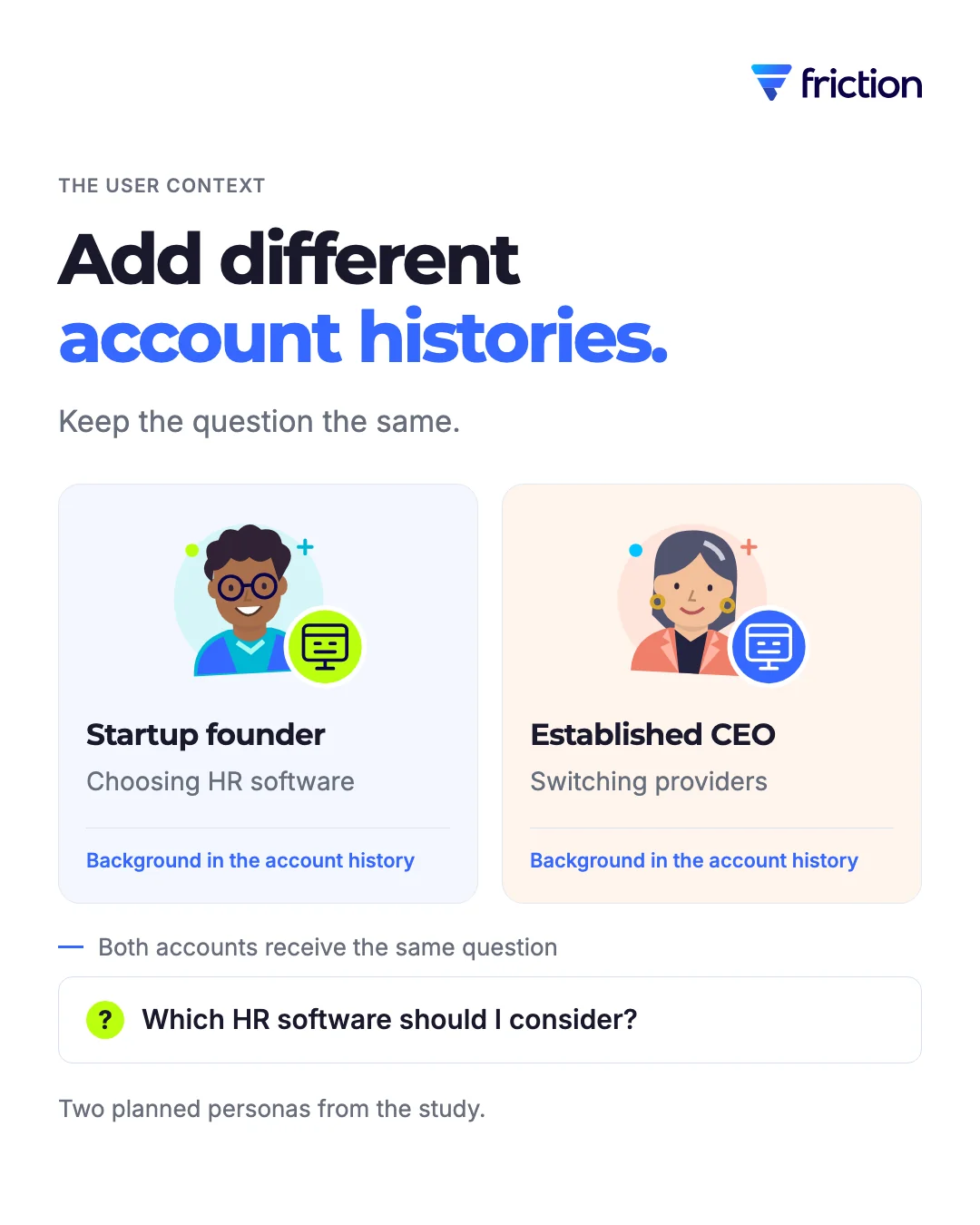
The background sits in the account history. The current question stays the same.
For your own research, start with a buying situation you want to understand. You might compare a business buying its first system with a business replacing an existing provider. Write down why that difference could matter before looking at the answers.
A persona name alone doesn't give you much to test. "Busy founder" leaves too much open to interpretation. A clear buying situation gives you something to test. Write down the account setup so you can repeat it.
Use your customer research to choose relevant backgrounds. Sales calls and support questions can help you choose what to test. They don't prove the test account will behave like the people who asked those questions. Our guide to finding buyer questions for AI covers useful starting sources.
Is this the same as putting a persona in the prompt?
No. Adding a persona to the prompt gives the model a new cue in that question. We wanted to test whether the account's existing history mattered without adding that cue each time.
Take this illustrative example: "Which HR software should I consider as a startup founder?" You have already told the model to consider the founder's background. Asking "Which HR software should I consider?" leaves that background out of the question.
Our method keeps the question the same and puts the background in the account history. Every account received the same study questions. Different prompt wording therefore couldn't explain the differences between those accounts. Study design, section 4.3.
That matters for measurement. A persona added to a prompt tests how the model responds when you explicitly describe the user. Our approach tests whether the brand recommendations differ across accounts with different histories, without telling the model who the user is in each question.
For that research question, keeping the prompt unchanged is a strength of the design. It gives us a way to study account context while holding the wording constant.
How should you compare the accounts?
Give neutral and persona accounts the same questions, on the same model and in the same market. Collect the answers over the same period and repeat the test. Check each account's results on their own before deciding whether a difference needs a closer look.
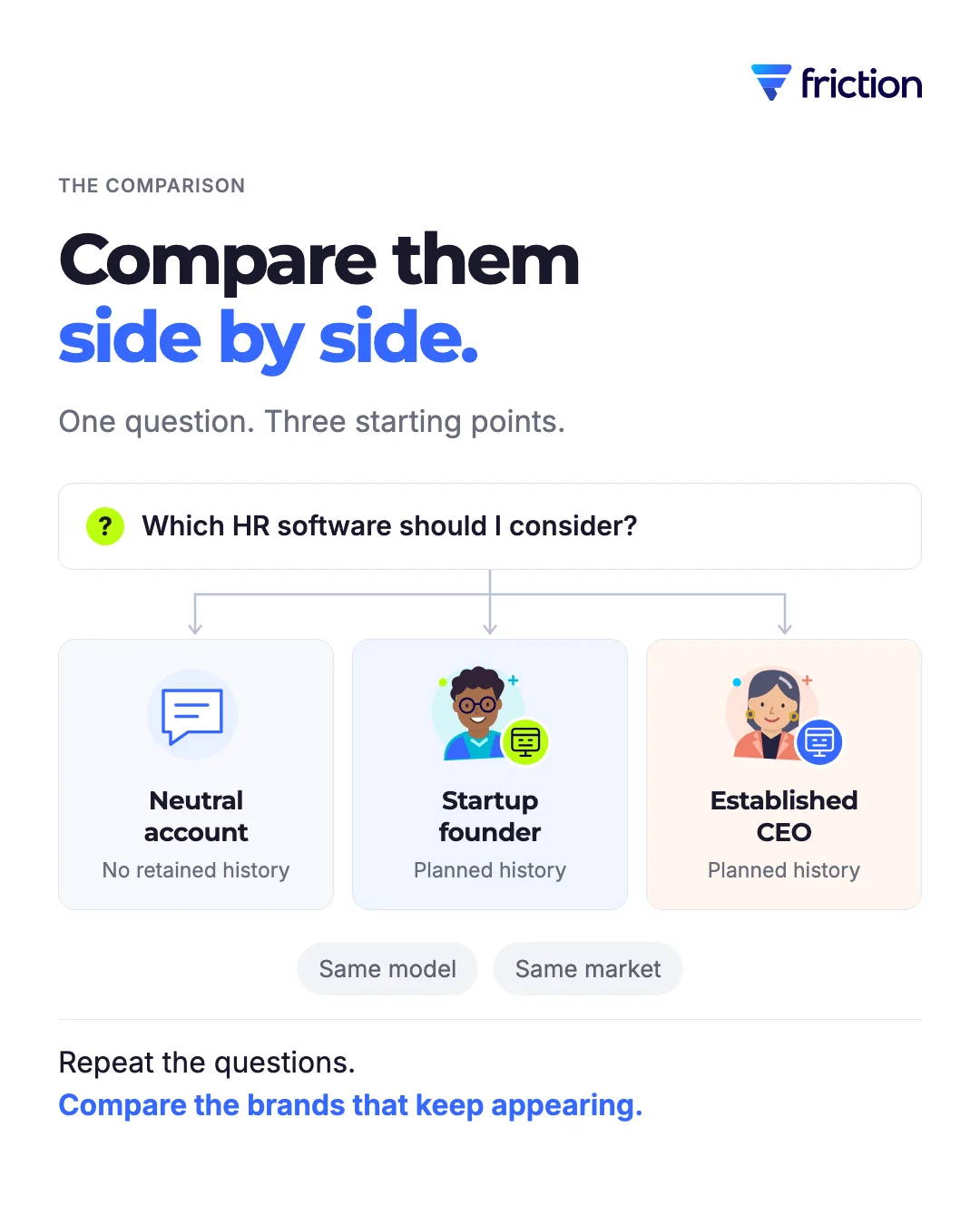
One question reaches different account conditions. This diagram explains the comparison; it doesn't predict which brands will appear.
Make the comparison repeatable
Before collecting answers, write down what you'll hold constant and what you'll vary:
- Hold the question text constant. Otherwise a wording change becomes another possible explanation.
- Match the model and market. Record the displayed model or mode and relevant location settings.
- Describe each account condition. Include its planned history and any visible memory or personalization settings.
- Use a shared collection window. Record the date and time instead of comparing an old baseline with a fresh persona run.
- Repeat and retain the answers. Separate failed runs from valid answers that don't name any brands.
Then check which brands keep appearing. In the paper, a brand joined the recurring list if it appeared in at least 50% of successful repeated answers in its series. We used that rule to build the study's lists. It doesn't guarantee future answers or set a rule that every report must follow. Analysis method, section 5.
Separate account differences from normal variation
Two answers can differ even when you change nothing. Our volatility floor estimated how much the brand lists would overlap from that normal variation alone. We then checked the overlap between account setups against that reference.
In plain language, the check asks whether the difference between accounts is larger than the difference the model can produce on its own. A new brand in one answer doesn't prove that history caused the change. Repeated answers give you more to work with than a pair of screenshots.
Turn the result into a useful next step
Keep a separate column for each account setup. Record how often a brand appeared and whether the answer recommended it. Save the sources the answer cited, where those links are available.
The table below shows possible patterns to investigate. These are illustrative interpretations, not additional study results.
| Pattern in repeated answers | What it supports | What to check next |
|---|---|---|
| Your brand appears across the neutral and persona conditions | It appears across the tested backgrounds | Check whether the descriptions and reasons for recommending it also match |
| Your brand appears mainly in one persona condition | Its appearance may depend on that tested setup | Repeat the comparison and inspect the cited sources and stated needs |
| Your brand is absent across the tested conditions | The collected answers show a wider gap | Review the question's relevance, competing brands and sources before deciding what to change |
| The lists keep changing within every condition | The current evidence is unstable | Collect more comparable answers before treating the difference as a finding |
Don't roll all the persona results into a score for your whole market by default. Giving each test account the same weight doesn't mean your buyers fall into equally sized groups. Keep the separate results visible so a single number doesn't hide where the accounts differ.
What comes next: keep the baseline and add context
Start with the tracking you already do and choose a buying situation worth testing. Add an account history to explore that question. Keep your original baseline running alongside it, so you can follow changes over time and explain what each view shows.
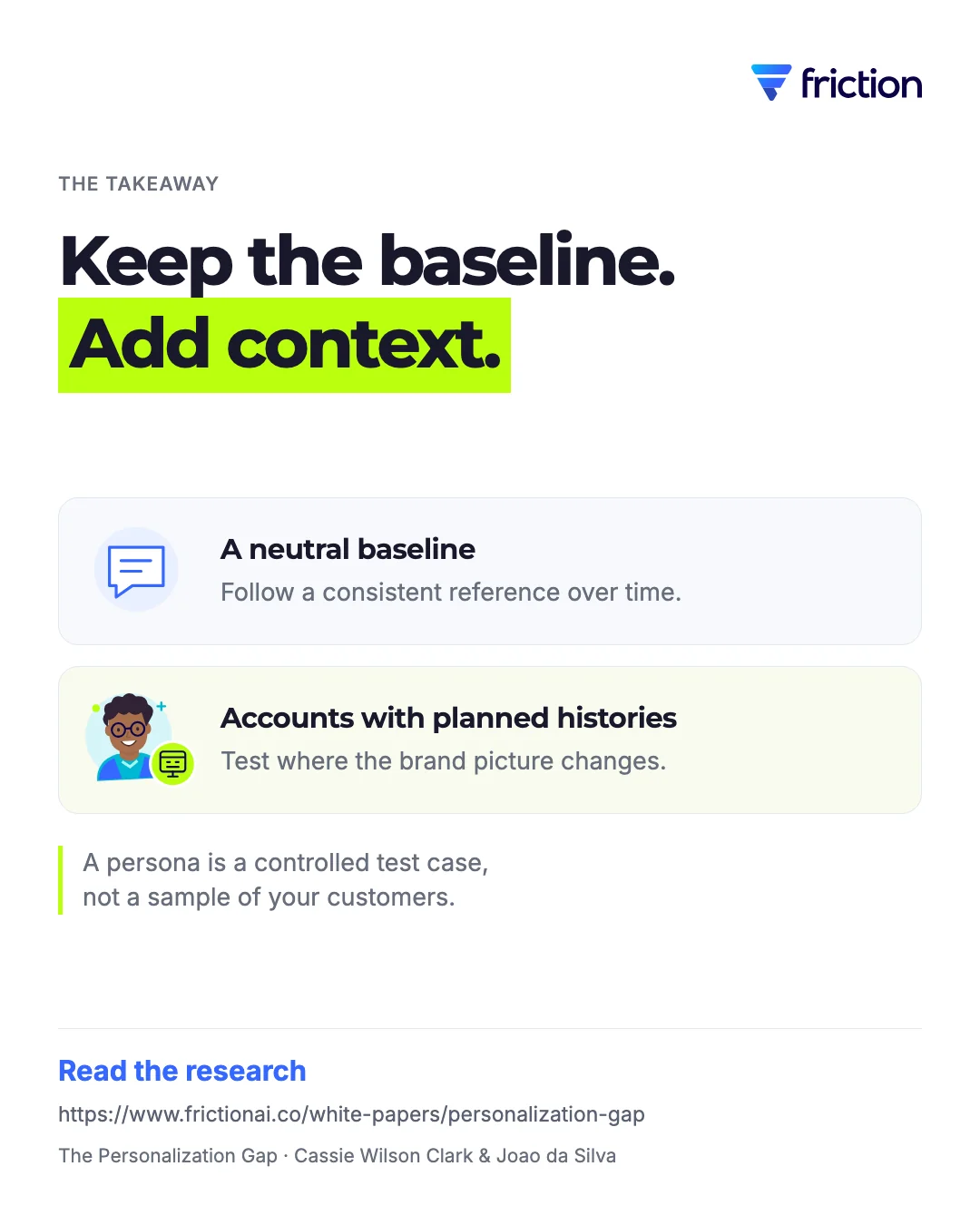
Keep both views visible. A planned persona gives you a controlled test case, rather than a customer sample.
Before you start, decide what you'd do with each outcome. If the brand lists match, this test didn't find a clear difference in that measure. If the lists keep differing, look more closely at the answers and the sources behind them.
For your marketing team, that might mean checking how cited sources describe your product for that type of buyer. A missing mention alone doesn't tell you to write another blog post. Read the answers and check the pattern before deciding what to change.
Make this part of your regular review. Our AI brand monitoring guide covers how to track and act on what AI says about your brand. The generative engine optimization guide explains how that work fits with content and discovery.
Frequently Asked Questions
Does chat history change AI brand recommendations?
It can. ChatGPT and Gemini showed clear differences in the brands that kept appearing across our account setups, beyond normal answer variation. That doesn't mean every chat history changes every answer. The result depends on what you test.
Should persona accounts replace neutral tracking?
Keep the neutral baseline and add persona conditions where they answer a useful question. The baseline gives you a reference over time. The extra accounts let you check whether the brand picture changes with a different background.
Can an API response stand in for a persona account?
An API answer comes from its own setup. You can't assume it matches a logged-in account with a chat history. We kept API answers separate in the study, and a report should state which setup its answers came from.
How many repeated answers are enough?
This study doesn't set a minimum that works for every question, model and account. Check how much the answers vary and how sure you need to be for the decision at hand. If the results are mixed, say so and gather more before calling a trend.
Build a clearer picture of your brand's AI visibility
I co-founded friction AI and wrote the study with Cassie Wilson Clark, so I have a commercial interest in AI visibility tracking. My recommendation is to keep the baseline and test where account history adds useful information.
The platform tracks your brand in AI answers and helps you review results over time. You can examine which brands keep appearing and the sources behind the answers. Explore the tracking plans.
The complete method, results and limitations are in The Personalization Gap, with the deposited paper available on Zenodo.