AI search optimization is the practice of structuring your brand's content, authority signals, and digital presence so that AI-powered search platforms, including Google AI Overviews, ChatGPT, Perplexity, and Gemini, surface, cite, and recommend your brand in their generated responses. It extends traditional search optimization into a new category of discovery where synthesized answers replace clickable links.
What is AI Search Optimization?
Traditional SEO got your pages ranked in a list. AI search optimization gets your brand mentioned in a conversation.
The distinction matters becuase AI search engines don't send users to ten blue links. They construct an answer by pulling from multiple sources, synthesizing the information, and presenting a unified response. Your brand either makes it into that response or it doesn't. There's no "page two" to scroll to.
This shift has been accelerating since Google launched AI Overviews (originally Search Generative Experience) in 2023, and as ChatGPT's browsing mode, Perplexity's real-time search, and Gemini's integrated AI became mainstream alternatives to traditional search. Data from Similarweb shows AI search platforms collectively growing usage month over month, pulling query volume away from traditional search.
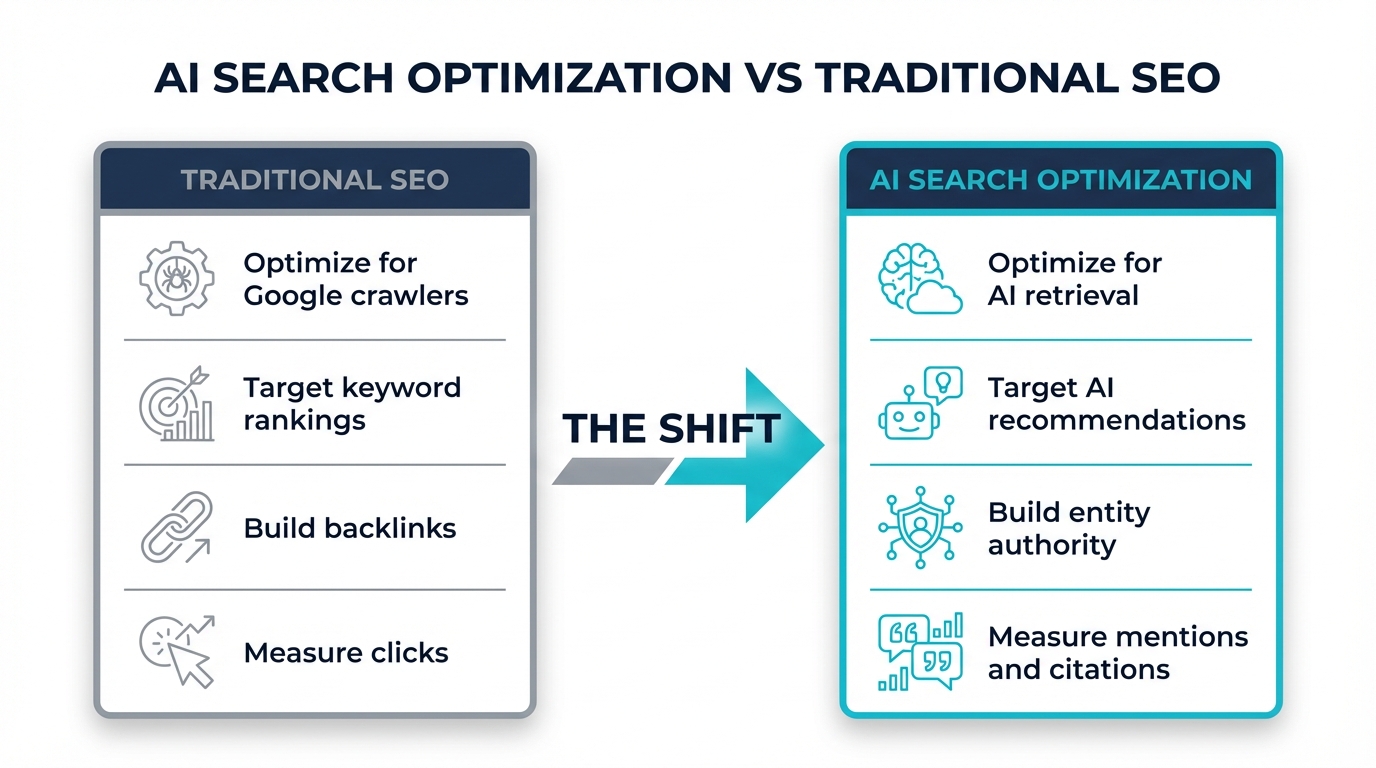
AI search optimization isn't a replacement for SEO. It's an additional layer. Your existing SEO work feeds into AI retrieval systems, but AI search requires distinct tactics around entity clarity, source authority, content structure, and third-party validation that traditional keyword optimization alone won't cover.
7 AI Search Ranking Factors
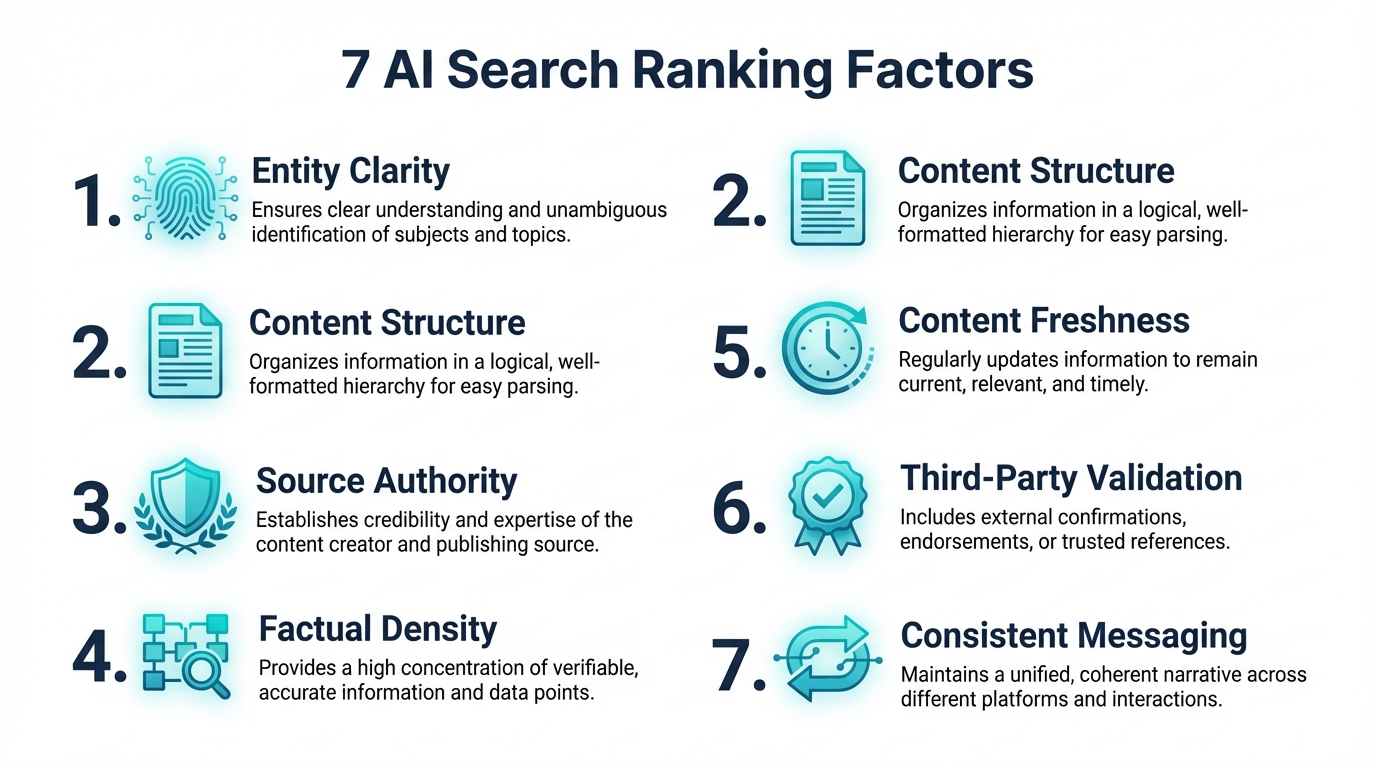
AI search engines don't publish ranking algorithms the way Google shares its Search Quality Rater Guidelines. But through research, testing, and analysis of AI-generated responses, clear patterns emerge. Here are the seven factors with the strongest influence on AI search visibility.
1. Source Authority and Trust
AI systems prioritize information from sources they can trust. Domain authority, editorial reputation, and a track record of accurate, well-sourced content all contribute to whether your pages make it through the retrieval stage.
Research from the GEO paper published by Princeton and collaborating universities confirmed that adding authoritative citations to content increased visibility in generative engine outputs by up to 40%. The AI's trust in your content correlates with the trust signals your domain carries.
2. Entity Clarity and Consistency
AI models work with entities, discrete concepts with defined attributes and relationships. If your brand is a clear entity with consistent attributes across your website, Wikipedia, Crunchbase, LinkedIn, and industry databases, AI systems can confidently include you in relevant responses.
Inconsistent brand descriptions, conflicting information across platforms, or vague positioning creates ambiguity that AI models resolve by omitting you from responses.
3. Content Freshness
Platforms like Perplexity crawl the web in real time. Google AI Overviews pull from the fresh search index. ChatGPT's browsing mode retrieves current pages. Across the board, stale content loses to current content.
This doesn't mean you need to publish daily. It means your core content, comparison pages, pricing data, feature descriptions, and industry statistics, needs regular updates with visible publication dates.
4. Factual Specificity
AI models favor content with concrete, verifiable claims over vague assertions. "Our platform processes 2.4 million queries per month across 47 markets" gets cited. "Our industry-leading platform delivers exceptional results" doesn't.
Audit your highest-value pages for vague marketing language. Replace it with specific numbers, timelines, methodologies, and measurable outcomes.
5. Structured Content Format
Clear heading hierarchies, comparison tables, definition paragraphs, and logically organized sections all improve the odds that a retrieval system will surface your content and that the synthesis model will incorporate it accurately.
The Nielsen Norman Group's research on how AI models process content supports what practitioners see in practice: well-structured content is parsed more reliably and cited more frequently.
6. Third-Party Consensus
When multiple independent sources mention your brand positively, AI systems gain confidence in recommending you. A product mentioned favorably by TechCrunch, G2 reviewers, and three independent bloggers carries more weight than a product promoted only on its own website.
This consensus signal makes earned media, product reviews, and genuine community presence direct inputs to AI search visiblity.
7. Query-Answer Alignment
AI search queries tend to be conversational and specific. "What's the best accounting software for freelancers?" rather than "accounting software." Content that directly addresses these specific, natural-language queries is more likely to be retrieved and synthesized.
Map your content to the actual questions your target audience asks AI search engines, not the short-tail keywords from your traditional SEO playbook.
Platform-by-Platform Optimization
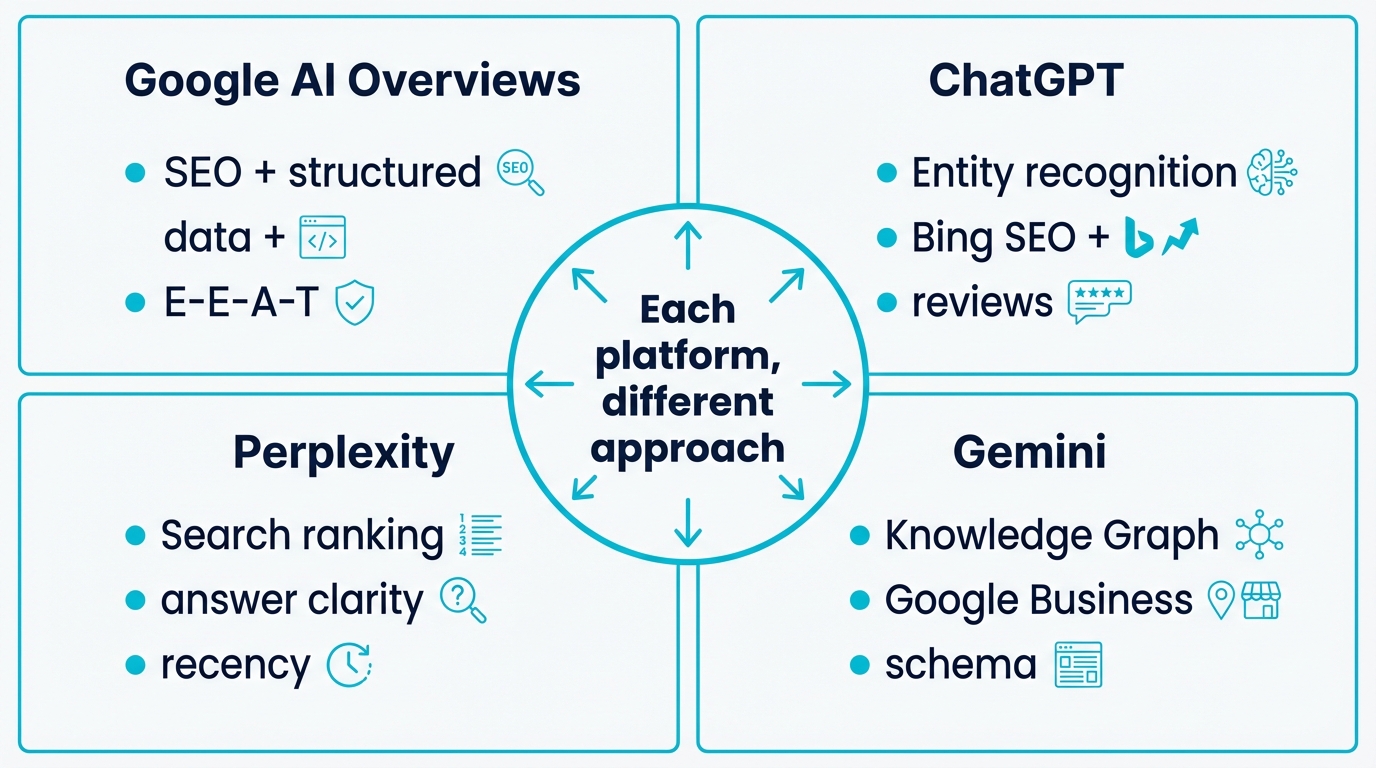
Each AI search platform has unique retrieval mechanics. Optimizing across all of them requires understanding these differences.
Google AI Overviews
Google AI Overviews sit at the top of search results for many queries, synthesizing information from Google's own search index into a generated summary.
Optimization for AI Overviews builds directly on traditional Google SEO. Pages that rank in the top 10 organic results are the primary source pool for AI Overviews. According to a study by Zyppy, approximately 99.5% of URLs cited in AI Overviews also appeared in the top 10 organic results.
Focus on strong on-page SEO, clear entity definitions, and structured content for your target queries. Schema markup (FAQ, HowTo, Product) helps Google's systems understand and extract your content for AI Overview synthesis.
ChatGPT
ChatGPT operates in two modes: generating from training data and browsing the web in real time via Bing's index. Your optimization strategy needs to address both.
For training-data influence, build a strong, consistant brand presence across high-authority sources that are likely included in OpenAI's training corpus, including Wikipedia, major publications, and established industry sites.
For browsing-mode visibility, optimize your Bing presence. Submit your sitemap to Bing Webmaster Tools, monitor your Bing rankings, and ensure your content loads properly for Bing's crawler.
Perplexity
Perplexity AI is a search-first platform that crawls the web in real time and cites every source it uses. This makes it the most transparent AI search engine for tracking your visibility.
Perplexity's crawler (PerplexityBot) respects robots.txt. Make sure you're not blocking it. Focus on creating content with specific, citable claims, because Perplexity's citation model rewards content it can attribute a distinct piece of information to.
Technical content with clear data points, step-by-step processes, and comparison tables performs well on Perplexity. The platform's users tend to ask detailed, research-oriented questions.
Gemini
Google's Gemini integrates with Google's broader ecosystem, including Search, Workspace, and Android. It draws from Google's search index and knowledge graph.
Optimization for Gemini overlaps heavily with Google AI Overviews. Strong organic rankings, clear entity presence in Google's Knowledge Graph, and well-structured content are the primary levers. Ensure your Google Business Profile (if applicable) is complete and accurate, as Gemini pulls from this data for local and business-related queries.
Common AI Search Optimization Mistakes
Knowing what not to do saves time and prevents wasted effort.
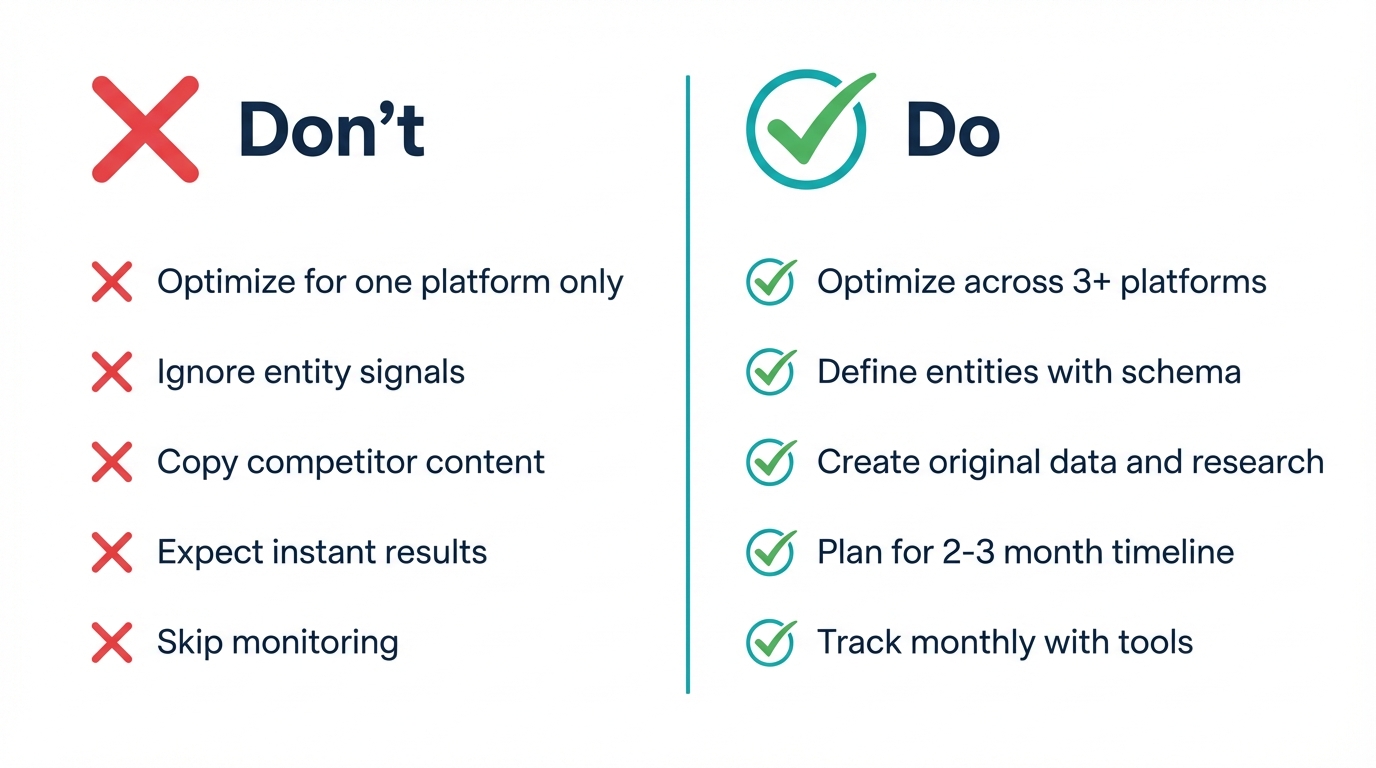
Treating AI Search as a Keyword Game
Stuffing conversational keywords into your content won't fool AI retrieval systems. These systems evaluate content quality, source authority, and factual accuracy, not keyword density. Focus on creating genuinely useful content that answers real questions.
Ignoring Bing
Many brands optimize exclusively for Google and treat Bing as an afterthought. Since ChatGPT and Microsoft Copilot both use Bing's index, this blind spot directly reduces your visibility on two major AI platforms.
Publishing Without Data
Generic thought leadership without supporting data rarely gets cited by AI systems. If you're publishing opinion pieces, supplement them with original research, specific examples, and verifiable claims that give AI models something concrete to reference.
Neglecting Entity Consistency
If your brand description says one thing on your website, something different on LinkedIn, and something else on Crunchbase, AI models face conflicting information. This ambiguity reduces the likelihood of confident recommendations. Audit your brand presence across platforms and align your messaging.
Blocking AI Crawlers
Some brands block AI crawlers (GPTBot, PerplexityBot, ClaudeBot) in their robots.txt out of concern about training data usage.
This is a legitimate choice, but understand the tradeoff: blocking these crawlers can reduce your visibility in the associated AI platforms. Make the decision deliberately, not by default.
Optimizing Once and Walking Away
AI search is not a set-and-forget channel. Models get updated, retrieval indexes refresh, and competitor content evolves. Brands that treat AI search optimization as a one-time project will see their visibility erode as others continue optimizing.
How to Measure AI Search Performance
Measurement is the biggest challenge in AI search optimization. Traditional analytics weren't built for this channel.
Core Metrics
Citation rate tracks how often your content is cited as a source in AI-generated responses. This is most directly measurable on Perplexity, which always shows source citations.
Brand mention rate measures how often your brand name appears in AI responses to relevant queries, whether or not a citation link is included. This captures training-data mentions where no link is provided.
Recommendation rate specifically tracks responses where the AI recommends your product or service. This is the highest-intent signal.
AI share of voice measures your brand's mention presence relative to competitors across AI search platforms. If five brands compete in your category, what percentage of AI mentions does each capture?
Building a Query Set
Create a list of 30-50 queries that represent how your target audience would ask AI search engines about your category, product type, and use cases. Run these queries monthly across ChatGPT, Perplexity, Gemini, and Google AI Overviews. Track which brands appear, in what context, and whether citations point to your content.
Referral Traffic
Monitor your analytics for referral traffic from AI platforms. ChatGPT (chatgpt.com), Perplexity (perplexity.ai), and Google AI Overviews (via Google organic, though harder to isolate) can all drive visitors. The volume may be modest compared to traditional search, but the intent is typically high.
Automated Monitoring
Manual testing gives you insight but doesn't scale. AI visibility platforms can automate query monitoring, track metrics over time, and alert you to changes in your competitive position across AI search engines.
For industry-specific guidance, see our guide on AI search optimization for SaaS.
Related Articles
- AEO Explained: Complete Guide for 2026
- What is Generative Engine Optimization?
- How to Improve Visibility in AI Search