An AI brand health audit is a systematic assessment of how AI platforms like ChatGPT, Perplexity, Gemini, and Google's AI features perceive, describe, and recommend your brand. It evaluates whether AI-generated answers about your brand are accurate, positive, and frequent enough to support your business goals, giving you a clear picture of your brand's standing in the AI-driven discovery channel.
What Is an AI Brand Health Audit?
Your brand has a reputation in AI. Whether you've shaped it or not, AI platforms are already answering questions about your company, products, and category. An AI brand health audit tells you what those answers look like.
This isn't a one-time curiosity exercise. AI platforms are increasingly where your customers go before they buy. A 2024 survey from McKinsey reported that 72% of organizations had adopted at least one AI tool, and consumer adoption of AI assistants for product research continues to climb.
If a potential customer asks ChatGPT "What's the best [your category] tool?" and your brand isn't mentioned, or worse, its mentioned with negative framing, that's a problem you need to know about. An AI brand health audit surfaces these issues before they compound.
The audit also establishes a baseline. You can't improve what you dont measure. Once you've documented your current AI brand health, you can track progress as you optimize your entity signals, content, and web presence.
The 5 Dimensions of AI Brand Health
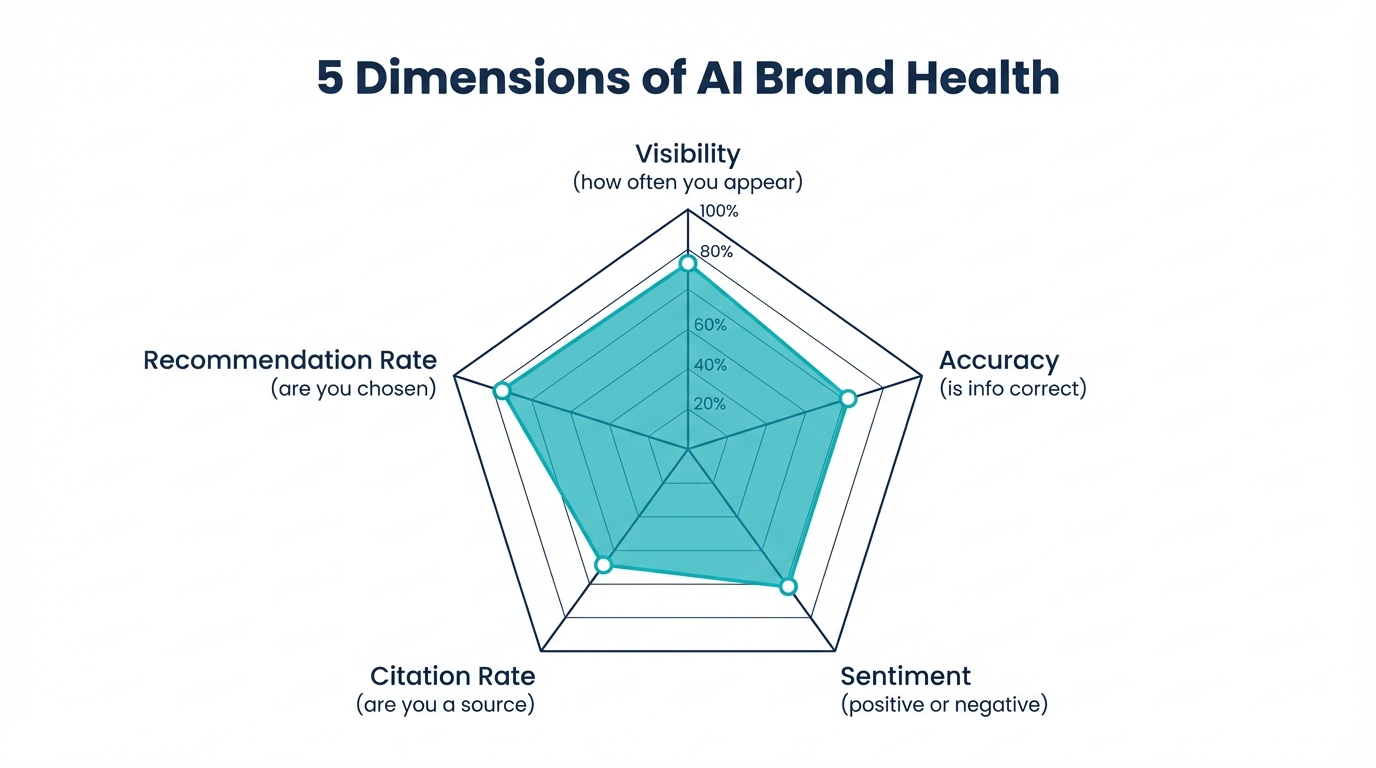
A comprehensive audit evaluates your brand across five distinct dimensions. Each captures a different aspect of how AI platforms interact with your brand.
Visibility
Visibility measures how often your brand appears in AI-generated answers. When users ask questions in your category, does your brand show up?
This goes beyond a binary yes or no. You need to know your visibility rate: out of 100 relevant prompts, how many produce a response that mentions your brand? You also need to know your position within those responses. Being mentioned first carries more weight than being listed fifth.
Track visibility across multiple AI platforms. Your brand might be well-represented in ChatGPT but absent from Perplexity, or strong in Google AI Overviews but missing from Gemini. Each platform draws from different data sources, so visibility gaps are common and platform-specific.
Accuracy
Accuracy measures whether AI platforms describe your brand correctly. This includes your product capabilities, pricing, company size, founding date, leadership team, and competitive positioning.
AI hallucination is a documented problem. Research published by Stanford's Institute for Human-Centered AI has shown that LLMs can generate plausible but incorrect statements about real entities, including brands. Your audit needs to catch these inaccuracies.
Test accuracy by asking AI platforms factual questions about your brand: "What does [your brand] do?", "How much does [your brand] cost?", "Who founded [your brand]?" Compare every answer against reality. Flag any inaccuracies and assess there severity. A wrong founding year is minor. A wrong description of your core product is critical.
Sentiment
Sentiment captures the emotional framing AI platforms use when discussing your brand. Is the language positive, neutral, or negative? Does the AI recommend your brand enthusiastically, or does it hedge with caveats and qualifiers?
Pay attention to subtle sentiment signals. There's a meaningful difference between "HubSpot is a popular CRM" and "HubSpot is widely regarded as the best CRM for small businesses." Both are positive, but the second carries a stronger endorsement.
Also check sentiment in competitive contexts.
When your brand appears alongside competitors, how does the AI frame the comparison? Are you positioned as the leader, an alternative, or an afterthought?
Citation Rate
Citation rate measures how often AI platforms link back to your content as a source. This applies primarily to platforms with source attribution: Perplexity, Google AI Overviews, AI Mode, and Claude (which sometimes cites sources).
A high citation rate means AI platforms aren't only mentioning your brand but actively referencing your content as authoritative. This drives direct traffic and reinforces your brand's expertise positioning.
Track which specific pages on your site get cited most often. This tells you what content formats and topics AI platforms consider most valuable from your domain.
Recommendation Rate
Recommendation rate is the most commercially important dimension. It measures how often AI platforms recommend your brand when users express purchase intent or ask for advice.
This differs from visibility. Your brand might be mentioned in an informational response ("companies in this space include...") without being recommended ("I'd recommend..."). The recommendation rate captures the higher-value interactions where AI platforms actively steer users toward your brand.
Test with purchase-intent prompts: "What's the best [category] tool?", "Which [category] product should I buy?", "What do you recommend for [problem]?" Your recommendation rate is the percentage of these prompts where your brand appears as a suggested option.
See It in Action
Watch how to run a quick AI brand visibility check:
Step-by-Step Audit Framework
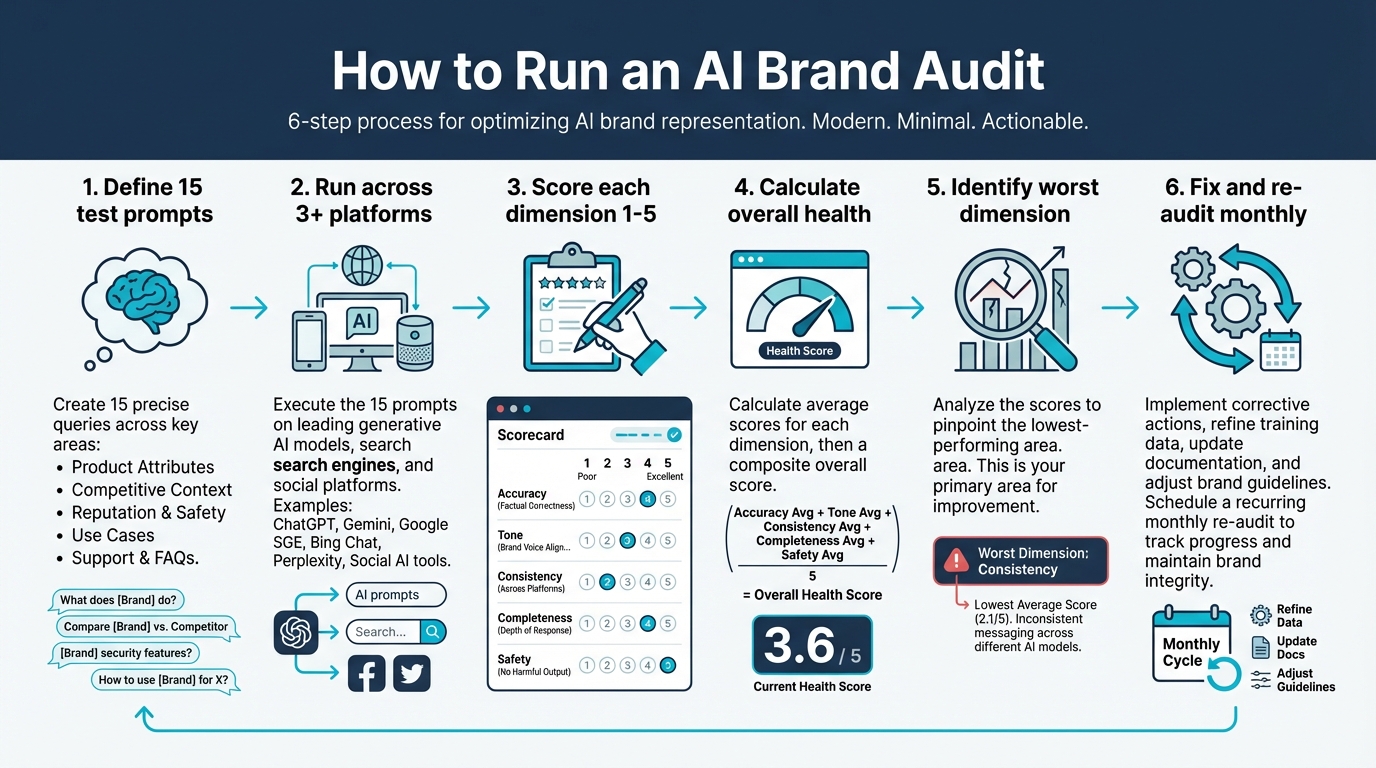
Follow this process to run a complete AI brand health audit.
Step 1: Define Your Prompt Library
Create 30-50 prompts across four categories:
- Brand-specific prompts (10-15): "What is [your brand]?", "Is [your brand] good?", "Tell me about [your brand]"
- Category prompts (10-15): "Best [your category] tool", "Top [your category] companies"
- Comparison prompts (5-10): "[Your brand] vs [competitor]", "Compare [your brand] and [competitor]"
- Problem/solution prompts (5-10): "How to solve [problem your brand addresses]", "Best way to [task your brand helps with]"
Step 2: Run Prompts Across Platforms
Execute every prompt on ChatGPT, Perplexity, Gemini, and Google AI Overviews. Run each prompt at least twice to account for response variation. Log the complete response for each.
Step 3: Score Each Dimension
For each response, evaluate and score the five dimensions. Use the scorecard framework below. Calculate averages per dimension and per platform.
Step 4: Identify Critical Gaps
Look for patterns in your scoring. Common gap patterns include:
- High visibility, low recommendation rate (you're known but not preferred)
- Low visibility on specific platforms (platform-specific entity gaps)
- Accuracy issues with specific facts (outdated or incorrect training data)
- Negative sentiment in competitive comparisons (competitors positioned above you)
Step 5: Build Your Action Plan
Prioritize fixes by business impact. Accuracy issues should be addressed first, since incorrect information about your brand causes immediate harm. Then focus on visibility and recommendation rate, which drive revenue outcomes. Sentiment improvements often follow naturally from the other optimizations.
Step 6: Re-Audit Monthly
AI platforms update their models and data sources regularly. A single audit gives you a snapshot. Monthly re-audits track your progress and catch regressions early.
AI Brand Health Scorecard
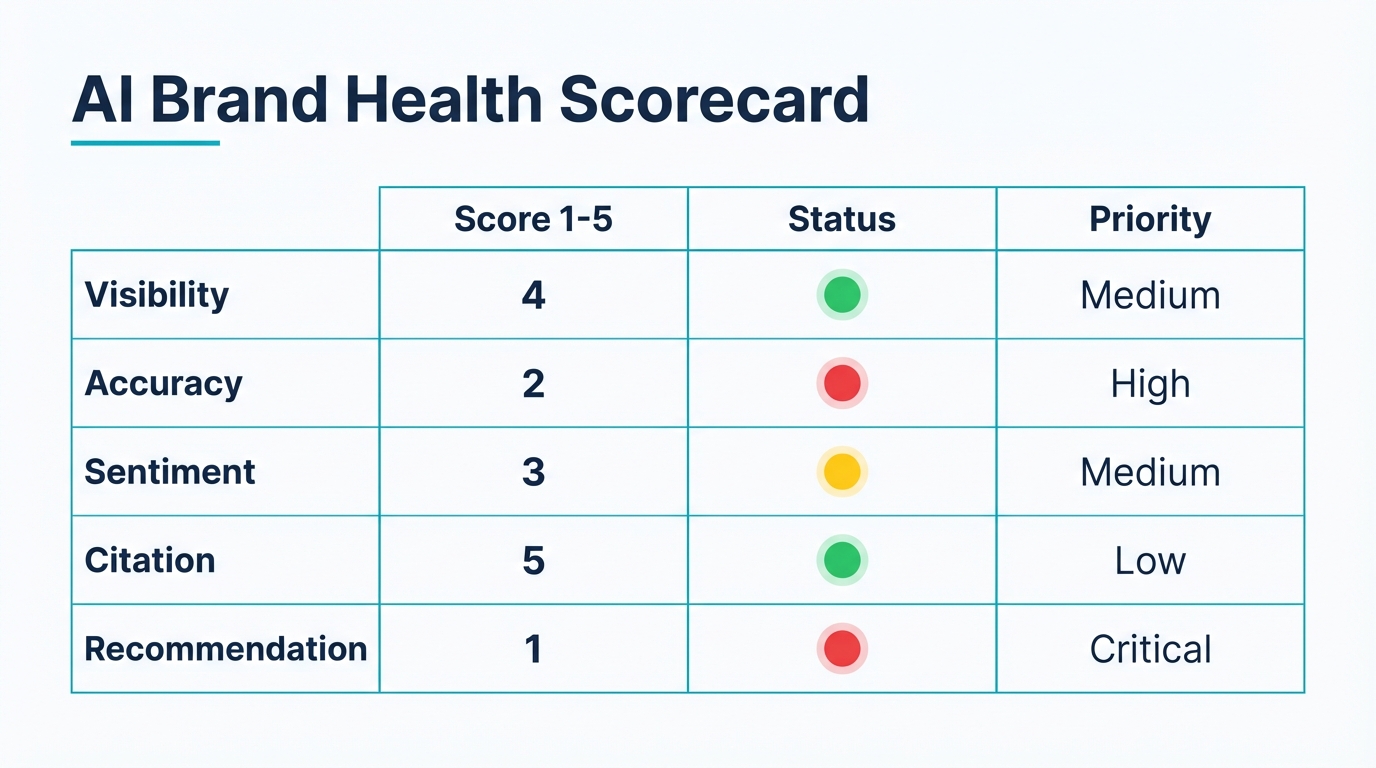
Use this scoring framework to evaluate each dimension of your AI brand health.
| Dimension | Score 1 (Poor) | Score 2 (Below Average) | Score 3 (Average) | Score 4 (Good) | Score 5 (Excellent) |
|---|---|---|---|---|---|
| Visibility | Not mentioned in any prompts | Mentioned in <20% of prompts | Mentioned in 20-50% of prompts | Mentioned in 50-75% of prompts | Mentioned in 75%+ of prompts |
| Accuracy | Multiple critical errors | 1-2 critical errors or many minor errors | No critical errors, several minor errors | No critical errors, 1-2 minor errors | Fully accurate across all responses |
| Sentiment | Negative framing or warnings | Neutral with caveats | Neutral, factual descriptions | Positive framing, some endorsement | Strong endorsement language |
| Citation Rate | Never cited as a source | Cited in <10% of responses | Cited in 10-25% of responses | Cited in 25-50% of responses | Cited in 50%+ of responses |
| Recommendation Rate | Never recommended | Recommended in <10% of intent prompts | Recommended in 10-30% of intent prompts | Recommended in 30-60% of intent prompts | Recommended in 60%+ of intent prompts |
Interpreting your aggregate score:
- 5-10 points: Your AI brand health needs urgent attention. AI platforms are either ignoring your brand or misrepresenting it.
- 11-15 points: You have foundational presence but significant gaps. Focus on the lowest-scoring dimensions first.
- 16-20 points: Solid baseline. Targeted optimization can push you into a leadership position.
- 21-25 points: Strong AI brand health. Maintain your position and monitor for regressions.
Tools for Automating Your Audit
Manual auditing works for a first-pass assessment, but it has hard limits. Running 40+ prompts across four platforms, scoring each response across five dimensions, and repeating this monthly is time-intensive and prone to inconsistency.
friction AI automates the entire AI brand health audit process. The platform monitors your brand across ChatGPT, Perplexity, Gemini, and Google's AI features continuously. Instead of running manual prompts, you get a live dashboard showing your visibility, sentiment, recommendation rate, and competitive positioning.
The platform's competitive intelligence feature lets you benchmark your AI brand health against specific competitors. You see exactly where you lead, where you trail, and what's changing over time.
For teams running their first audit, the manual framework above gives you a solid baseline. For ongoing monitoring and competitive tracking, automated tooling becomes a requirement. The brands that treat AI brand health as a continuous metric rather than a one-time project are the ones that maintain and grow their positions.
Related Articles