ChatGPT brand recommendations are the brands named when a user asks ChatGPT for product or service options. This article reports a point-in-time study of more than 50 prompts across SaaS, ecommerce, finance, and health.
The study found repeated leaders within the tested prompt set, but it does not establish why ChatGPT selected them. Model versions, prompt wording, retrieval mode, location, and repeated runs can all change an answer.
Study snapshot: Each prompt was run three times with default GPT-4o settings and no browsing mode. The tables below show representative prompts from the broader log. - The results describe this test window, not a permanent leaderboard - First mention, inclusion, and recommendation framing were recorded separately - Associations with reviews, Wikipedia, editorial coverage, and community discussion are observational, not causal
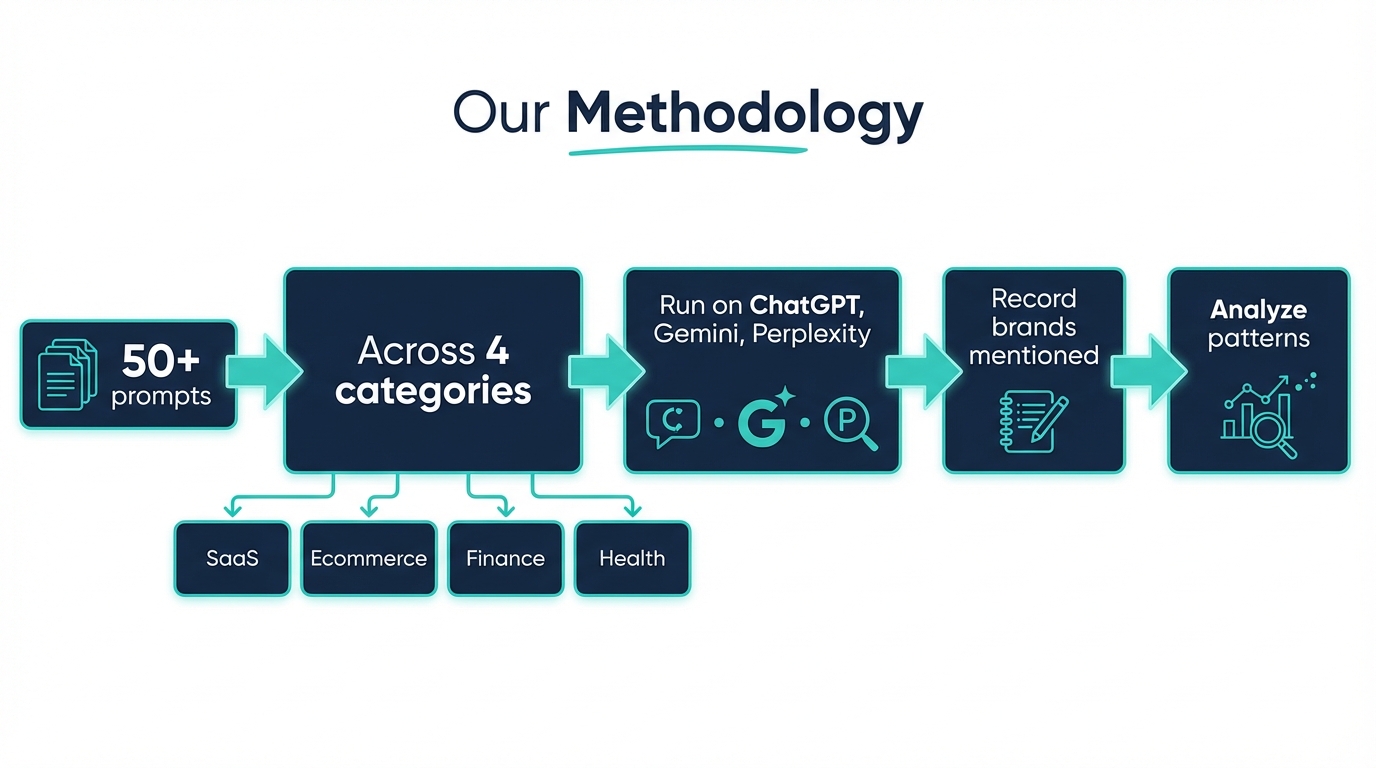
Our Methodology
We queried ChatGPT (GPT-4o) with 50+ prompts across four categories: SaaS/Productivity, Ecommerce, Finance, and Health/Wellness. Each category received 12-15 unique prompts, phrased the way real users ask questions.
Prompts ranged from broad ("What's the best project management tool?") to specific ("Which CRM is best for a 20-person sales team?"). We also tested comparison prompts ("Slack vs. Teams vs. Discord for remote work") and recommendation prompts ("What do you recommend for email marketing?").
Every response was logged with the exact brands mentioned, their position in the response (first mention carries weight), and whether ChatGPT framed them positively, neutrally, or with caveats. We ran each prompt three times on different days to check for consistency.
A few ground rules: we used default ChatGPT settings with no custom instructions, no plugins, and no browsing mode. This isolated the model-only experience from live web retrieval. It also limits the result: these findings should not be treated as a current ChatGPT Search benchmark.
Study scope and limitations
This was an observational spot check, not a statistically representative market survey. The 16 rows below are the representative prompts published with the study; they don't expose every run from the broader log. Results can change with model releases, retrieval settings, location, personalization, and small wording differences.
The study records co-occurrence. It cannot prove that a review profile, Wikipedia article, media mention, or community discussion caused a recommendation. Those factors are useful hypotheses to test, not ranking factors established by this dataset.
Category-by-Category Findings
SaaS and Productivity
SaaS brands dominated in terms of recommendation consistency. The same names appeared across multiple prompt variations with little fluctuation between runs.
| Prompt | Top Brands Mentioned | Notes |
|---|---|---|
| "Best project management tool" | Asana, Monday.com, Trello, Jira, ClickUp | Asana appeared first in 2 of 3 runs |
| "Best CRM for small business" | HubSpot, Salesforce, Zoho CRM, Pipedrive | HubSpot recommended first every time |
| "Best email marketing platform" | Mailchimp, ConvertKit, ActiveCampaign, Constant Contact | Mailchimp appeared in every response |
| "Best team communication tool" | Slack, Microsoft Teams, Discord, Zoom | Slack led in all 3 runs |
HubSpot and Mailchimp stood out for consistency. Both appeared as the first recommendation in every single prompt variation we tested. Newer tools like Notion and Linear appeared only when prompts were highly specific (e.g., "best tool for engineering teams").
Ecommerce
Ecommerce recommendations were more fragmented. ChatGPT frequently hedged its answers and offered more caveats than in other categories.
| Prompt | Top Brands Mentioned | Notes |
|---|---|---|
| "Best ecommerce platform" | Shopify, WooCommerce, BigCommerce, Squarespace | Shopify appeared first in all runs |
| "Best online payment processor" | Stripe, PayPal, Square | Stripe and PayPal alternated for first position |
| "Best dropshipping platform" | Shopify, Oberlo, Spocket, DSers | Shopify dominated despite Oberlo being deprecated |
| "Best product review tool" | Yotpo, Judge.me, Trustpilot, Bazaarvoice | More variation between runs |
Shopify's dominance was striking. It appeared in every ecommerce-adjacent prompt, even ones not directly about platform selection. This suggests deep entity embedding in ChatGPT's training data, likely driven by teh sheer volume of Shopify-related content across the web.
One notable finding: ChatGPT recommended Oberlo in two of three dropshipping prompt runs, despite Oberlo shutting down in June 2022. This highlights a real limitation of LLM recommendations: training data cutoffs create stale suggestions.
Finance
Finance prompts triggered the most cautious responses.
ChatGPT added disclaimers to nearly every recommendation, adn the phrasing shifted from "I recommend" to "popular options include."
| Prompt | Top Brands Mentioned | Notes |
|---|---|---|
| "Best investing app for beginners" | Robinhood, Fidelity, Charles Schwab, Vanguard | Fidelity and Schwab appeared together consistently |
| "Best business bank account" | Mercury, Bluevine, Chase, Relay | Mercury led for startup-focused prompts |
| "Best accounting software" | QuickBooks, Xero, FreshBooks, Wave | QuickBooks appeared first in every run |
| "Best budgeting app" | YNAB, Mint, PocketGuard, Goodbudget | YNAB and Mint alternated |
Established financial institutions (Fidelity, Schwab, Vanguard) appeared far more consistently than fintech startups. The exception was Mercury, which showed up reliably for startup-focused finance prompts. This tracks with Mercury's heavy presence in startup media and editorial coverage from TechCrunch and Y Combinator's directory.
ChatGPT also recommended Mint in two of three budgeting runs, despite Intuit shutting Mint down in January 2024. Another training data artifact.
Health and Wellness
Health recommendations were the most variable across runs. ChatGPT frequently changed which brands it mentioned first, and it added more qualifiers than any other category.
| Prompt | Top Brands Mentioned | Notes |
|---|---|---|
| "Best meditation app" | Headspace, Calm, Insight Timer, Ten Percent Happier | Headspace and Calm split first position |
| "Best fitness tracker" | Apple Watch, Fitbit, Garmin, Whoop | Apple Watch led consistently |
| "Best meal delivery service" | HelloFresh, Blue Apron, Factor, Home Chef | Most variation between runs |
| "Best telehealth platform" | Teladoc, MDLive, Amwell, PlushCare | High variation across runs |
Apple Watch and Headspace were the standout performers. Apple Watch appeared first in every wearable-related prompt, reflecting Apple's dominant entity presence across news, reviews, and technical documentation. Headspace and Calm split the meditation category almost evenly, consistent with their heavy PR and editorial footprint.
Patterns observed among frequently recommended brands
The repeated brands shared several visible characteristics. These are correlations from a small observational sample, not proven ChatGPT ranking factors.
Broad review coverage
Frequently repeated software brands had substantial coverage on review platforms such as G2 and Capterra. Those pages give buyers, search engines, and retrieval systems comparable descriptions of a product. The study did not test whether review volume caused the recommendations.
Wikipedia or Wikidata references
Several category leaders had established Wikipedia or Wikidata records. Those records can help disambiguate an entity, but companies should follow Wikimedia's notability and sourcing rules rather than creating promotional entries.
Consistent entity information
The leading brands generally used stable names and category descriptions across their sites and public profiles. Consistency reduces ambiguity. It does not guarantee that a model will mention the brand.
Independent editorial coverage
Frequently repeated brands also had years of coverage from trade publications, news sites, and specialist reviewers. This provides more independent context than a brand's own site, although this study did not isolate editorial coverage as a causal factor.
Community discussion
Many of the repeated brands were discussed on Reddit, Stack Overflow, Quora, or category-specific communities. These discussions can become retrievable public evidence about use cases and tradeoffs. Their influence varies by system and query.
How to Check If Your Brand Is Recommended
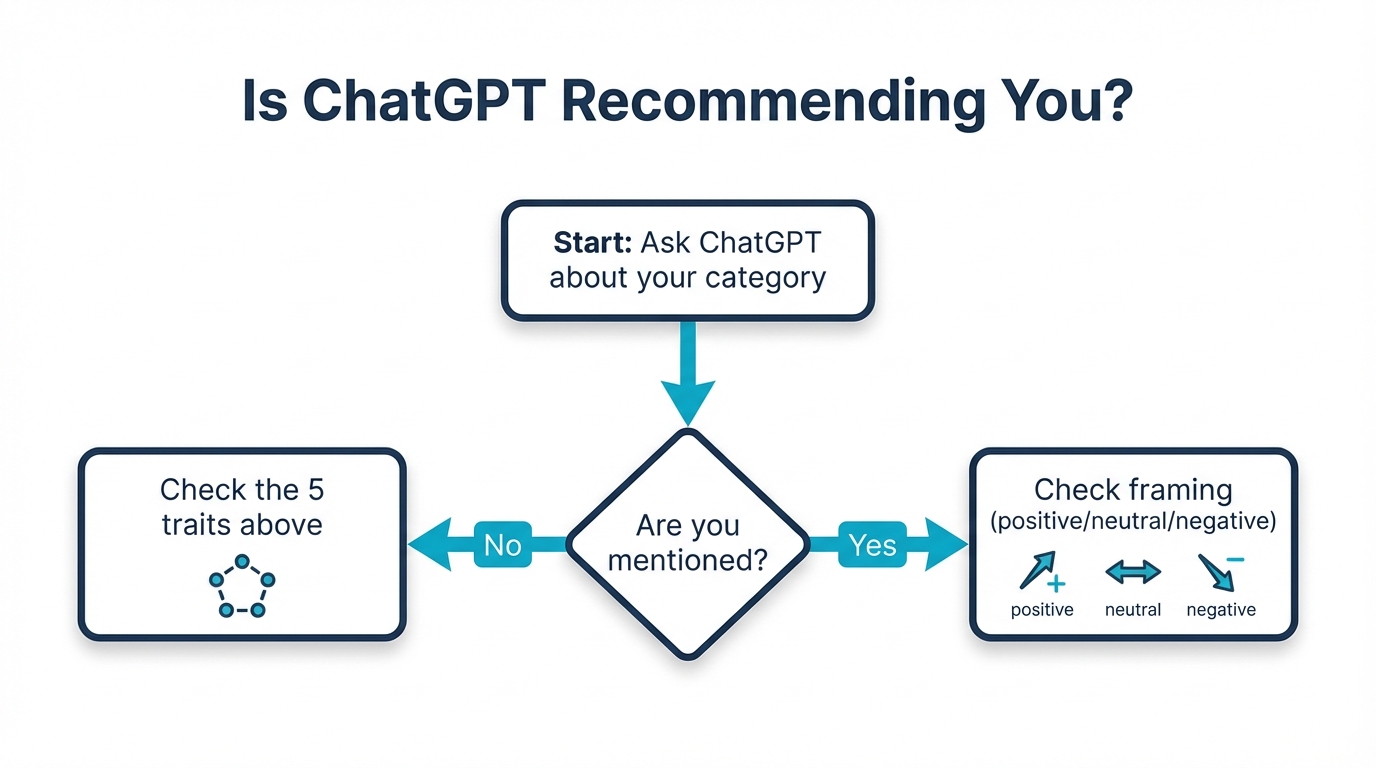
Start with manual testing. Open ChatGPT and run these prompt templates with your brand's category:
- "What's the best [your category] tool/product/service?"
- "What do you recommend for [problem your brand solves]?"
- "[Your brand] vs [top competitor] vs [another competitor]"
- "Best [your category] for [your target audience]?"
Run each prompt at least three times on different days. Log which brands appear, their position, and whether your brand is mentioned. Pay attention to framing: does ChatGPT describe your brand positively, or does it add caveats?
This manual process works for a snapshot, but it doesn't scale. AI models update their responses over time, competitors shift, and new brands enter the conversation. You need ongoing monitoring.
friction AI automates this entire process. It runs prompts across ChatGPT, Perplexity, Gemini, and Claude, tracking your brand's recommendation rate, sentiment, and competitive positioning over time. Instead of manual spot-checks, you get a continuous dashboard showing exactly where your brand stands in AI-generated answers.
The manual approach tells you where you are today. Automated monitoring with friction AI tells you whether your trending up or down, and how every competitive move affects your position.
What to Do If Your Brand Isn't Recommended
If your brand didn't show up in your testing, focus on the patterns above. Build your review profile on G2, Capterra, and industry-specific review platforms. Pursue a Wikipedia article if you qualify under their notability guidelines. Standardize your brand entity signals across every web property. Invest in earning editorial coverage from authoritative publications.
These aren't quick fixes. LLM training data reflects years of accumulated web presence. But every brand that dominated our test results built its position through these same channels. The playbook is clear. The question is how quickly you execute it.
Frequently Asked Questions
Which brands did ChatGPT recommend most consistently in this study?
HubSpot, Mailchimp, Slack, Shopify, QuickBooks, and Apple Watch were among the most consistent first mentions in their tested categories. The result applies to this prompt set and model configuration, not every ChatGPT answer.
Does this show how the current ChatGPT Search product ranks brands?
No. The study used GPT-4o without browsing. ChatGPT Search can retrieve current web sources, so its answers may differ from this model-only snapshot.
Can a company pay to appear in these recommendations?
This study did not test paid placement and cannot determine whether advertising affected any result. It recorded the brands returned by the tested prompts.
How should I test my own brand?
Choose a stable set of category, comparison, and problem-based prompts. Run each prompt more than once, record the date and model, and separate simple mentions from recommendations and citations.
Why can the recommendation list change between runs?
Generative answers are variable. Model releases, retrieval settings, prompt wording, location, and previous context can all change the response.
Related Articles
- How to Rank in ChatGPT
- AI Competitive Intelligence: Tracking Brand vs. Competitors
- How to Measure AI Visibility