AI SEO strategy is a unified approach to search optimization that integrates traditional SEO practices with Answer Engine Optimization (AEO) and Generative Engine Optimization (GEO) into a single, coordinated plan. It accounts for the reality that your audience now discovers brands through Google organic results, AI Overviews, ChatGPT, Perplexity, and Gemini, and that each channel requires deliberate optimization.
Why AI Changed SEO Strategy
The 2024-2026 period marked a structural shift in how people search for information, evaluate products, and make purchasing decisions.
Google AI Overviews now appear for a significant portion of search queries, synthesizing answers at the top of the results page. ChatGPT crossed 200 million weekly active users. Perplexity's monthly visits grew from under 100 million to over 500 million in 18 months. Microsoft Copilot integrated Bing-powered AI search into Windows, Office, and Edge.
This isn't a trend that might matter someday. It's the current state of search. Gartner's prediction of a 25% decline in traditional search volume by 2026 looks increasingly accurate.
For SEO professionals and marketing teams, the implication is clear: optimizing for Google organic alone leaves growing portions of your audience untouched. An AI SEO strategy addresses this by treating traditional search and AI-generated search as parallel channels within one unified framework.
The brands adapting fastest aren't abandoning SEO. They're extending it. Traditional SEO provides the foundation, the crawlable, authoritative content that AI retrieval systems draw from. AEO and GEO add the layers that ensure your content and brand appear when AI systems generate responses.
The 2026 AI SEO Stack
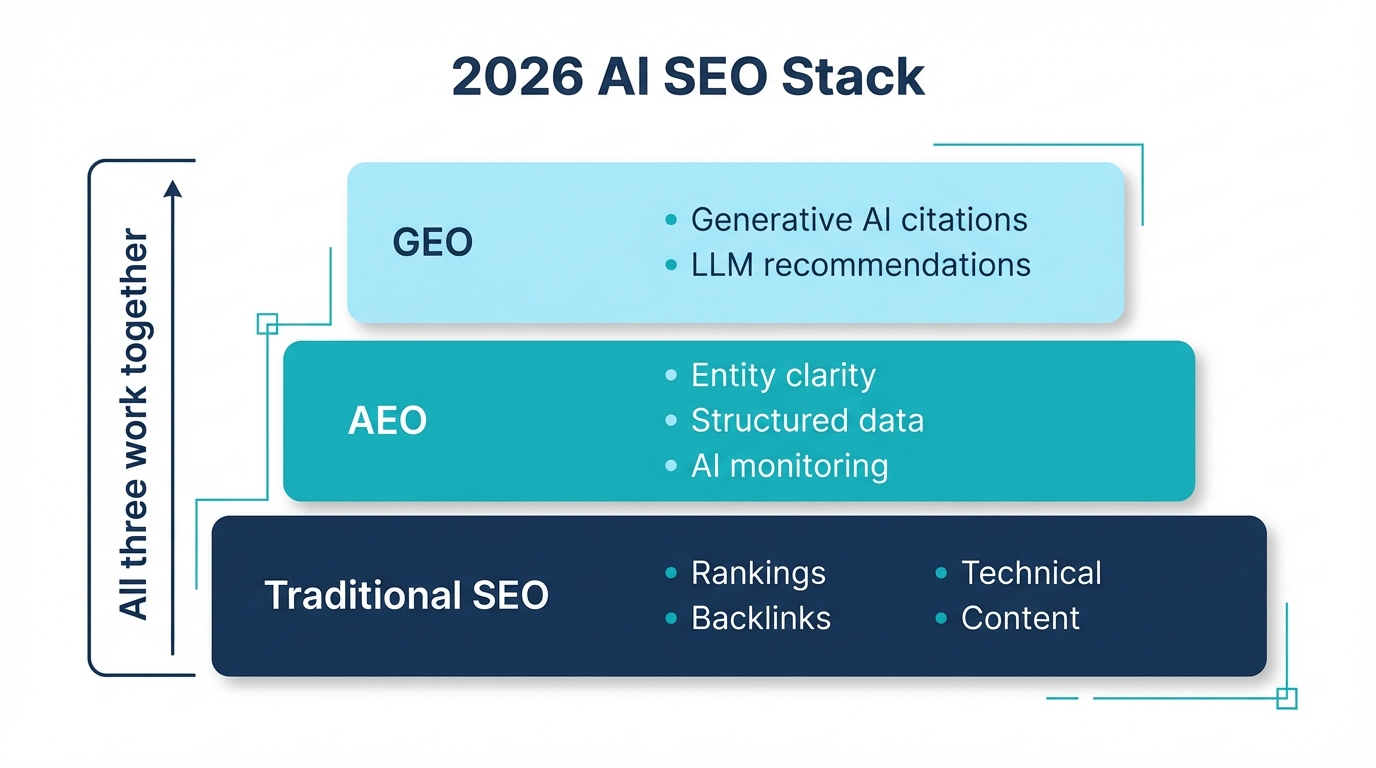
Think of AI SEO as three layers, each building on the one below it.
Layer 1: Traditional SEO (Foundation)
This hasn't changed. Your site needs strong technical health, relevant content targeting the right keywords, a solid backlink profile, and good Core Web Vitals. This foundation feeds every layer above it.
Without organic visibility, AI retrieval systems have less to work with. Pages that rank well in Google and Bing are disproportionately represented in AI-generated responses. Research by Zyppy showed that nearly all URLs cited in Google AI Overviews also appeared in the top 10 organic results.
Layer 2: Answer Engine Optimization (AEO)
AEO targets the structured answer formats that sit between traditional results and full AI generation. Featured snippets, People Also Ask boxes, knowledge panels, and voice assistant responses all fall here.
Tactical priorities for AEO include schema markup (FAQ, HowTo, Product, Organization), concise question-and-answer content structures, and direct-answer formatting that search engines can extract and display.
AEO content also feeds AI systems. The same structured, Q&A-formatted content that wins featured snippets performs well in AI retrieval pipelines.
Layer 3: Generative Engine Optimization (GEO)
GEO targets teh synthesized, narrative responses that ChatGPT, Perplexity, Gemini, and AI Overviews produce. This layer focuses on entity clarity, source authority, factual specificity, citation-worthy content, and third-party validation signals.
GEO-specific tactics include building consistent entity definitions across the web, publishing original research adn proprietary data, earning mentions on high-authority third-party platforms, and monitoring your brand's presence in AI-generated responses.
For a detailed breakdown of GEO practices, see What is Generative Engine Optimization?. For the overlap between layers, see How SEO and AEO Work Together.
Quarterly Execution Roadmap
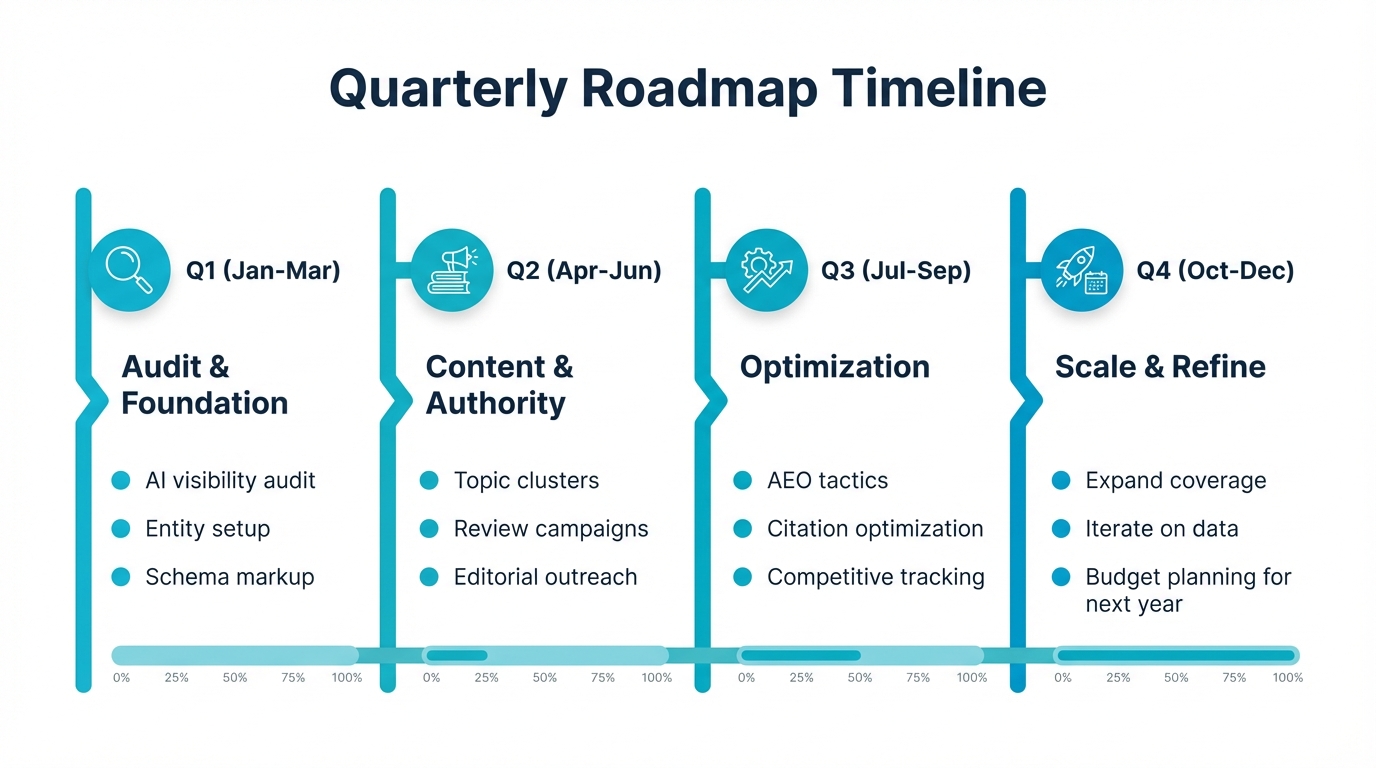
Strategy without execution is a document that sits in a shared drive. Here's a quarter-by-quarter framework for building your AI SEO capability in 2026.
Q1: Audit and Foundation
Traditional SEO audit. Run a technical audit covering crawl health, indexation status, Core Web Vitals, and your backlink profile. Fix blocking issues. This is your baseline.
Bing audit. Many teams have never checked their Bing Webmaster Tools account. Set it up, submit your sitemap, and review your Bing rankings for your top 50 keywords. ChatGPT and Copilot depend on Bing's index, so this matters now.
AI visibility baseline. Run your top 30-50 category-relevant queries through ChatGPT, Perplexity, Gemini, and Google (to check AI Overviews). Document which brands appear, whether yours is included, and the context of each mention. This baseline tells you where you stand.
Entity audit. Compare your brand description across your website, LinkedIn, Crunchbase, G2, Wikipedia (if applicable), and major review sites. Identify and fix inconsistencies.
Q2: Content and Structure
Schema implementation. Add Organization, Product, FAQ, and HowTo schema to your key pages. Validate with Google's Rich Results Test.
Create citation-worthy content. Identify three to five topics where your brand has proprietary data, unique expertise, or a differentiated perspective. Publish in-depth content with original data points, specific claims, and clear methodologies. This content becomes your citation magnet for AI systems.
Restructure existing content. Take your top 20 organic pages and restructure them for AI parsing. Add clear heading hierarchies, comparison tables, definition paragraphs, and FAQ sections. Update stale statistics and examples.
Build a query-answer map. Document the conversational questions your audience asks about your category. Map these to existing content or flag gaps for new content creation.
Q3: Authority and Amplification
Earn third-party mentions. Launch a targeted campaign to get your brand mentioned on high-authority platforms in your space. This could include product reviews on industry publications, expert contributions to relevant outlets, podcast appearances, or case studies published by partners.
Review site presence. Ensure your profiles on G2, Capterra, Trustpilot, and industry-specific review platforms are complete, current, and actively generating reviews. These platforms feed heavily into AI training data and retrieval.
Content update cycle. Establish a recurring schedule for updating your core content. Monthly updates to comparison pages and pricing data. Quarterly updates to industry statistics and trend analysis.
Reddit and community strategy. AI models, especially ChatGPT, draw heavily from Reddit discussions and community forums. Participate authentically in relevant communities. Don't spam. Add genuine expertise to discussions about your category.
Q4: Measurement and Iteration
Full AI visibility audit. Repeat your Q1 baseline measurement using the same query set. Compare mention rates, recommendation rates, and competitive positioning. Identify what improved and what didn't.
ROI analysis. Assess the business impact of your AI SEO investments. Track referral traffic from AI platforms, leads generated from AI-influenced discovery, and changes in brand awareness surveys that might correlate with improved AI visibility.
2027 planning. Based on what you've learned, allocate budget and resources for the next year. AI search is still evolving rapidly. Plans need quarterly review.
If building this capability in-house isn't practical, specialized AI SEO agencies can help accelerate the first few quarters while your team ramps up.
Budget Allocation Framework
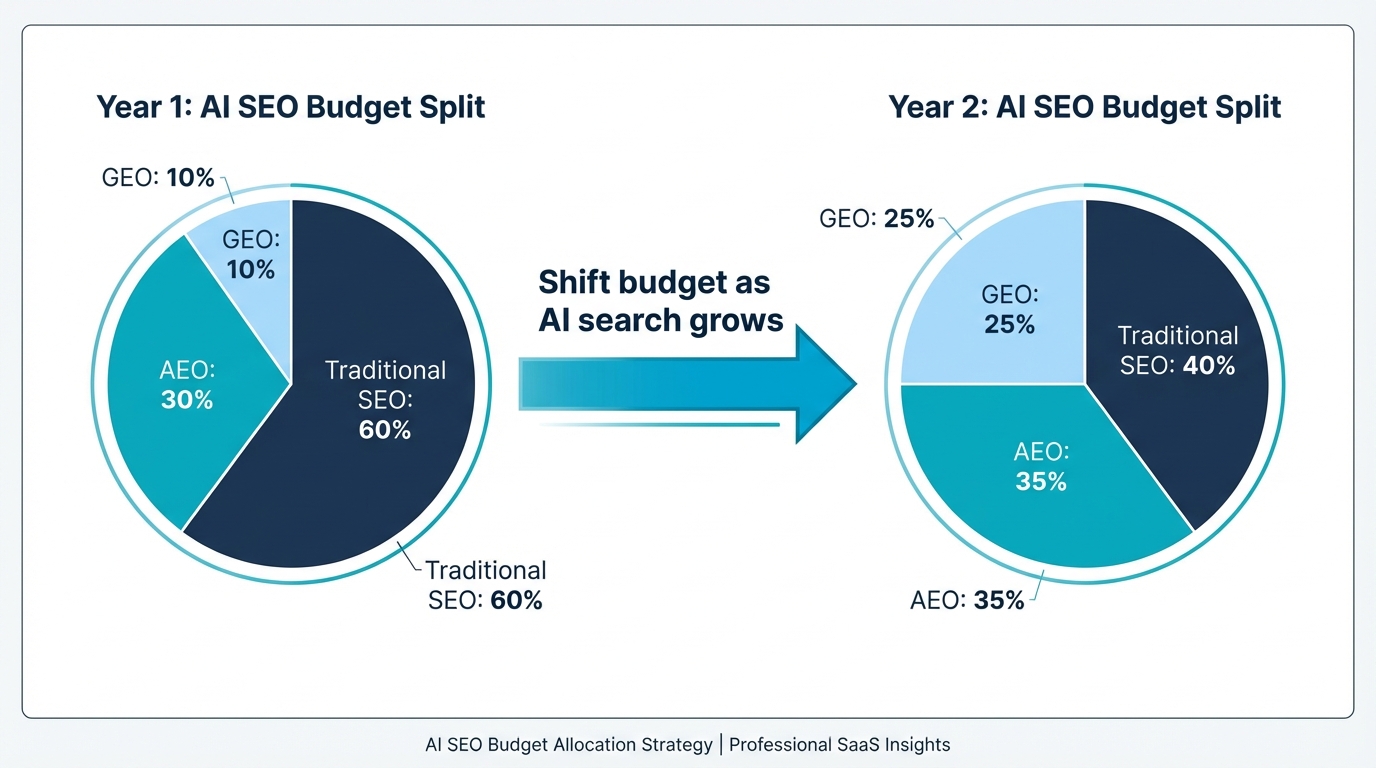
The right split between traditional SEO and AI optimization depends on your starting position and industry, but here's a framework to work from.
| Category | Year 1 Allocation | Year 2 Allocation | Focus Areas |
|---|---|---|---|
| Traditional SEO | 50-60% | 40-50% | Technical health, content, backlinks |
| AEO/Schema | 15-20% | 10-15% | Structured data, Q&A content |
| GEO/AI Optimization | 15-20% | 25-30% | Entity building, citation content, monitoring |
| AI Visibility Monitoring | 5-10% | 10-15% | Tracking tools, competitive analysis |
In year one, traditional SEO still takes the majority becuase it's the foundation. Without strong organic rankings and a healthy site, your GEO efforts have less to work with. By year two, as your foundation stabilizes, shift more budget toward GEO and monitoring.
Don't cut traditional SEO to fund AI optimization. The two work together. Strong organic rankings improve your chances of being retrieved by AI systems. The budget shift is about adding AI-specific work, not subtracting SEO work.
For B2B brands in competitive markets, consider adding 5-10% specifically for third-party authority building: PR, review site management, and analyst relations. These earned-media signals have outsized impact on AI recommendations.
KPIs and Measurement
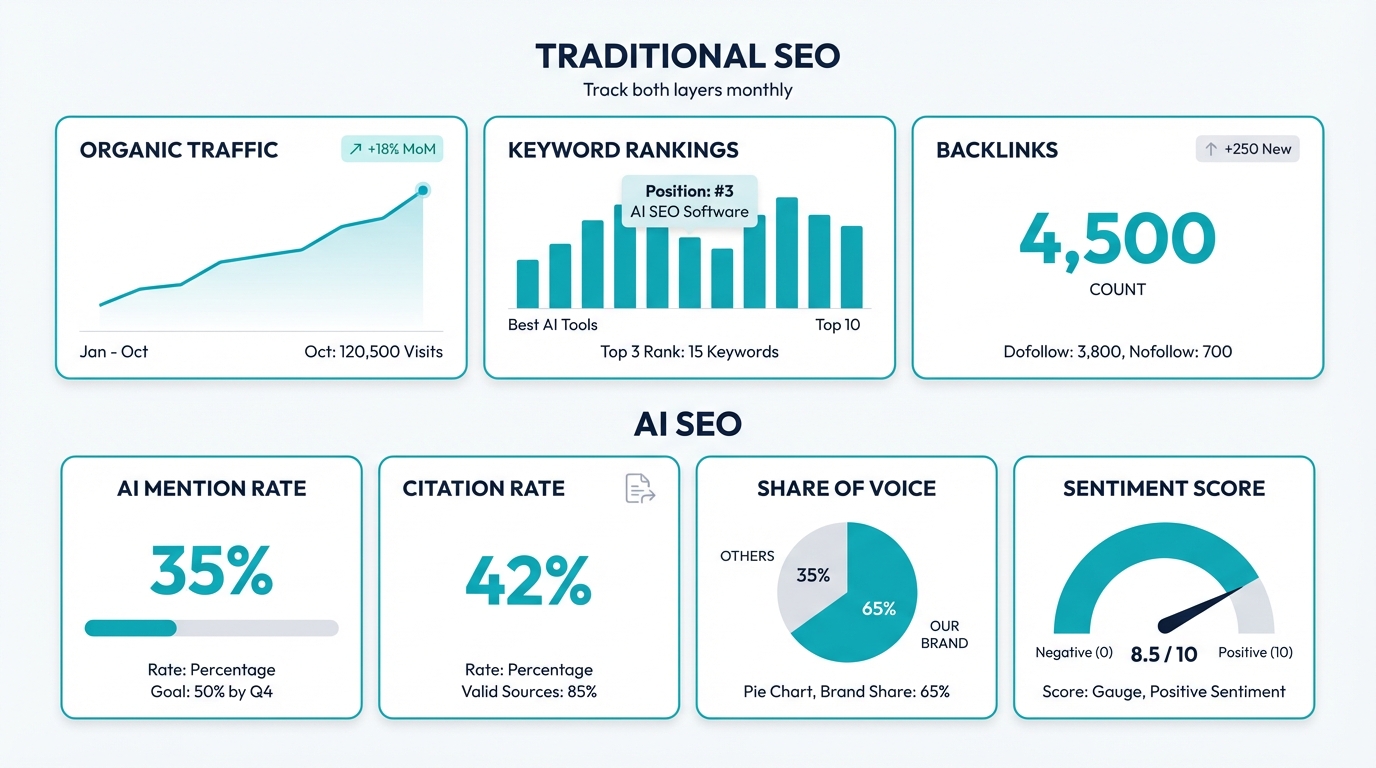
Your AI SEO strategy needs measurable goals. Here's the measurement framework organized by layer.
Traditional SEO KPIs (Still Essential)
Organic traffic, keyword rankings, domain authority, backlink growth, and conversion rate from organic visitors. These aren't obsolete. They're the leading indicators for your AI visibility.
AEO KPIs
Featured snippet wins, People Also Ask appearances, schema validation pass rates, and rich result impressions (visible in Google Search Console). Track these monthly to measure your structured-answer performance.
GEO KPIs
Citation rate measures how often your content is cited as a source in AI-generated responses, most directly visible on Perplexity.
Brand mention rate tracks appearances of your brand name in AI responses, including training-data mentions without citation links.
Recommendation rate captures instances where AI systems recommend your product or service in response to category queries.
AI share of voice measures your brand mentions relative to competitors across AI platforms. This is your competitive position metric.
Track these monthly using a consistent query set of 30-50 relevant questions run across ChatGPT, Perplexity, Gemini, and Google AI Overviews. For detailed guidance on AI-specific measurement, see How to Measure AI Visibility.
Cross-Layer KPIs
Referral traffic from AI platforms. Monitor sessions from chatgpt.com, perplexity.ai, and other AI sources in your analytics.
Brand search volume. An increase in branded searches on Google can indicate that AI mentions are driving awareness. People who hear about your brand from ChatGPT often Google you afterward.
Pipeline influence. For B2B, survey prospects about how they discovered your brand. "AI search" as a discovery channel should be a tracking option in your attribution model.
Tools for AI SEO
Your AI SEO stack builds on existing tools with new additions.
Existing Tools (Extend Their Use)
Google Search Console and Bing Webmaster Tools remain essential. Use them to monitor organic health and ensure proper indexation across both major search indexes. Google's rich results reporting shows your structured data performance.
Your existing SEO platform (Ahrefs, Semrush, or similar) covers traditional SEO auditing, keyword tracking, and backlink monitoring. These tools don't track AI visibility, but they measure the foundation that supports it.
AI-Specific Additions
You need a tool that tracks your brand's presence across AI search platforms.
The core capabilities to look for: multi-platform monitoring (ChatGPT, Perplexity, Gemini, AI Overviews), citation and mention tracking, competitive share of voice, and historical trend analysis.
For a comprehensive comparison of the available options, see AEO Explained: Guide for 2026.
Schema and Structured Data
Google's Structured Data Markup Helper and Schema.org documentation are free resources for implementing and validating your schema markup. JSON-LD is the preferred format.
Related Articles
- How SEO and AEO Work Together
- AEO Explained: Complete Guide for 2026
- What is Generative Engine Optimization?
- How to Measure AI Visibility